
Ally Financial's Q2 Earnings: A Strategic Turnaround with Strong ROI Potential
Ally Financial (ALLY) has emerged from a period of uncertainty with a Q2 2025 earnings report that signals a strategic recalibration. In a macroeconomic environment marked by rising unemployment risks and a looming rate-cutting cycle, the company's focus on capital-efficient growth, margin resilience, and credit discipline positions it as a standout performer in the financial sector. For investors seeking undervalued opportunities in a slowing economy, Ally's recent results offer compelling evidence that the company is not only surviving but thriving.
A Net Interest Margin That Defies the Headwinds
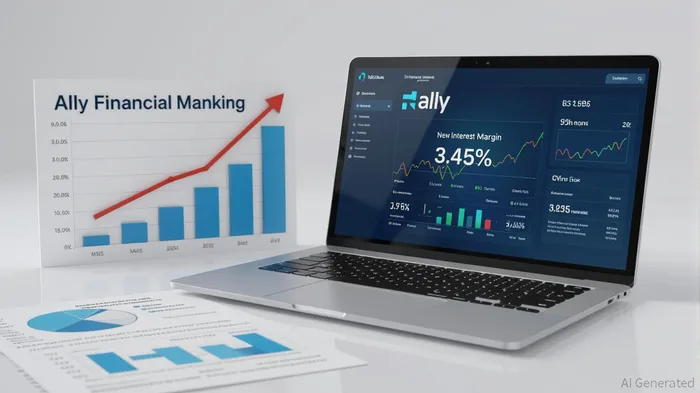
Ally's net interest margin (NIM) expanded by 10 basis points quarter-over-quarter to 3.45%, a figure that outperformed Wall Street estimates by 30 basis points. This improvement is not a one-time anomaly but a structural shift driven by disciplined deposit repricing and a strategic reallocation of assets. By offloading low-yielding mortgages and reinvesting in higher-yielding retail auto and corporate finance loans, Ally has transformed its balance sheet into a high-margin engine.
The company's NIM guidance for 2025—3.4% to 3.5%—remains intact despite the drag from its credit card divestiture. This resilience is critical in a rate-cutting environment. As the Federal Reserve prepares to ease policy in late 2025 and early 2026, banks with strong NIMs and low-cost deposit bases will outperform. Ally's deposit base, with $143 billion in balances and 92% FDIC insurance, provides a durable funding advantage.
Cost Discipline: The Unsung Hero of Margin Resilience
Ally's efficiency ratio dropped to 60.6% in Q2 2025, a dramatic improvement from 106.0% in Q1 2025. This turnaround reflects a disciplined approach to cost management, including automation in digital banking and a focus on high-return segments. Adjusted non-interest expenses fell to $1.3 billion, down 4% sequentially and 2% year-over-year.
The company's cost-to-income ratio is now in the sweet spot for a financial institution: low enough to ensure profitability, yet high enough to justify reinvestment in growth. This balance is particularly important as Ally navigates a potential economic slowdown. With $66 billion in liquidity and a CET1 ratio of 9.9%, the company has the flexibility to deploy capital selectively—whether through share repurchases, dividends, or strategic investments in its core franchises.
Auto Lending: A Franchise Built for the Long Haul
Ally's Auto Finance segment remains a cornerstone of its growth strategy. The company reported $11 billion in consumer auto originations in Q2 2025, driven by 3.9 million applications—a record for the second consecutive quarter. The S Tier mix (highest credit quality loans) held steady at 42%, reinforcing Ally's ability to maintain strong risk-adjusted returns.
The segment's retail auto net charge-off rate of 1.75% and 30-plus day delinquency rate of 4.88% marked the first year-over-year improvement since 2021. These metrics are particularly reassuring in a macroeconomic slowdown, as they suggest Ally's underwriting standards are holding firm without sacrificing growth. The 9.82% origination yield—slightly down from the prior year—remains robust, reflecting pricing discipline in a competitive lending environment.
Valuation: A Contrarian Opportunity in a Overlooked Sector
Despite these strengths, Ally's stock trades at a P/E ratio of 64.1x, significantly higher than the industry average of 9.9x. At first glance, this appears expensive. But a closer look reveals a compelling story: analysts have assigned a fair value of $44.99, implying the stock is undervalued by 11.4%. The average one-year price target of $45.47 suggests a potential 11.5% upside from current levels.
Ally's P/B ratio of 1.2x is also attractive, particularly for a company with a core return on tangible common equity (ROTCE) of 13.6%. While peers like Enova InternationalENVA-- and DaveDAVE-- trade at higher multiples, Ally's diversified business model and capital-efficient operations give it a unique edge. The company's $0.30 per share quarterly dividend and plans for selective share repurchases further enhance its appeal as a total return play.
The Macro Play: Positioning for Rate Cuts
Ally's strategic focus on capital efficiency and high-margin assets makes it well-positioned for a rate-cutting cycle. As borrowing costs decline, banks with strong NIMs and low-cost funding will see their margins stabilize or expand. Ally's deposit base, which is 5.9 times its uninsured balances, provides a natural hedge against rising credit costs.
Management has also signaled a data-driven approach to credit risk, with a focus on maintaining underwriting standards even as economic conditions weaken. This prudence is critical: while the auto loan segment is a growth engine, it also carries cyclical risks. Ally's ability to balance growth with credit discipline will be a key differentiator in the coming quarters.
Conclusion: A Strategic Turnaround with ROI Potential
Ally Financial's Q2 2025 results underscore a company that is not only regaining its footing but redefining its competitive advantages. By focusing on capital-efficient growth, margin resilience, and core franchise strength, Ally has positioned itself to outperform in a macroeconomic slowdown. For investors, the current valuation offers an opportunity to capitalize on a company that is executing its strategy with discipline and foresight.
As the Federal Reserve prepares to ease policy, Ally's low-cost deposit base, high-yielding auto loans, and disciplined cost structure will serve as tailwinds. With a CET1 ratio of 9.9%, a dividend yield of 3.0%, and a 13.6% ROTCE, the company is a rare blend of defensive resilience and offensive potential. For those willing to look beyond short-term volatility, Ally FinancialALLY-- represents a compelling long-term investment.





Comentarios
Aún no hay comentarios