
Allied Gold's Strategic Operational Turnaround and Growth Catalysts in Q2 2025
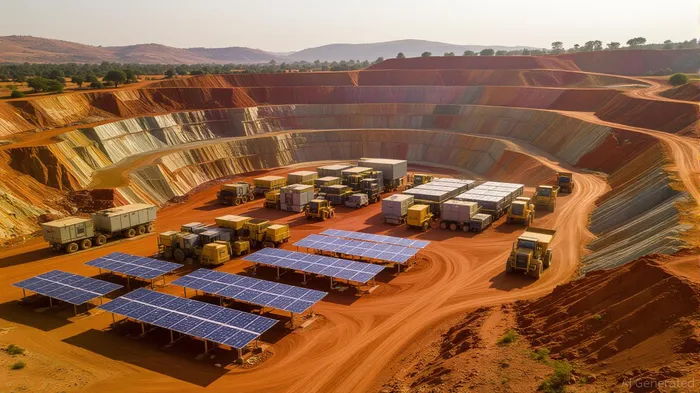
In a gold market characterized by sustained high prices and global macroeconomic uncertainty, Allied GoldAAUC-- Corporation has emerged as a compelling case study in operational resilience and strategic foresight. The company's Q2 2025 results underscore a transformative phase marked by production growth, cost optimization, and aggressive expansion, positioning it to capitalize on favorable gold price dynamics while unlocking long-term shareholder value.
Production Growth: A Foundation for Value Creation
Allied Gold delivered a robust 8.3% quarter-over-quarter increase in gold production, churning out 91,017 ounces in Q2 2025. This performance aligns with its 45%/55% production weighting for the year, with the fourth quarter projected as the strongest. The company's asset-level execution is particularly noteworthy:
- Sadiola (49,283 ounces): High-grade oxide ore from the Korali-Sud zone and Phase 1 expansion progress are driving output.
- Bonikro (25,775 ounces): Higher-grade ore from PB3 and improved throughput highlight operational efficiency.
- Agbaou (15,959 ounces): Prioritizing waste removal now sets the stage for a material production ramp-up in H2 2025, with annual output expected to hit 83,500 ounces.
This production trajectory is not just volume-driven but quality-focused, with higher-grade ore contributing to stronger cash flow margins. Investors should note that Q4's anticipated production surge—coupled with the Kurmuk Project's mid-2026 start—creates a compounding effect for revenue growth.
Cost Optimization: A Catalyst for Margin Expansion
Allied Gold's Q2 cost metrics ($2,294 total cost of sales per ounce, $2,034 cash costs, $2,343 AISC) reflect the challenges of early-stage expansion and higher gold prices. However, the company's roadmap for cost reduction is both aggressive and achievable:
- AISC guidance for H2 2025 is projected to drop to $1,850 per ounce, driven by normalized sales timing, higher production volumes, and reduced stripping costs.
- Phase 1 of the Sadiola expansion (on schedule and budget) will boost processing capacity to 5.7 Mt/y, enabling economies of scale.
- Power solutions combining solar-battery and thermal energy aim to cut energy costs, with framework agreements expected by year-end.
These initiatives are not just incremental—they are structural. For context, Allied Gold's AISC is expected to fall below $1,200 per ounce by 2028 with the Sadiola Phase 2 expansion, while Kurmuk's AISC is projected at under $950 per ounce. In a $3,000+ gold price environment, such margin expansion directly translates to higher free cash flow, which can be reinvested or returned to shareholders.
Expansion Momentum: A Multi-Year Growth Engine
Allied Gold's growth story is anchored in its dual-track strategy: near-term optimization of existing assets and long-term scaling via greenfield projects.
- Kurmuk Project: On track for mid-2026 first production, this asset is expected to deliver 290,000 ounces annually in its first four years, with AISC below $950/oz. The project's 5 million-ounce exploration inventory also provides a tailwind for future reserve additions.
- Sadiola Phase 2: A new processing plant targeting 10 Mt/y of throughput, with production expected to reach 400,000 ounces annually by 2028. This phase will be critical for sustaining Allied Gold's growth trajectory beyond 2026.
- Exploration spend of $17 million in Q2 (across Sadiola, Côte d'Ivoire, and Kurmuk) signals a commitment to organic growth, with updates expected in October 2025 and January 2026.
Strategic Initiatives: Strengthening the Balance Sheet and Risk Profile
The company's Q2 strategic moves further solidify its value proposition:
- A $61.9 million capital raise via a bought deal public offering funds optimization and growth, reducing reliance on debt.
- A zero-cost collar hedge locks in a minimum gold price of $3,048/oz for 155,000 ounces of production through March 2026, mitigating volatility while retaining upside.
- Improved safety metrics (TRIR: 0.87, LTIR: 0.35) and no major environmental incidents reinforce ESG credibility, a growing priority for institutional investors.
Investment Thesis: A High-Conviction Play in a Gold-Bull Market
Allied Gold's Q2 results validate its strategic pivot from a mid-tier producer to a growth-oriented gold developer. With production growth accelerating, costs on a clear downward trajectory, and expansion projects nearing fruition, the company is well-positioned to outperform in a high-gold-price environment.
Key risks include execution delays at Kurmuk or Sadiola Phase 2, as well as gold price volatility. However, the hedge in place and the company's strong liquidity ($61.9 million in proceeds) provide a buffer.
For investors seeking exposure to a gold producer with a clear path to margin expansion and production scaling, Allied Gold offers a compelling risk-reward profile. The stock's current valuation, trading at a discount to peers with similar growth profiles, suggests further upside as Q4 production and cost improvements materialize.
In conclusion, Allied Gold's operational turnaround and growth catalysts make it a standout in the gold sector. As the company transitions from execution to realization, the focus should shift from skepticism to conviction—a rare opportunity in today's market.





Comentarios
Aún no hay comentarios