
Alibaba and Nvidia's Strategic AI Partnership: A Catalyst for Cloud and AI Hardware Markets
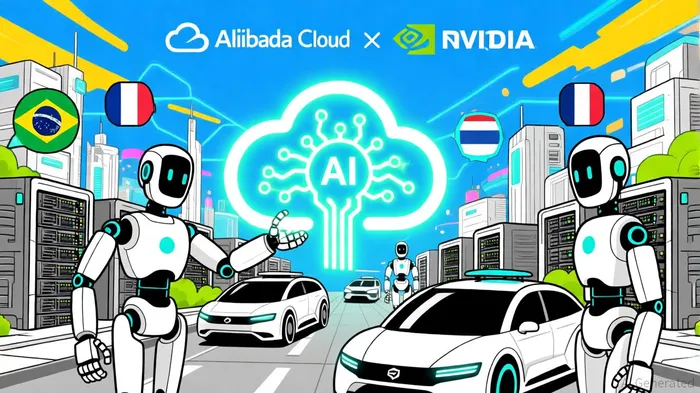
The recent alliance between AlibabaBABA-- and NvidiaNVDA-- marks a pivotal moment in the global AI landscape, with profound implications for cloud computing and hardware markets. By integrating Nvidia's full suite of physical AI development tools into Alibaba Cloud, the partnership accelerates the deployment of real-world AI applications, from humanoid robotics to autonomous vehicles. This collaboration not only underscores Alibaba's aggressive AI ambitions but also positions Nvidia as a critical enabler of next-generation AI infrastructure, creating a win-win scenario for both companies and investors.
Strategic Integration: Bridging Software and Hardware Ecosystems
At the heart of this partnership is the integration of Nvidia's physical AI software stack into Alibaba Cloud's platform, enabling developers to build, simulate, and deploy AI systems for complex real-world tasks[1]. This includes tools for synthetic data generation, model training, and environment simulation—capabilities essential for advancing robotics and autonomous systems[2]. For Nvidia, this represents a strategic expansion into cloud-based AI development, complementing its dominance in AI hardware. Alibaba, meanwhile, gains access to cutting-edge tools that enhance its cloud platform's appeal to enterprises and researchers, solidifying its position against domestic rivals like Huawei Cloud and Baidu AI Cloud[3].
The partnership also aligns with Alibaba's broader infrastructure investments. CEO Eddie Wu revealed that the company is scaling its AI spending beyond the previously announced $53 billion commitment, with a focus on high-performance computing and global data center expansion in markets such as Brazil, France, and the Netherlands[4]. This infrastructure buildout ensures that Alibaba Cloud can handle the computational demands of large-scale AI training, further entrenching Nvidia's hardware in its ecosystem.
Market Implications: Stock Surge and Investor Confidence
The market has already responded positively to the partnership. Alibaba's stock surged over 9% following the announcement, reaching a four-year high, as investors bet on its AI-driven growth trajectory[5]. This surge reflects confidence in Alibaba's ability to leverage Nvidia's technology to capture a larger share of the AI cloud market, which is projected to grow exponentially in the coming years. For Nvidia, the collaboration expands its reach into enterprise AI, where demand for GPUs and AI chips is surging. According to a report by Bloomberg, Nvidia's data center revenue grew 60% year-over-year in 2025, driven by AI adoption[6], and this partnership is likely to amplify that trend.
Long-Term Value for Nvidia and AI-Focused Investors
The partnership's long-term value lies in its potential to drive AI adoption across industries. By embedding Nvidia's tools into Alibaba Cloud, the collaboration lowers barriers for developers to experiment with physical AI applications, accelerating innovation in robotics and autonomous systems. For instance, Alibaba's recent launch of Qwen3-Max, a 1-trillion-parameter AI model optimized for code generation and autonomous agent tasks[7], demonstrates how the integration of advanced software and hardware can unlock new capabilities. This synergy is expected to fuel demand for Nvidia's AI chips, particularly its H100 and Grace CPU lines, which are critical for large-scale model training and inference[8].
Moreover, the partnership aligns with global trends in AI infrastructure. As enterprises increasingly rely on cloud platforms for AI development, Alibaba Cloud's expanded capabilities position it as a key player in the race for AI supremacy. For Nvidia, this means sustained revenue growth from both hardware sales and software licensing, reinforcing its leadership in the AI hardware market. Investors focused on AI-driven growth should also consider the indirect benefits, such as Alibaba's global data center expansion, which creates recurring revenue streams for Nvidia through long-term hardware contracts[9].
Challenges and Considerations
While the partnership is a strategic win, challenges remain. Regulatory pressures in China, which encourage local firms to prioritize domestic suppliers, could pose risks to Nvidia's market share in the region. However, Alibaba's decision to partner with Nvidia—despite these pressures—highlights the chipmaker's irreplaceable role in high-performance computing. Additionally, the success of the collaboration hinges on Alibaba's ability to attract developers and enterprises to its cloud platform, a competitive landscape where differentiation through AI capabilities will be key[10].
Conclusion
Alibaba and Nvidia's partnership is a masterstroke in the AI arms race, combining Alibaba's cloud infrastructure with Nvidia's hardware and software expertise. For investors, this collaboration signals a clear path to long-term value creation, driven by accelerated AI adoption, global infrastructure expansion, and sustained demand for AI hardware. As the world moves toward an AI-first future, this alliance not only strengthens both companies' competitive positions but also offers a compelling investment opportunity for those betting on the next wave of technological innovation.





Comentarios
Aún no hay comentarios