
The Alibaba-JPMorgan Tokenized Payment Alliance: A New Era for Global Trade Finance
Blockchain's role in accelerating institutional adoption is underscored by its ability to reduce transaction costs by up to 70% compared to traditional wire transfers according to industry analysis. For context, stablecoin transaction volumes in cross-border payments alone reached $5.7 trillion in 2024, with blockchain settlements occurring in under three minutes-a stark contrast to legacy systems according to data. Alibaba's collaboration with JPMorganJPM-- aligns with a global trend: 71% of financial institutions are now testing or deploying blockchain solutions.
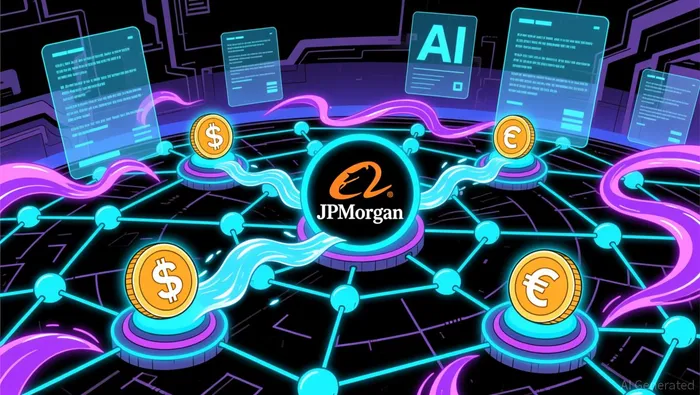
The alliance's strategic use of tokenized money transfers also highlights the growing importance of stablecoins and central bankBANK-- digital currencies (CBDCs). By 2025, 81% of cross-border blockchain initiatives incorporate stablecoins or CBDCs, reflecting their role as bridges between traditional finance and decentralized systems. Alibaba's exploration of stablecoin-like technology, though slated for post-tokenized implementation, further cements its position at the forefront of this transition.
However, regulatory challenges remain a critical hurdle. Eighty-three percent of multinational corporations cite compliance with evolving frameworks as their top concern. The European Union's Markets in Crypto-Assets Regulation (MiCA), effective January 2025, exemplifies the global push for harmonized standards, requiring institutions to balance innovation with anti-money laundering (AML) protocols according to regulatory analysis. AlibabaBABA-- and JPMorgan's alliance, by partnering with a major bank, may mitigate these risks through institutional-grade compliance infrastructure.
Looking ahead, the cross-border blockchain market is projected to exceed $4.5 trillion in value by year-end 2025 according to market forecasts. This growth is driven notNOT-- only by cost efficiency but also by AI integration, such as Alibaba's Agentic Pay, which automates contract generation and reduces human error. JPMorgan's adoption of AI for payment processing-enhancing straight-through processing (STP) rates-demonstrates how blockchain and machine learning are converging to create a frictionless financial ecosystem.
Critics may argue that tokenized systems still face scalability and interoperability issues. Yet, the Asia-Pacific region's dominance in blockchain-based remittance flows with 48% of global volume in 2025 suggests that these challenges are being actively addressed. As Alibaba and JPMorgan scale their alliance, their success could set a blueprint for other institutions navigating the transition to digital currencies.
In conclusion, the Alibaba-JPMorgan Tokenized Payment Alliance is not merely a technological experiment but a harbinger of a new financial paradigm. By combining blockchain's inherent advantages with institutional credibility and AI innovation, the partnership is poised to accelerate the global adoption of digital currencies, reshaping cross-border commerce for the better.





Comentarios
Aún no hay comentarios