
Algoma Steel Group Inc's Position in North America's Reshoring and Green Steel Revolution
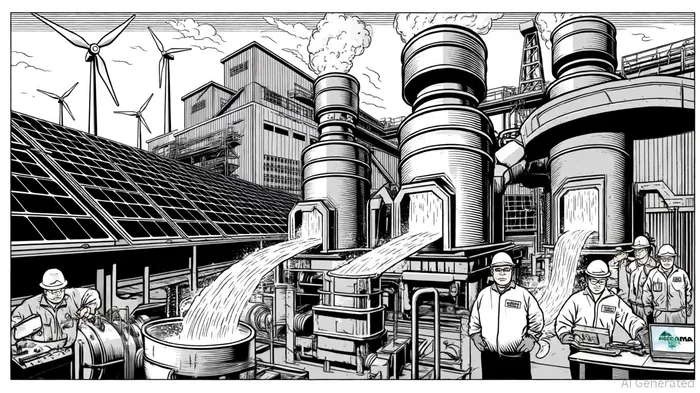
The global steel industry is undergoing a seismic shift as decarbonization and reshoring converge to redefine market dynamics. Algoma Steel Group Inc.ASTL-- (ASTL) stands at the intersection of these forces, leveraging strategic investments in green steel technology and domestic manufacturing partnerships to position itself as a leader in North America's sustainable industrial renaissance. While the company faces near-term financial headwinds, its long-term vision aligns with both regulatory tailwinds and growing demand for low-carbon materials.
Strategic Exposure to Decarbonization
Algoma's pivot to Electric Arc Furnace (EAF) technology marks a pivotal step in its decarbonization strategy. By transitioning to EAF-based production, the company aims to reduce greenhouse gas emissions by approximately 70% compared to its legacy processes, with annual CO2 reductions projected at 3 million tonnes [1]. This shift notNOT-- only aligns with Canada's Paris Agreement commitments but also positions Algoma to capitalize on the burgeoning green steel market, where demand is expected to grow at a compound annual rate of 12% through 2030 [4].
The company's progress is already tangible: in Q2 2025, Algoma produced its first batch of green steel using EAF technology, a milestone underscoring its operational transformation [6]. According to a report by ReportLinker, this move could redefine industry benchmarks, as Algoma's low-carbon output may soon command premium pricing in markets prioritizing sustainability [4]. However, the transition is not without challenges. Analysts have downgraded the stock amid concerns over short-term profitability, citing a projected EBITDA loss of $55–65 million for Q4 2024 [5].
Financial Resilience and Reshoring Synergies
To fund its green transition and navigate trade uncertainties, Algoma has bolstered its liquidity through strategic financing. In September 2025, the company upsized its asset-based revolving credit facility to $375 million, with Export Development Canada (EDC) providing the incremental $75 million [3]. This move enhances financial flexibility amid U.S. tariff pressures, which have prompted Algoma to seek $500 million in federal support under the Large Enterprise Tariff Loan program [6]. Such measures reflect a proactive approach to mitigating risks while maintaining focus on long-term sustainability goals.
Reshoring efforts further amplify Algoma's strategic positioning. A July 2025 Memorandum of Understanding with Seaspan Vancouver Shipyards and Stigterstaal Canada exemplifies this, aiming to secure a domestic steel supply chain for shipbuilding projects [3]. By aligning with national infrastructure and defense priorities, Algoma is not only insulating itself from global supply chain volatility but also tapping into a $12 billion U.S. shipbuilding market [3].
Balancing Risks and Rewards
Despite its ambitious roadmap, Algoma's stock remains a double-edged sword. While its EAF project and reshoring partnerships signal strong long-term potential, near-term financial metrics remain a concern. A June 2025 sustainability report highlighted progress in environmental metrics but coincided with analyst downgrades, reflecting skepticism about the pace of profitability [2]. Investors must weigh these risks against the company's alignment with global decarbonization trends and its role in North America's industrial revival.
Conclusion
Algoma Steel Group Inc. embodies the tension between immediate financial pressures and transformative long-term potential. Its strategic bets on green steel and domestic manufacturing resonate with both regulatory and market imperatives, positioning it as a key player in North America's reshoring revolution. For investors with a multi-year horizon, the company's alignment with decarbonization trends and its proactive financial strategies may outweigh current volatility. However, those prioritizing short-term stability should approach with caution, as the path to profitability remains uneven.





Comentarios
Aún no hay comentarios