
Algo Grande's AI-Driven Exploration Breakthrough at Adelita: A New Paradigm in Copper-Gold Discovery
The mining industry is undergoing a transformative shift, driven by the integration of artificial intelligence (AI) and advanced geophysics to unlock previously inaccessible mineral resources. At the forefront of this revolution is Algo Grande, whose Adelita Copper-Gold-Silver Project in the Arizona–Sonora Copper Belt exemplifies how cutting-edge technology is redefining exploration paradigms. By combining AI-driven analysis with traditional geophysical methods, the company is not only accelerating resource delineation but also de-risking exploration in a high-potential skarn-porphyry system.
A Strategic Acquisition with Deep Geological Potential
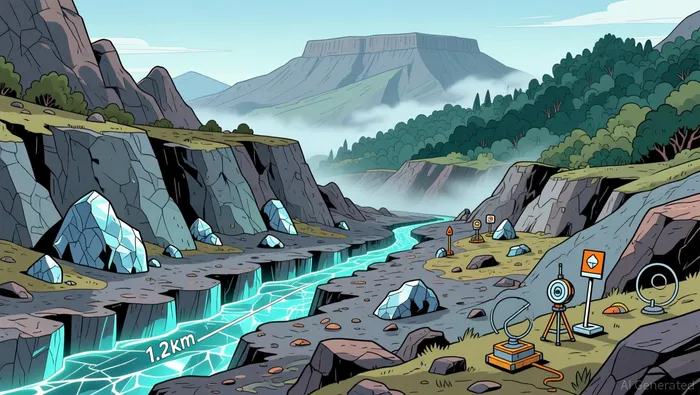
Algo Grande's full acquisition of the 5,895ha Adelita project marks a pivotal milestone in its exploration strategy. The project is anchored by the high-grade Cerro Grande skarn, a copper-gold-silver system that remains open along strike and at depth according to recent reports. Historical exploration efforts, including $8 million in expenditures and 7,000m of drilling, have already established a robust technical foundation as documented. Recent reprocessing of geophysical data suggests the skarn extends beyond 350m down-dip and along a structural fold to the northwest, potentially forming a 1.2km mineralized trend according to analysis. This geological complexity, however, demands innovative tools to fully realize its potential-a challenge Algo Grande is addressing through AI.
AI and Machine Learning: Enhancing Precision and Efficiency
The integration of AI and machine learning (ML) into mineral exploration is revolutionizing the industry's ability to interpret complex datasets. At Adelita, Algo Grande leverages ML algorithms to identify subtle variations in surface reflectance and geology, recognizing spectral "fingerprints" of mineral alteration zones as reported. These models are not merely supplementary; they are redefining exploration workflows. For instance, 32 high-priority copper-gold-silver targets have been identified, with 14 generated through ML-based prospectivity analysis according to company data. These targets, validated by independent consultants GSM Geoscience Pty Ltd. and Southern Geoscience (SGC), extend beyond the existing geophysical coverage into underexplored areas such as Mezquital and Las Tablas as confirmed.
 The success of these models lies in their ability to synthesize historical geophysical and geochemical data with modern high-definition ground magnetic surveys and 3D geophysical inversions according to technical documentation. This approach not only accelerates target identification but also reduces the need for costly, exploratory drilling in low-potential zones. As stated by industry experts, the combination of AI with traditional geodesy and geophysical methods is a "paradigm shift" in mineral discovery as noted.
De-Risking Exploration with Advanced Geophysics
Algo Grande's Phase 1 exploration program underscores its commitment to de-risking the Adelita project. Oriented-core drilling is being used to define structural geometry, while ground magnetic surveys map magnetite-rich horizons-a critical indicator of skarn systems according to field reports. Concurrently, soil geochemistry programs refine near-surface targets, creating a multi-pronged strategy to validate AI-generated hypotheses. The data from these efforts will inform a Phase 2 drilling campaign slated for 2Q26, which aims to expand high-grade skarn mineralization and test deeper porphyry systems as planned.
The use of 3D geophysical inversions further enhances the company's ability to delineate porphyry targets, a critical step in unlocking the full economic potential of the Adelita project according to technical analysis. By integrating these advanced geophysical techniques with AI-driven analysis, Algo Grande is effectively bridging the gap between surface and subsurface exploration, a capability that is increasingly rare in the industry as observed.
A Model for the Future of Exploration
The Adelita project's success is emblematic of a broader trend in 2025: the convergence of AI, geophysics, and geoscience. As noted in industry analyses, deep learning models and advanced programming languages like Julia and Golang are enabling faster fault detection, hazard prediction, and resource discovery according to industry reports. Algo Grande's approach aligns with these advancements, leveraging satellite imagery and geophysical surveys to identify mineral deposits with unprecedented precision as demonstrated.
For investors, the implications are clear. By adopting a technology-driven exploration model, Algo Grande is not only accelerating resource expansion but also mitigating the financial and operational risks traditionally associated with early-stage projects. The third-party validation of its ML-generated targets as confirmed adds an additional layer of credibility, reinforcing the company's position as a leader in the AI-driven exploration space.
Conclusion: A Paradigm Shift in Mineral Discovery
Algo Grande's work at Adelita represents more than a technical achievement-it signals a paradigm shift in how mineral exploration is conducted. By integrating AI and advanced geophysics, the company is setting a new standard for efficiency, accuracy, and de-risking in the search for copper-gold-silver deposits. As the global demand for critical minerals intensifies, firms that embrace these innovations will be best positioned to capitalize on the next generation of discoveries. Algo Grande's Adelita project is not just a case study in technological application; it is a blueprint for the future of mining.







Comentarios
Aún no hay comentarios