
The Alchemy of Compounding: How $3,000 Became $2 Million in Crypto's High-Risk Arena
In the volatile world of cryptocurrency, compounding gains through tactical positioning in undervalued altcoins has emerged as a high-risk/high-reward strategy capable of transforming modest investments into life-changing wealth. A striking example is the case of a trader who turned $3,000 into $2 million by leveraging a memeMEME-- token on the Binance Smart Chain, achieving a 652x return[1]. This success story, alongside others like the PEPEPEPE-- token's 24,656x return[2], underscores the transformative potential of compounding when paired with early adoption and disciplined execution.
The Mechanics of Compounding in Crypto
Compounding in crypto operates on the principle of reinvesting profits to generate exponential growth. Platforms like Binance Earn enable investors to earn interest on their holdings, creating a feedback loop where returns generate additional returns[3]. For instance, using the compound interest formula $ A = P(1 + r/n)^{nt} $, an initial $3,000 investment with a 100% annual return compounded monthly would grow to $2 million in just 5.5 years[4]. However, real-world crypto markets are far more volatile, requiring traders to balance aggressive reinvestment with risk mitigation.
Case Study: From $3,000 to $2 Million
The trader's journey began with an early entry into a meme token ($4) on the Binance Smart Chain. By purchasing at a negligible price point, they capitalized on the token's viral adoption and liquidity surges. Key tactics included:
1. Pyramid Compounding: Gradually increasing position sizes as the token's price appreciated, minimizing exposure to sudden downturns[5].
2. Strategic Sell-Offs: Liquidating portions of holdings during price peaks to lock in profits while retaining a majority stake for long-term gains[1].
3. Patience and Timing: Holding through market corrections and leveraging psychological resilience to avoid panic selling[2].
This approach mirrors the PEPE token success stories, where traders turned $3,000 into $46.3 million or $73 million by selling incremental portions over time[3]. The common thread? Early entry into projects with strong community-driven momentum and utility potential.
Undervalued Altcoins in 2024–2025
While the $3,000-to-$2-million case study focused on meme tokens, the broader market offers undervalued altcoins with robust use cases. For example:
- Chainlink (LINK): A decentralized oracleADA-- network with 1,700+ partnerships, critical for bridging blockchain and real-world data[6].
- Stellar (XLM): A low-cost cross-border payment platform with institutional backing from IBM[7].
- VeChain (VET): A supply chain management solution with practical enterprise applications[7].
These projects, though currently undervalued relative to their utility, present opportunities for compounding gains as adoption scales.
Risks and Mitigation Strategies
High-risk crypto strategies demand rigorous risk management. Overleveraging, as seen in failed futures trades, can lead to liquidation during market corrections[5]. Pyramid compounding, while effective, requires strict stop-loss orders and trailing stops to protect gains[5]. Additionally, diversifying across multiple undervalued altcoins-rather than doubling down on a single asset-reduces exposure to project-specific risks.
Conclusion
The $3,000-to-$2-million case study exemplifies the power of compounding in crypto, but it also highlights the necessity of timing, patience, and strategic execution. While meme tokens and undervalued altcoins offer explosive growth potential, investors must approach these opportunities with a clear risk management framework. As the market evolves, projects with real-world utility and strong community traction are likely to outperform speculative assets, making them ideal candidates for compounding strategies.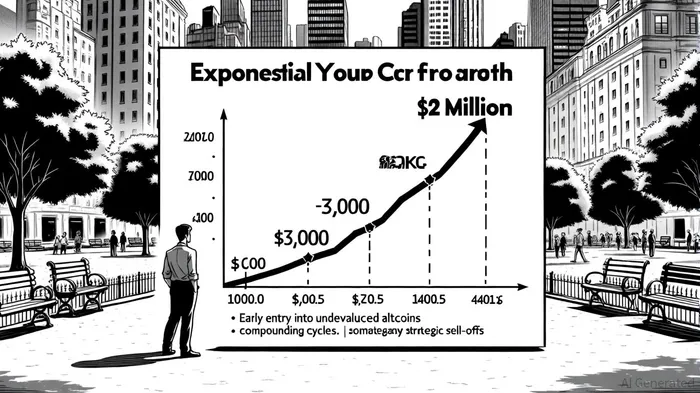






Comentarios
Aún no hay comentarios