
The Alchemy of Bitcoin: Compounding Returns and the High-Stakes Game of Timing
In the annals of modern finance, few stories rival the meteoric rise of BitcoinBTC--. From a near-valueless digital experiment in 2009 to a $110,723.60 asset with a $2.2 trillion market cap as of September 2025, Bitcoin's journey is a masterclass in compounding returns—and a stark reminder of the perils and rewards of timing the market. For investors who recognized its potential early, the rewards have been nothing short of astronomical. But the path to such wealth has been anything but smooth.
The Power of Compounding: A 11.18 Billion Percent Journey
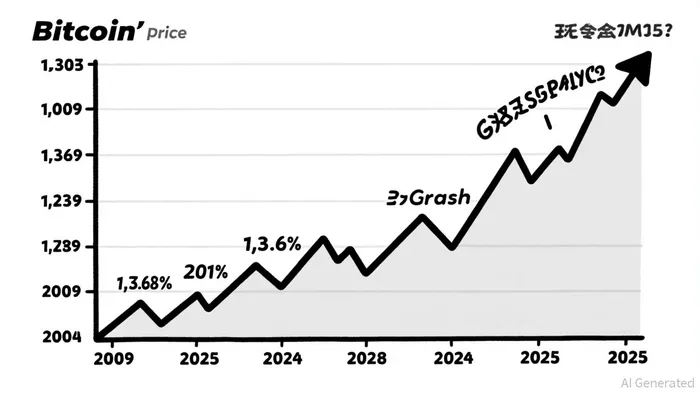
Bitcoin's price history is a rollercoaster of extremes. In 2009, 5,050 BTCBTC-- were exchanged for $5.02, valuing each coin at roughly $0.00099 [1]. By 2025, that same 5,050 BTC would be worth over $558 million, a 11.18 billion percent increase [1]. This exponential growth underscores the compounding magic of assets that defy traditional valuation metrics.
Year-over-year returns have been equally volatile. The 2017 surge of +1,368.7% [1] was followed by a 2018 freefall of -73.6% [1], testing the resolve of even the most bullish investors. Yet, those who stayed the course were rewarded: 2020's +303.2% [1] and 2024's +121.0% [1] erased earlier losses and more. As of September 2025, Bitcoin has added 18.51% to its value in just over a month [1], illustrating its relentless upward trajectory.
Timing the Market: A High-Stakes Gamble
Bitcoin's volatility makes timing the market a perilous endeavor. For instance, an investor who bought at the peak of the 2017 bubble and sold during the 2018 crash would have lost 73.6% of their portfolio in a single year [1]. Conversely, those who purchased during the 2020 market bottom and held through 2024 would have seen their holdings multiply by over 300% [1].
The key to navigating this volatility lies in conviction. Long-term holders (LTHs)—those who retain Bitcoin for more than 155 days—have demonstrated a “dual structure” of profit-taking and accumulation. On-chain data from platforms like Glassnode and CryptoQuant reveals that LTHs added over 880,000 BTC to their portfolios in a 30-day period in mid-2025 [2]. This behavior, driven by a belief in Bitcoin's long-term value, has helped stabilize the market during periods of geopolitical and macroeconomic uncertainty.
Michael Saylor, CEO of MicroStrategy, has been a vocal advocate for the HODL strategy. “Bitcoin isn't a stock or a commodity—it's a store of value,” he argues, urging investors to treat it like digital gold [2]. His approach, which prioritizes patience over panic, has influenced a generation of investors to weather short-term fluctuations for long-term gains.
The Psychology of Early Adoption: FOMO, Scarcity, and Institutional Validation
Early Bitcoin adopters were often driven by a mix of technological optimism and psychological factors. The fear of missing out (FOMO), the allure of scarcity (with its 21 million coin cap), and the influence of social proof created a self-reinforcing cycle of adoption [3]. Behavioral economics further explains this phenomenon: loss aversion and confirmation bias led investors to cling to Bitcoin during downturns, while institutional validation from companies like Tesla and MicroStrategy bolstered its legitimacy [3].
Academic research corroborates these behavioral patterns. Studies show that Bitcoin's volatility timing framework offers diversification benefits, particularly during dovish monetary policy periods [4]. However, its high-risk profile necessitates careful portfolio integration. As one paper notes, “Bitcoin adds more economic value than gold in certain regimes but requires robust risk management” [4].
The Risks of Conviction: Volatility and Regulatory Uncertainty
For all its promise, Bitcoin remains a high-stakes asset. Its price swings—exemplified by the 2022 -64.3% drop [1]—demand a tolerance for risk that many investors lack. Regulatory uncertainties further complicate its role in traditional portfolios. Yet, the growing influence of spot ETFs and institutional demand suggests that Bitcoin is increasingly being treated as a mainstream asset class [2].
Conclusion: A Test of Patience and Vision
Bitcoin's story is one of compounding returns and the critical importance of timing. For early adopters, the rewards have been extraordinary—but only for those who held through the chaos. As the market matures, the role of high-conviction investors in shaping Bitcoin's trajectory becomes ever clearer. In a world of fleeting trends and speculative frenzies, Bitcoin's long-term value proposition remains a testament to the power of patience, vision, and the willingness to defy conventional wisdom.






Comentarios
Aún no hay comentarios