
Alberta's TIER Carbon Market and the Pathways Project: A Strategic Nexus for Carbon Credit Valuation and Industrial Decarbonization
Alberta's Technology Innovation and Emissions Reduction (TIER) carbon market and the Pathways Project represent a pivotal intersection of policy innovation and industrial transformation. As Canada's energy heartland grapples with the dual imperatives of decarbonization and economic competitiveness, these initiatives are reshaping the valuation dynamics of carbon credits and unlocking new investment opportunities in carbon capture, utilization, and storage (CCUS). This analysis explores how Alberta's evolving regulatory framework and large-scale decarbonization projects are creating a fertile ground for investors seeking to capitalize on the transition to a low-carbon economy.
The TIER Carbon Market: Structure, Pressures, and Price Signals
Alberta's TIER system operates under a benchmarking approach that tightens annual emissions limits by 2% for regulated facilities, compelling emitters to reduce output or purchase credits according to market analysis. The market's compliance mechanisms include Emissions Performance Credits (EPCs), emission offset credits, TIER Fund payments, and capture recognition tonnes. While the TIER Fund Price is set to rise from CAD 80/tonne in 2024 to CAD 170/tonne by 2030 as official documents state, the current market price for EPCs and offsets remains significantly lower-around CAD 20/tonne in Q3 2025 as reported by industry data. This disconnect reflects an oversupply of credits, with large volumes of unserialized EPCs and offsets lingering in the Alberta Carbon Registries according to recent analysis. 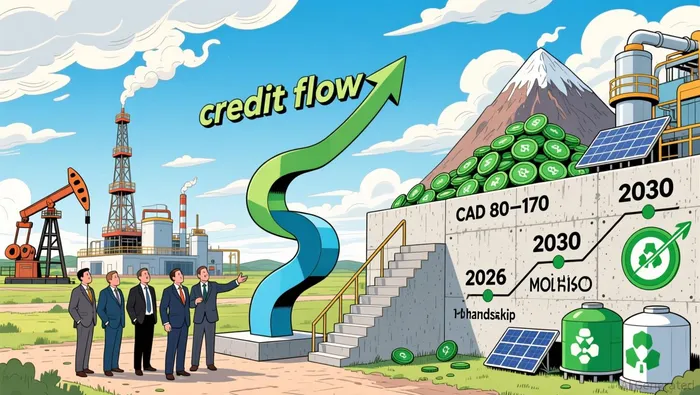
The recent Memorandum of Understanding (MOU) between Alberta and the federal government has introduced a critical turning point. By aligning TIER with the federal Output-Based Pricing System (OBPS) and establishing a minimum effective carbon price of CAD 130/tonne by 2026 as per government announcements, the agreement aims to harmonize pricing and enhance market predictability. However, the success of this alignment hinges on resolving the oversupply issue, which could delay the depletion of the credit bank and dampen price momentum as market experts warn.
The Pathways Project: A Catalyst for CCUS and Emissions Reduction
At the core of Alberta's decarbonization strategy is the Pathways Project, a CCUS initiative designed to reduce the carbon intensity of oil production and position Alberta as a global leader in low-carbon energy. The project's projected emissions reductions-13.9 Mt CO2 by 2030 and 62 Mt CO2 annually by 2050 as outlined in official documents-are contingent on sustained investment in CCUS infrastructure. The MOU explicitly ties the project's viability to the TIER system, with the minimum CAD 130/tonne price serving as a financial signal to attract private capital as noted in policy analysis.
The integration of the Pathways Project with TIER is further strengthened by regulatory updates allowing regulated facilities to meet up to 90% of their compliance obligations through direct investments in on-site emissions reduction technologies as stated in government communications. This shift not only incentivizes innovation but also aligns with the federal government's emphasis on industrial competitiveness and clean technology investment in Budget 2025 as reported in policy analysis. For instance, the Alberta Carbon Capture Incentive Program (ACCIP) is projected to allocate CAD 3.2–5.3 billion between 2024 and 2035 to support CCUS projects like Pathways as detailed in official plans.
Valuation Dynamics: Oversupply, Policy Uncertainty, and Market Resilience
Despite the MOU's ambitious targets, carbon credit valuation in Alberta remains constrained by short-term market fundamentals. The oversupply of EPCs and offsets, coupled with the frozen headline carbon price of CAD 95/tonne as observed in market data, has created skepticism about the system's ability to sustain higher prices. However, the proposed TIER updates-such as the opt-out for smaller facilities and the direct investment pathway-aim to reduce compliance costs and redirect resources toward emissions reduction as detailed in regulatory analysis. These measures could enhance the liquidity of the TIER credit market by 2026, particularly as the credit-use limit increases from 80% to 90% as reported in official statements.
The voluntary carbon market also provides a counterpoint to these challenges. High-quality ARR (Afforestation, Reforestation, and Revegetation) credits have surged to USD 24/tCO₂e in September 2025 as reported in industry data, underscoring a growing demand for premium offsets. This trend highlights the potential for Alberta's TIER system to evolve into a dual-track market, where compliance credits coexist with voluntary offsets, each catering to distinct investor preferences.
Investment Opportunities and Risks
For investors, the convergence of TIER's regulatory reforms and the Pathways Project's CCUS ambitions presents a compelling case. Key opportunities include:
1. CCUS Infrastructure Providers: Companies supplying equipment and services for carbon capture and storage are poised to benefit from the CAD 90 billion in projected CCUS investment tied to the CAD 130/tonne price target as projected by market analysts.
2. Technology Innovators: Firms developing on-site emissions reduction technologies (e.g., heat recovery systems, fuel switching solutions) stand to gain from the TIER system's direct investment pathway as detailed in regulatory updates.
3. Carbon Credit Brokers: As the TIER market transitions toward higher stringency, brokers facilitating credit transactions between oversupplied and undersupplied sectors could see increased demand as noted in market analysis.
However, risks persist. Regulatory delays in finalizing the TIER-OBPS alignment could disrupt market confidence, while the province's decision to suspend federal Clean Electricity Regulations and Oil and Gas Emissions Caps introduces policy uncertainty as reported by industry sources. Additionally, the projected shortfall of 222.4 megatonnes in Alberta's emissions reduction targets by 2050 as outlined in policy analysis raises questions about the long-term viability of the TIER system.
Conclusion
Alberta's TIER Carbon Market and the Pathways Project exemplify the complex interplay between policy design, market dynamics, and industrial innovation. While the current oversupply and price volatility pose challenges, the alignment with federal OBPS and the integration of CCUS projects like Pathways offer a clear roadmap for carbon credit valuation to evolve. Investors who navigate these dynamics with a focus on regulatory resilience and technological scalability are likely to find fertile ground in Alberta's decarbonization journey.







Comentarios
Aún no hay comentarios