
U.S. Airline Industry Consolidation and the Rise of a Post-Pandemic Duopoly: Strategic Positioning in a Shrinking Premium Sector
The Case for a Duopoly: United's Strategic Rationale
Scott Kirby's assertion that only United and DeltaDAL-- will emerge as dominant premium carriers is not mere bravado. It is a calculated assessment of the industry's trajectory. As Kirby has emphasized, the "large, revenue-diverse, full-service, brand-loyal" nature of United and Delta positions them to outcompete peers in a landscape where cost efficiency and customer experience are paramount. This is already manifesting in key metrics: United's recent outperformance in Chicago O'Hare underscores its ability to leverage infrastructure and route networks to capture market share.
United's strategy hinges on three pillars: premium product differentiation, disciplined capacity management, and fleet modernization. The airline has invested heavily in enhancing the premium experience, from installing Starlink high-speed Internet to reimagining in-flight service. These upgrades cater to business and high-yield travelers, who are less price-sensitive and more likely to pay a premium for comfort and connectivity. According to a report by Chayan Agarwal, , a testament to the effectiveness of this approach.
Equally critical is United's capacity discipline. , the airline is aligning supply with demand while maintaining cost efficiency. This contrasts with competitors who have struggled to balance growth with profitability, often overexpanding during recovery phases only to face margin compression. United's approach ensures that it can sustain higher yields without sacrificing operational flexibility.
Delta's Counterstrategy: Operational Excellence and Technological Edge
While United focuses on premium differentiation, Delta Air Lines is betting on operational efficiency and technological innovation to secure its place in the duopoly. The airline's partnership with STV-a global engineering firm-is a case in point. By integrating automation and cutting-edge infrastructure improvements into airport operations, Delta aims to streamline passenger flow, reduce delays, and lower costs. These advancements are particularly timely as global tourism rebounds, with destinations like Paris, Barcelona, and Tokyo poised to benefit from smoother airport operations.
Delta's investments in automation extend beyond airports. Smarter baggage handling systems and AI-driven check-in processes are expected to enhance the customer experience while reducing labor costs-a critical advantage in an industry where margins are razor-thin. For investors, this signals a long-term commitment to leveraging technology to maintain a competitive edge, a strategy that aligns with broader trends in the travel sector.
The Broader Implications for the Premium Sector
The duopoly narrative is not without its challenges. Both United and Delta face headwinds, from macroeconomic uncertainty to infrastructure bottlenecks. United, for instance, at Newark Liberty International Airport (EWR) due to FAA-imposed restrictions, . Similarly, Delta's reliance on technology-driven efficiency could be tested if supply chain disruptions or labor shortages persist.
Yet, these challenges also highlight the resilience of the two airlines. in 2025 alone, , demonstrates its commitment to sustainability and cost optimization. Meanwhile, Delta's focus on automation reduces its exposure to labor cost volatility, a persistent risk in the industry.
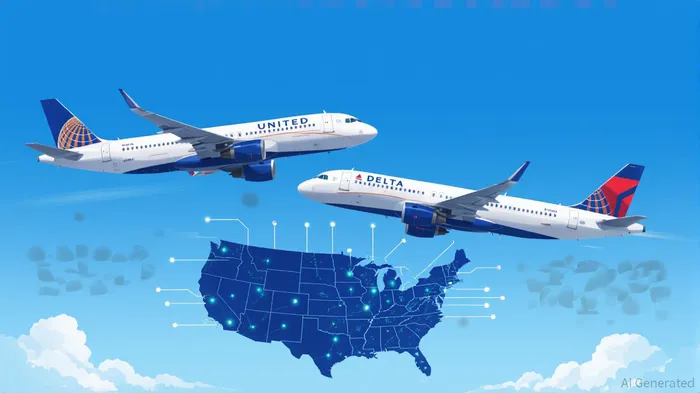
For investors, the key takeaway is clear: the premium airline sector is narrowing, and only those with the scale, brand strength, and operational agility to adapt will survive. United and Delta are not just preparing for a duopoly-they are actively engineering it.
Conclusion: Strategic Positioning and Long-Term Value
The U.S. airline industry's post-pandemic evolution is a story of consolidation, but it is also a tale of strategic reinvention. United and Delta are leading the charge, each leveraging distinct but complementary approaches to secure dominance in a shrinking premium market. For investors, the question is not whether to bet on this duopoly, but how to assess which airline is better positioned to outperform.
United's focus on premium differentiation and disciplined capacity management offers a compelling value proposition, particularly as business travel rebounds. Delta's technological edge and operational efficiency, meanwhile, provide a hedge against macroeconomic volatility. Both strategies are valid, but they reflect different risk profiles. In a sector where margins are thin and competition is fierce, the ability to execute-whether through superior customer experience or operational innovation-will determine who thrives and who falters.
As the industry continues to consolidate, one thing is certain: the days of a fragmented premium airline sector are numbered. The winners will be those who, like United and Delta, recognize that survival in this new era requires more than just surviving-it demands reinvention.







Comentarios
Aún no hay comentarios