
Airdrops and Their Impact on Crypto Valuation and Investor Sentiment: Analyzing Pendle's Strategic Moves
In the rapidly evolving DeFi landscape, airdrops have emerged as both a strategic tool for ecosystem growth and a barometer of market sentiment. Pendle's recent airdrop strategy-spanning a $6.1 million distribution in January 2025 and subsequent monthly rewards-offers a compelling case study for understanding how token incentives influence valuation dynamics and investor behavior. By dissecting Pendle's approach, we gain insights into the broader implications for crypto markets.
Pendle's Airdrop Strategy: A Dual-Pronged Approach
Pendle's January 2025 airdrop marked a pivotal moment in its ecosystem development. According to CoinMarketCap analysis, the protocol distributed 3.46 million SENA, 1.58 million REZ, and 691,000 ETHFI to vePENDLE holders, with a snapshot taken at 07:59 Beijing time on January 1, 2025. This was followed by an announcement of monthly airdrops from February to June 2025, rewarding vePENDLE holders based on their snapshot positions, as reported by Cryptopolitan. The dual strategy-large upfront rewards and sustained monthly distributions-signals a deliberate effort to balance immediate liquidity incentives with long-term holder retention.
This approach contrasts with Pendle's earlier struggles. In April 2024, EigenLayer's airdrop announcement triggered a 45% price drop, as users questioned the fairness of EIGENEIGEN-- token allocations, per Cryptopolitan. Pendle's subsequent TVL plummeted from $6.6 billion to $3.54 billion by July 2024, according to a Cryptofada report, underscoring the fragility of investor confidence in airdrop-dependent ecosystems.
Price Volatility and Technical Indicators
The January 2025 airdrop coincided with mixed technical signals. While short-term indicators like the RSI(14) at 40.65 and a negative MACD histogram (-0.158) suggested bearish momentum, CoinMarketCap noted that the 50-day moving average on daily charts retained bullish potential, with a break above the $4.50 resistance level hinting at a possible continuation of the uptrend, according to TronWeekly.
However, the price trajectory post-airdrop was not without turbulence. As of late September 2025, PENDLEPENDLE-- traded around $4.45, reflecting a 13.35% weekly decline and a 1.98% 24-hour dip, per CoinMarketCap. Analysts attribute this to technical corrections, profit-taking after TVL milestones, and broader DeFi leverage risks. Notably, TVL maturity outflows of $898 million in late September triggered sell pressure, while Pendle's $6.4 billion AaveAAVE-- exposure to Ethena's Loop Risks posed a potential bearish catalyst if yields declined, according to CoinMarketCap.
Investor Sentiment: From Panic to Cautious Optimism
Investor sentiment around Pendle has oscillated dramatically. Pre-airdrop, EigenLayer's April 2024 announcement caused a 45% price drop, as users feared inequitable airdrop allocations, per Cryptopolitan. Post-airdrop, however, sentiment improved. A 31.75% weekly price increase and rising trading volume indicated strong buying interest, according to TronWeekly. Institutional activity further bolstered confidence: $8.3 million in PENDLE tokens were withdrawn from Binance in a short period, signaling growing institutional demand, as reported by The Currency Analytics.
Retail participation also showed resilience. New and active wallet addresses rose by 11% and 1%, respectively, according to The Currency Analytics, suggesting that smaller investors remained engaged despite macroeconomic uncertainties. This duality-retail optimism and institutional accumulation-highlights Pendle's ability to attract diverse capital flows even amid market volatility.
Future Outlook: Airdrops as a Strategic Lever
Pendle's monthly airdrop program from February to June 2025 is designed to sustain ecosystem growth. BlockBeats reported that these distributions would be funded by team-negotiated points, ensuring a steady reward stream for vePENDLE holders, per Cryptopolitan. This approach could mitigate the TVL outflows observed in July 2024, as recurring incentives may stabilize liquidity.
Longer-term forecasts are cautiously bullish. Changelly predicts a minimum price of $5.04 and a maximum of $5.72 for 2025, with an average of $17.00 by 2028, according to Cryptopolitan. Innovations like the Boros upgrade, which tokenizes perpetual funding rates, are expected to drive TVL to $11 billion and expand institutional participation, per the Cryptofada report. However, risks persist: regulatory uncertainties and leverage in DeFi stablecoin yields could disrupt price stability, according to Cryptofada.
Conclusion: Airdrops as a Strategic Indicator
Pendle's airdrop strategy exemplifies the dual-edged nature of token incentives in DeFi. While large upfront distributions can boost short-term liquidity, sustained monthly rewards are critical for long-term holder retention. The protocol's ability to recover from the EigenLayer-driven sell-off and attract institutional capital underscores its strategic adaptability. For investors, Pendle's airdrop model offers a blueprint for balancing immediate incentives with ecosystem resilience-a lesson that may resonate across the broader crypto market.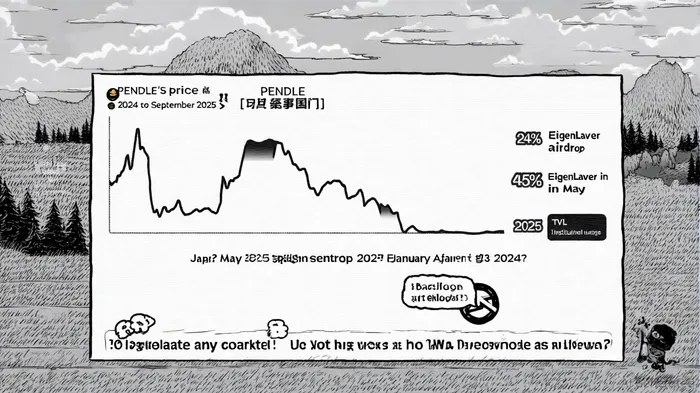






Comentarios
Aún no hay comentarios