
Airbus's Surging Aircraft Services: A Profitable Post-Delivery Opportunity
The aviation industry has long been defined by the sale of aircraft, but a seismic shift is underway. As manufacturers like Airbus pivot toward services, the post-delivery market is emerging as a goldmine for investors. According to Airbus's Global Services Forecast 2025–2044, the company projects a staggering $311 billion in annual demand for aviation services by 2044, driven by a global commercial fleet that will nearly double to over 49,000 aircraft. This represents a compound annual growth rate (CAGR) of 3.6% from 2025 to 2044, with key segments like digital connectivity and training poised to outpace even the most optimistic expectations. For investors, the question is no longer whether to bet on this trend but how to position for its inevitability.
The Aftermarket: From Niche to Nexus
Airbus's aftermarket services-encompassing maintenance, modifications, training, and digital solutions-are no longer ancillary to its core business. They are now central to its long-term strategy. The company's 2025–2044 forecast reveals a 10% year-on-year growth in services demand in 2025 alone, with off-wing maintenance leading the charge. This segment, valued at $107 billion in 2025, is projected to balloon to $218 billion by 2044, fueled by an aging fleet and the sheer scale of aircraft in operation, the forecast shows. On-wing maintenance, which includes routine checks and component replacements, is also set to expand, rising from $21 billion to $34 billion over the same period.
But the most compelling story lies in the digital transformation of aviation. The Digital & Connectivity segment, currently valued at $9 billion, is expected to surge to $26 billion by 2044-a CAGR of nearly 6%-as airlines adopt predictive maintenance, real-time diagnostics, and data-driven efficiency tools, according to the forecast. Airbus estimates these technologies could unlock $83 billion in annual operational savings for its customers, a figure that underscores the sector's transformative potential.
Strategic Leverage: Technology, Training, and Sustainability
Airbus is not merely reacting to market forces; it is actively shaping them. The company is investing heavily in digital platforms that enable predictive maintenance, reducing downtime and costs for airlines. Virtual reality simulators and AI-driven training programs are also being deployed to address a looming labor shortage, with the forecast projecting the industry will require 2.35 million new aviation professionals by 2044. Training revenue, currently at $10 billion annually, is expected to reach $17 billion by 2044, reflecting both the scale of the challenge and the opportunity.
Sustainability is another lever. As regulators and consumers demand greener operations, Airbus is positioning its services to support hydrogen-powered aircraft and sustainable aviation fuel (SAF) integration. These initiatives not only align with global decarbonization goals but also create new revenue streams through retrofitting and technical support for next-generation technologies, as noted in Airbus's Global Market Forecast 2025–2044.
Regional Dynamics: Where Growth Is Concentrated
While global demand is rising, the most dynamic markets are concentrated in Asia-Pacific, South Asia, and China. These regions are expected to outpace the global CAGR, driven by urbanization, rising middle-class travel, and government investments in infrastructure, the forecast predicts. For investors, this means opportunities are not evenly distributed. Firms with strong regional partnerships or localized service hubs-such as Airbus's recent expansion in India and Southeast Asia-will likely capture disproportionate market share.
Risks and Realities
No investment opportunity is without risk. The aftermarket is capital-intensive, requiring significant R&D and infrastructure spending. Regulatory shifts, particularly in emissions standards, could also disrupt timelines. However, Airbus's long-term forecasts suggest a resilient market, with demand insulated from short-term economic cycles. The company's emphasis on digital solutions and sustainability further mitigates risk by aligning with macroeconomic trends.
Conclusion: A Long-Term Play with Short-Term Momentum
For investors, Airbus's services division represents a rare confluence of long-term secular growth and near-term execution. The company's ability to monetize its intellectual property through recurring revenue streams-maintenance contracts, software subscriptions, and training programs-creates a durable competitive advantage. As the industry transitions from selling planes to selling services, Airbus is not just adapting; it is redefining the value chain.
The numbers tell the story: a $311 billion market by 2044, with the fastest-growing segments offering CAGRs that outpace traditional aviation sectors. For those with the patience to hold through the next two decades, the rewards could be as transformative as the industry itself.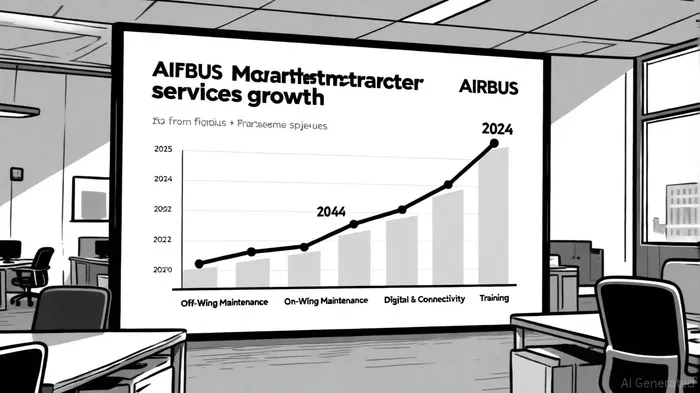







Comentarios
Aún no hay comentarios