
Airbus Production and Delivery Momentum in 2025: A Strategic Window for Investors
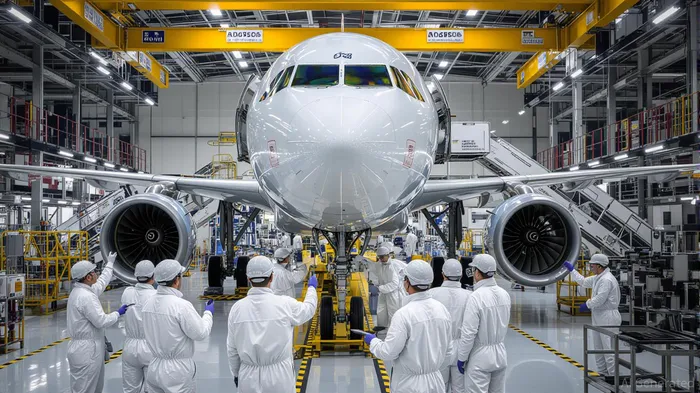
The Airbus A320neo program has long been the cornerstone of the European manufacturer's narrowbody strategy, but 2025 has brought both progress and persistent challenges. For investors, the question is whether Airbus can stabilize its production rates, meet its 2025 delivery guidance, and maintain its competitive edge against Boeing's 737 MAX. The answer to this question could determine not only Airbus's short-term financial performance but also its long-term dominance in the narrowbody market.
Stabilizing the A320neo: A Mixed Picture
In July 2025, Airbus achieved a critical milestone: producing 58 A320neo aircraft in a single month, surpassing its 50-unit-per-month target for the first time in months. This marked a rebound after a rocky first half of the year, where production dipped to 40 units in April and 39 in May. While the July figure is encouraging, it also underscores the program's volatility. Forecast International, a leading aerospace analyst firm, has cautioned that Airbus has yet to demonstrate consistent monthly output at or above 50 units—a prerequisite for scaling up to its long-term goal of 75 aircraft per month by 2027.
The company's 2025 delivery guidance of 820 commercial aircraft (including 600 A320neos) remains intact, but achieving this will require an average of 64 A320neos per month for the remainder of the year. Given the first half's average of 42.3 units per month, this is a steep climb. Airbus CEO Guillaume Faury has expressed confidence in the target, but investors should remain cautious. Supply chain bottlenecks, particularly for critical components like LEAP-1A engines and winglets, and the looming threat of international tariffs (notably in the U.S. and China) could derail these plans.
The BoeingBA-- 737 MAX: A Steady but Struggling Competitor
While Airbus's production has been erratic, Boeing's 737 MAX program has shown more consistency. In July 2025, Boeing hit its FAA-approved rate of 38 aircraft per month for the second consecutive month, producing 40 units (35 MAX 8s and five MAX 9s). This stability has bolstered Boeing's case for regulatory approval to increase production to 42 units per month, with long-term ambitions of reaching 52. However, Boeing's path is not without hurdles. Certification delays for the MAX 7 and MAX 10 variants—now pushed to 2026—and technical issues with the LEAP-1B engine's de-icing system have constrained its ability to compete.
The A320neo's edge in fuel efficiency and reliability remains a key differentiator. The LEAP-1A engine, which powers most A320neos, is widely regarded as more efficient than the LEAP-1B used on the 737 MAX, offering airlines a 1-2% fuel savings. This advantage, combined with the A320neo's larger order backlog, has allowed Airbus to maintain a stronger market position.
Long-Term Implications: Market Share and Profitability
For Airbus, the ability to stabilize A320neo production at 50 units per month is not just a near-term goal—it's a strategic imperative. The narrowbody market accounts for over 70% of global commercial aircraft demand, and the A320neo's performance will directly impact Airbus's profitability. If the company can achieve consistent production and meet its 2025 delivery targets, it will reinforce its dominance in this segment. However, failure to do so could erode market share to Boeing and emerging competitors like China's COMAC C919.
The long-term outlook also hinges on Airbus's ability to innovate. The company is reportedly developing a next-generation single-aisle aircraft to eventually replace the A320 family. While this transition period could introduce short-term uncertainty, it also presents an opportunity to lock in long-term profitability through advanced technologies like hybrid-electric propulsion or hydrogen-powered designs.
Investment Considerations
For investors, the key variables to monitor are:
1. Production Consistency: Can Airbus sustain A320neo output above 50 units per month?
2. Supply Chain Resilience: How will Airbus navigate component shortages and geopolitical risks?
3. Competitive Dynamics: Will Boeing's 737 MAX production ramp-up challenge Airbus's market share?
If Airbus can stabilize its production and maintain its delivery guidance, the stock (AIR.PA) could see upward momentum, particularly if it outperforms Boeing in the narrowbody segment. However, risks remain. A failure to resolve supply chain issues or a surge in Boeing's production could pressure Airbus's margins and stock price.
Conclusion: A Strategic Window for Investors
Airbus's 2025 performance represents a pivotal moment for the company. The A320neo's production and delivery momentum will determine whether Airbus can solidify its leadership in the narrowbody market or cede ground to Boeing. For investors, this is a strategic window to assess the company's operational resilience and long-term vision. If Airbus can navigate its current challenges and maintain its edge in efficiency and reliability, it remains a compelling long-term investment. But patience and vigilance will be required—this is a race with no clear finish line.





Comentarios
Aún no hay comentarios