
Airbus's Global Safety Directive and the Aerospace Sector: Navigating Operational and Geopolitical Risks
Operational Disruptions: A Test of Resilience
Airbus's emergency directive, issued after a JetBlue flight incident in October 2025, , or half of the global fleet of this model. The flaw, tied to the (ELAC) system, could allow solar flares to corrupt flight control data, prompting regulators to mandate software rollbacks or hardware modifications. For airlines, the fixes are time-consuming: , while older models require more complex hardware changes.
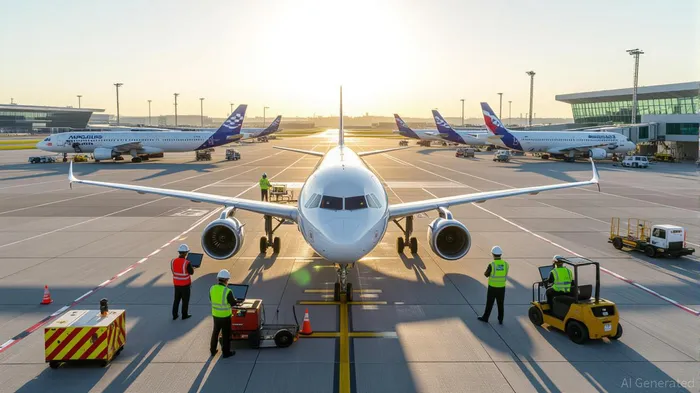 The timing-during peak holiday travel-has exacerbated the fallout. Major carriers like American AirlinesAAL--, DeltaDAL--, and IndiGo have reported cancellations and delays, with . The European Union Aviation Safety Agency (EASA) has barred affected aircraft from carrying passengers until repairs are complete, though ferry flights without passengers are permitted. According to the report, this operational strain is not merely a short-term inconvenience; it underscores the fragility of airline networks when critical systems fail.
Financial Implications: A Sector Under Pressure
The ripple effects extend beyond operational hiccups. For Airbus, the directive risks damaging its reputation and incurring significant costs, though the company has not yet disclosed financial details. For airlines, the costs are more tangible: lost revenue from cancellations, higher maintenance expenses, and potential penalties for service disruptions. These pressures are compounded by broader industry challenges, including rising insurance costs driven by "" in legal settlements and jury awards. According to industry analysis, these trends are placing additional strain on the sector's financial stability.
Historically, safety crises have punished aerospace stocks. For instance, . While Airbus's directive is less severe, . Investors are also wary of secondary effects: if airlines reduce orders for new aircraft to offset repair costs, manufacturers like Airbus and BoeingBA-- could face long-term revenue declines.
Geopolitical Risks: Tariffs, Supply Chains, and Strategic Shifts
The Airbus crisis unfolds against a backdrop of intensifying geopolitical risks. In 2025, the Trump administration's tariffs on aerospace materials-steel, aluminum, and semiconductors-have already strained production costs. According to a report by Qima, these tariffs have forced companies to absorb higher expenses or pass them on to customers, squeezing profit margins. The S&P Aerospace & , , reflects a sector balancing robust defense demand with supply chain bottlenecks.
Supply chain disruptions are compounding these challenges. The aerospace industry's reliance on globalized networks has been exposed as vulnerabilities, prompting a shift toward "" and localized production. For example, are increasing near-sourcing to mitigate risks from geopolitical conflicts and trade wars. However, this transition is costly and time-consuming, with companies like RTX Corporation warning .
Strategic Responses: Innovation and Resilience
To navigate these headwinds, aerospace firms are doubling down on technological innovation. , and are being deployed to reduce dependency on traditional logistics and accelerate production. For instance, Airbus has accelerated its use of automation to streamline repairs under the A320 directive, though this requires upfront investment.
Regulatory divergence also plays a role. The European Union Aviation Safety Agency's strict enforcement of the A320 directive contrasts with more lenient approaches in other regions, creating compliance complexities for global operators. This regulatory fragmentation is likely to persist, forcing companies to adopt region-specific strategies-a costly but necessary adaptation.
Conclusion: A New Normal for Aerospace Investing
The Airbus safety directive and its intersection with geopolitical risks highlight a new normal for the aerospace sector: one defined by operational fragility and strategic uncertainty. For investors, the key takeaway is that aerospace stocks are no longer insulated from the broader forces of global politics and supply chain volatility. While defense spending and technological innovation offer growth avenues, the sector's exposure to tariffs, regulatory shifts, and operational shocks demands a more cautious approach.
As the S&P Aerospace & Defense Index demonstrates, resilience is possible-but it comes at a cost. Companies that successfully navigate these challenges through innovation and strategic agility will emerge stronger. For now, however, the path forward remains fraught with turbulence.





Comentarios
Aún no hay comentarios