
Airbus vs. Boeing: Who Will Outperform in 2026 Aircraft Deliveries?
The global commercial aviation industry is poised for a pivotal year in 2026, as Airbus and BoeingBA-- navigate the dual challenges of scaling production and stabilizing supply chains. With both manufacturers vying to meet surging demand for narrowbody aircraft and recover from years of operational setbacks, their ability to ramp up deliveries will hinge on their capacity to resolve supplier bottlenecks and optimize production efficiency. This analysis evaluates their respective strategies and prospects, drawing on recent data and industry insights.
Airbus: Resilience Amid Persistent Constraints
Airbus delivered 121 aircraft in December 2025, including 87 A320neo-family aircraft and 17 A220s, underscoring its dominance in the narrowbody segment. However, supply chain disruptions-particularly defective panels from a supplier-forced the company to revise its 2025 delivery target downward to 790 aircraft from an initial goal of 823. For 2026, Airbus is projected to deliver between 800 and 850 aircraft, contingent on resolving ongoing issues, including delays in Pratt & Whitney GTF engines for the A220.
Despite these hurdles, Airbus has demonstrated resilience in managing its supply chain. Its narrowbody backlog remains robust, driven by strong demand for the A320neo family, which accounted for 87% of its December 2025 deliveries. However, the company has tempered expectations for the A220, reducing its 2026 production target from 14 to 12 units per month due to supplier constraints. This adjustment highlights the fragility of Airbus's supply chain, even as it maintains a competitive edge in narrowbody production.
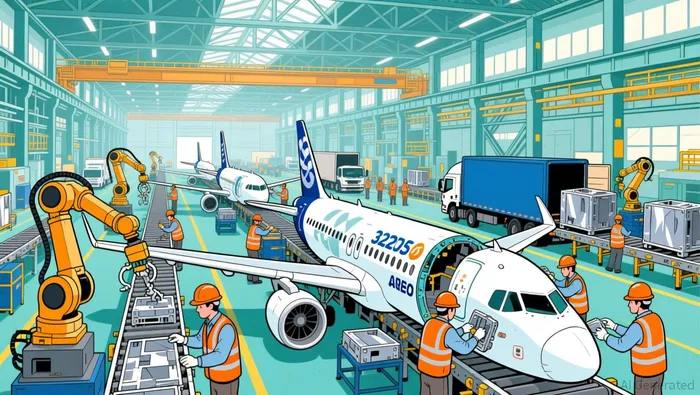
Boeing: A Path to Recovery
Boeing's December 2025 deliveries totaled 64 aircraft, primarily 737 MAX models, reflecting its focus on regaining momentum in the narrowbody market. The company aims to deliver around 700 aircraft in 2026, a target contingent on lifting production caps on the 737 MAX and resolving quality assurance issues. Boeing's recovery hinges on stabilizing the 737 MAX program and accelerating 787 Dreamliner production, both of which have been hampered by supplier and regulatory challenges.
To address supply chain vulnerabilities, Boeing has pursued strategic acquisitions, including the pending acquisition of Spirit AeroSystems, a critical supplier of fuselage components. This move is expected to streamline production and reduce reliance on third-party vendors. Additionally, Boeing is diversifying its supplier base to mitigate risks, a strategy that could enhance resilience amid global disruptions. While these efforts position Boeing for a rebound, its ability to meet 2026 delivery goals will depend on resolving long-standing quality control issues and regaining customer confidence.
Comparative Outlook
Airbus's stronger 2025 delivery performance and larger backlog suggest it is better positioned to outperform Boeing in 2026, provided supply chain constraints ease. Its narrowbody dominance, particularly with the A320neo family, offers a clear advantage in a market where 70% of new aircraft orders are for single-aisle models. However, Airbus's reliance on suppliers for critical components-such as the A220's engines-remains a vulnerability.
Boeing's 2026 prospects are more uncertain. While its supplier strategies and production caps are designed to stabilize output, the company must overcome a legacy of quality issues and regulatory scrutiny. A successful recovery would require not only resolving supplier bottlenecks but also rebuilding trust with airlines and regulators.
Conclusion
For investors, the key differentiator in 2026 will be supply chain resilience. Airbus's ability to maintain consistent deliveries despite ongoing challenges underscores its operational strength, while Boeing's strategic moves-such as acquiring Spirit AeroSystems-signal a commitment to long-term stability. However, Airbus's current momentum and stronger backlog make it the more likely outperformer in the short term. That said, Boeing's aggressive restructuring efforts could narrow the gap if executed effectively.
As the year unfolds, close monitoring of supplier performance, production rates, and regulatory developments will be critical for assessing each company's trajectory.







Comentarios
Aún no hay comentarios