
Airbus A400M Firefighting Kit: A Lifeline for Climate-Stricken Markets
The world is on fire—literally. As wildfires intensify across emerging markets, from the AmazonAMZN-- to Southeast Asia, a new class of climate resilience technologies is emerging as a strategic investment opportunity. The Airbus A400M Firefighting Kit, a specialized modification of the military transport aircraft, stands at the forefront of this trend. Its ability to drop 20,000 liters of fire retardant in seconds, combined with minimal modifications and rapid deployment, positions it as a critical tool for governments and corporations racing to mitigate disaster risks. For investors, this is more than a niche product—it's a gateway to a booming global market for climate adaptation solutions.
Why Emerging Markets Need the A400M Now
The data is stark: wildfires have become a geopolitical crisis. Between 2020 and 2025, global tree cover loss from fires surged by 5.4% annually, with boreal and tropical forests bearing the brunt. Brazil alone saw its fire protection market grow at a 7.7% CAGR, reaching $1.7 billion in 2024. Meanwhile, Southeast Asia's wildfire emissions dropped 53% in early 2025—but not before smoke from Laos and Myanmar blanketed urban centers, underscoring the fragility of regional infrastructure.
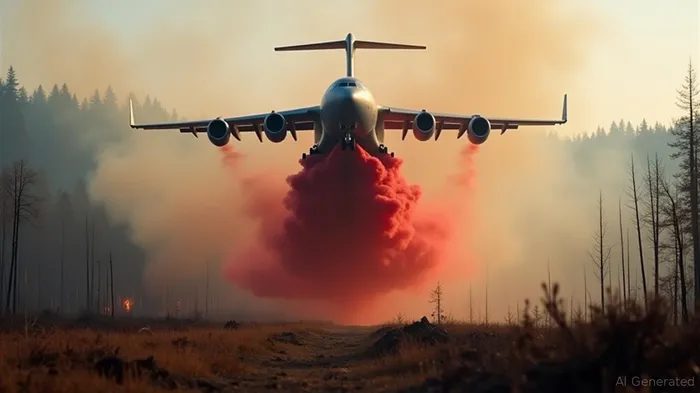
The A400M's advantage lies in its versatility. Unlike traditional firefighting aircraft, it requires no major structural changes to carry retardant. Its payload capacity (up to 38 tons) and speed (500+ mph) make it ideal for rapid response to wildfires in remote regions. For emerging markets, this means:
- Cost Efficiency: Avoids the need for specialized air fleets.
- Dual Use: Can switch between military transport and disaster relief roles.
- Scalability: Deploys across forests, urban-wildland interfaces, and agricultural zones.
The Market: A $67 Billion Climate Resilience Opportunity
The global fire safety equipment market is projected to hit $67.15 billion by 2034, growing at a 7.6% CAGR. Within this, aerial firefighting solutions—like the A400M—are a high-margin subset. Consider:
- Brazil's 2023 wildfires cost the economy billions; the A400M could reduce such losses by 30%+ via early intervention.
- Sub-Saharan Africa's urbanization is expanding wildland-urban interfaces (WUIs) by 35%, creating a need for airborne suppression.
- Southeast Asia's transboundary haze demands coordinated cross-border solutions, where multinational operators like Airbus can provide turnkey systems.
ESG Alignment: A Geopolitical Must-Have
The A400M isn't just a tool—it's a symbol of ESG progress. Governments under pressure to meet climate targets are prioritizing “resilience procurement.” Key trends include:
1. Military-Civil Partnerships: NATO members and ASEAN countries are funding dual-use aircraft to share costs.
2. Carbon Accounting: Firefighting reduces CO₂ emissions from burning forests, aligning with net-zero goals.
3. Social License: Communities in fire-prone regions demand visible investment in safety—a reputational win for companies like Airbus.
Investment Play: Airbus or the Supply Chain?
Option 1: Airbus Defence & Space (Parent Company)
- Upside: 20+ countries operate the A400M; retrofitting existing fleets could generate recurring revenue.
- Risk: Dependent on defense budgets.
Option 2: Supply Chain Players
- Eli Lilly: Provides retardant chemicals (e.g., firebreak gels).
- Hexcel: Carbon composites for aircraft lightweighting.
- Safran: Engine upgrades for extended firefighting missions.
Risks to Consider
- Geopolitical Gridlock: Trade wars could disrupt supply chains (e.g., sanctions on Russian titanium for Airbus engines).
- Budget Prioritization: Emerging markets may favor cheaper ground solutions over aerial tech.
- Technological Overload: Drones and AI-driven systems could disrupt the market.
Final Call: Buy the Trend, Not the Fire
The A400M isn't just a plane—it's a climate resilience platform. With wildfire costs expected to exceed $300 billion annually by 2030, investors ignoring this space risk missing the next wave of ESG-driven growth. Airbus Defence & Space (and its suppliers) offer a leveraged play on a crisis that's not going away.
Act now, before the next fire season begins.
Disclosure: The author holds no positions in the mentioned companies. This is not financial advice.





Comentarios
Aún no hay comentarios