
Airbus A320neo's Dominance Signals a Shift in Aerospace Investment Dynamics
The global narrow-body aircraft market is undergoing a seismic shift, with Airbus's A320neo family outpacing Boeing's 737 MAX in deliveries, orders, and investor confidence. This trend, now spanning nearly two years, signals a long-term realignment of manufacturer dominance and underscores the importance of reallocating capital toward aerospace firms with superior product cycles and supply chain resilience.
Delivery Data: Airbus's Structural Advantage
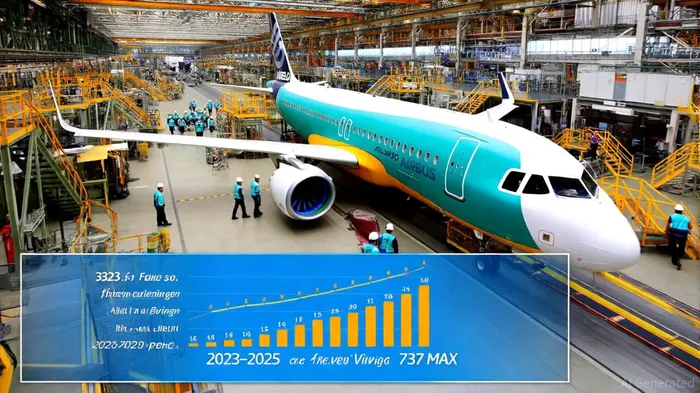
From Q1 2023 to Q2 2025, Airbus delivered 4,100 A320neo family aircraft out of 7,156 total orders, achieving a 36% delivery rate, according to the August 2025 deliveries report. BoeingBA--, by contrast, delivered 2,000 737 MAX aircraft out of 3,235 orders-a 28% rate. In August 2025 alone, Airbus accounted for 47 of its 61 deliveries with the A320neo family, while Boeing managed 42 of 57 deliveries with the 737 MAX. This gap is not merely a short-term fluctuation but a reflection of structural advantages in Airbus's production and supply chain management.
The 737 MAX's grounding from 2019 to 2020 created a trust deficit that Boeing has yet to fully repair. As of late 2025, the 737 MAX backlog remains 45% smaller than the A320neo's, according to a SimpleFlying analysis. Even as Boeing stabilizes production-aiming to reach 42 aircraft per month by 2026-Airbus is targeting 75 A320neos per month by 2027, per Manufacturing Digital. This trajectory suggests Airbus is better positioned to capture market share in the critical narrow-body segment, which accounts for over 70% of global commercial aircraft demand, according to Airbus's Global Market Forecast.
Supply Chain Resilience: Airbus's Strategic Edge
Airbus's ability to maintain production momentum despite engine shortages and coating issues highlights its supply chain resilience. In April 2025, Airbus delivered 40 A320neos-46 in June-despite bottlenecks from CFM International and Pratt & Whitney, according to April 2025 production data. CEO Guillaume Faury has prioritized supplier diversification and proactive risk management, expanding the supply chain team and investing in digital tools to mitigate disruptions, as described in a Forbes profile.
Boeing, meanwhile, continues to grapple with FAA-mandated quality checks and component shortages. Its April 2025 production rate of 31 737 MAX aircraft fell short of the FAA-approved 38 units per month, per the April 2025 production data. Analysts attribute this to lingering regulatory scrutiny and a debt-laden balance sheet that limits reinvestment in supply chain modernization, according to Supply Chain Digital. While Boeing's 777X program and potential China orders offer hope, its near-term challenges-such as fastener shortages and maintenance delays-remain significant headwinds, as highlighted in an IntelliWings analysis.
Investor Sentiment: A Clear Divide
Market sentiment reflects this operational disparity. Airbus has attracted "Buy" ratings from RBC, UBS, and Jefferies, with an average target price of €199.21, according to the MarketScreener consensus. Its stock has outperformed Boeing's in 2025, buoyed by consistent delivery growth and a robust order backlog. Boeing, though rated positively by 16 of 20 analysts, faces skepticism over its debt load and production bottlenecks. A recent report noted that China's potential pivot to Airbus could further erode Boeing's margins in an Investing.com analysis.
The Federal Reserve's rate cuts and AI-driven market optimism have benefited both firms, per the Morningstar market outlook.
Future Outlook: Reallocating Capital for Long-Term Gains
The A320neo's dominance is not a temporary anomaly but a harbinger of long-term industry trends. Airbus's Global Market Forecast projects 25,000 narrow-body aircraft will be needed by 2044, with the A320neo family likely to capture a disproportionate share. Investors should prioritize aerospace firms with:
1. Scalable production capacity (e.g., Airbus's 75-per-month target).
2. Resilient supply chains (e.g., Airbus's supplier diversification).
3. Strong order backlogs (e.g., 7,156 A320neos vs. 3,235 737 MAX).
While Boeing's 737 MAX may regain traction, its historical liabilities-groundings, quality issues, and regulatory overhangs-make it a riskier proposition. For capital seeking stability and growth, Airbus's A320neo family represents a compelling case for reallocation.





Comentarios
Aún no hay comentarios