
Ainos' Expansion into Semiconductor Manufacturing via AI Nose: A New Frontier in AI-Driven FEOL Optimization
The semiconductor industry in 2025 stands at a pivotal inflection point, driven by the convergence of artificial intelligence (AI) and advanced manufacturing. As global demand for chips surges-fueled by AI, cloud computing, and data centers-companies are racing to adopt AI-driven process optimization to maintain competitiveness. While Ainos' recent foray into semiconductor manufacturing via its AI Nose technology remains shrouded in limited public detail, the broader industry's shift toward AI-powered Front-End-of-Line (FEOL) optimization provides a compelling framework to assess its potential disruptive impact.
The AI Revolution in FEOL: A Catalyst for Efficiency
FEOL processes, which involve the intricate fabrication of transistors and interconnects on silicon wafers, have long been a bottleneck for semiconductor manufacturers. Traditional methods rely on manual inspection and iterative trial-and-error, which are costly and time-intensive. However, generative AI and vision foundation models (VFMs) are reshaping this landscape. For instance, NVIDIA's Cosmos Reason, a vision language model (VLM), achieves over 96% accuracy in wafer-level defect classification while enabling semantic reasoning to diagnose root causes. Similarly, NV-DINOv2, an NVIDIANVDA-- VFM, cuts manual annotation requirements by leveraging self-supervised learning, attaining 98.51% accuracy in die-level defect detection. These tools exemplify how AI is not only streamlining defect analysis but also reducing time-to-market for advanced chips.
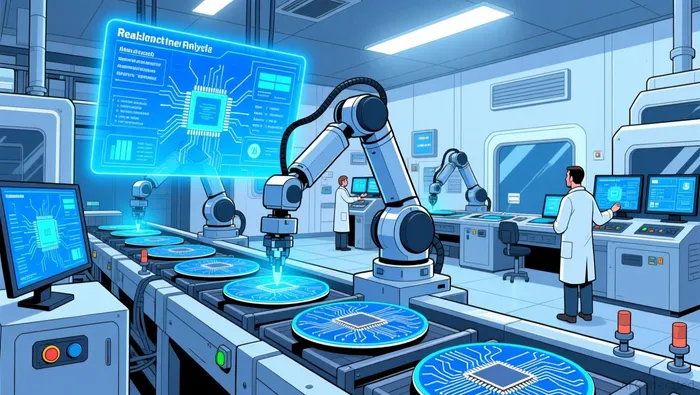
Ainos' AI Nose, though unverified in technical specifics, appears poised to align with this trend. If the company's technology mirrors the capabilities of NVIDIA's tools-such as few-shot learning, real-time anomaly detection, or predictive maintenance-it could address critical pain points in FEOL. For investors, the key question is whether Ainos can replicate or surpass the performance of established AI platforms while offering a cost-effective solution for mid-tier foundries or niche markets.
Industry Momentum and Strategic Imperatives
The semiconductor sector's embrace of AI is not merely speculative. According to a KPMG report, 92% of industry executives anticipate revenue growth in 2025, driven by AI and cloud demand. Leaders like TSMCTSM-- and Intel are already deploying AI across design, manufacturing, and supply chains to mitigate geopolitical risks and rising complexity. For example, AI-powered Electronic Design Automation (EDA) tools have reduced chip design cycles by up to 30%, accelerating time-to-market. This widespread adoption underscores a paradigm shift: AI is no longer a "nice-to-have" but a strategic necessity.
Ainos' entry into this arena, while unpublicized, could capitalize on gaps in the market. Smaller foundries and emerging players often lack the infrastructure to deploy high-end AI solutions like NVIDIA's. If AI Nose is tailored for accessibility-offering modular, scalable AI tools with lower upfront costs-it could disrupt the FEOL optimization space. However, without concrete data on Ainos' technical roadmap or partnerships, such speculation remains cautious.
Risks and Realities: Talent, Geopolitics, and Validation
Despite the optimism, challenges persist. The KPMG report highlights talent shortages as a critical headwind, with 78% of executives citing skill gaps in AI integration. Ainos' success will hinge on its ability to attract expertise in both semiconductor engineering and AI model training. Additionally, geopolitical tensions-such as export controls on advanced manufacturing equipment-could constrain Ainos' global reach, particularly if its technology relies on U.S.- or EU-based supply chains.
Another risk lies in validation. NVIDIA's tools have been rigorously tested in industry settings, but Ainos' AI Nose lacks peer-reviewed benchmarks or third-party case studies. Until the company publishes performance metrics or secures partnerships with foundries, skepticism about its efficacy may linger.
Investment Implications: A Calculated Bet on AI's Next Frontier
For investors, Ainos represents a high-risk, high-reward proposition. The semiconductor AI optimization market is projected to grow at a double-digit CAGR through 2030, driven by the need for yield improvement and cost reduction. If Ainos' AI Nose gains traction-even as a niche player-it could capture a segment of this expanding pie. However, the absence of detailed disclosures necessitates a cautious approach.
Ainos' potential should be evaluated alongside broader industry trends. Companies that successfully integrate AI into FEOL, such as those leveraging NVIDIA's TAO Toolkit for custom model training, are already outpacing competitors. Ainos' ability to differentiate itself-through proprietary algorithms, domain-specific training data, or strategic alliances-will determine its long-term viability.
Conclusion
The semiconductor industry's AI-driven transformation is undeniable, with FEOL optimization emerging as a linchpin of competitive advantage. While Ainos' AI Nose remains an enigma in terms of technical specifics, the company's alignment with this megatrend positions it as a candidate to disrupt traditional manufacturing paradigms. For investors, the path forward requires balancing optimism about AI's potential with scrutiny of Ainos' execution risks. As the line between AI innovation and industrial application blurs, the winners will be those who bridge the gap between cutting-edge technology and real-world scalability.





Comentarios
Aún no hay comentarios