
"Can AI Make Work Optional? Musk's Vision Divides Experts"
Tesla CEO Elon Musk has reignited debates about the future of labor and currency, predicting that artificial intelligence and robotics could render work optional within 10 to 20 years and eliminate the need for money altogether. Speaking at the U.S.-Saudi Investment Forum in Washington, D.C., Musk likened future work to hobbies like playing sports or gardening, emphasizing that automation would shift employment from necessity to choice.
Musk's vision hinges on rapid advancements in AI and humanoid robotics, particularly through Tesla's Optimus project. He argued that these technologies could eliminate poverty by drastically reducing the cost of goods and services, stating, "There is basically one way to make everyone wealthy, and that is AI and robotics." The TeslaTSLA-- Bot, currently in development, is central to this ambition, with Musk claiming it could outpace even smartphones in global adoption according to Musk.
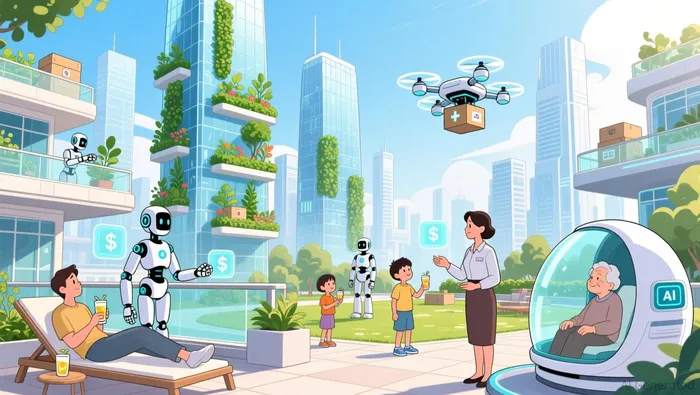
While Musk's optimism is rooted in speculative fiction-such as Iain M. Banks' post-scarcity "Culture" series-economists and industry experts remain skeptical. Ioana Marinescu, an economist at the University of Pennsylvania, highlighted the challenges of scaling robotics, noting that while AI costs are declining, physical automation remains expensive and specialized. She questioned whether Musk's timeline aligns with historical trends of diminishing returns in technological adoption.
The economic implications of a work-optional society also raise complex questions. Samuel Solomon, a labor economist at Temple University, emphasized the need for universal basic income or similar systems to sustain a post-labor economy. Musk, however, has avoided detailing how such a system would function, instead referencing "universal high income" as a byproduct of AI-driven productivity.
Critics also point to growing inequality in the AI boom. Despite Musk's $1 trillion pay package and Tesla's focus on robotics, wealth concentration remains a concern. Apollo Economics' Torsten Slok noted that AI-driven gains are disproportionately benefiting the "Magnificent 7" tech giants, while broader S&P 500 companies face earnings declines.
Philosophical challenges accompany the technological ones. Anton Korinek, an AI economics expert at the University of Virginia, warned that a post-labor world could erode societal structures tied to work, such as meaningful relationships. Musk acknowledged this existential shift, suggesting humans might find purpose by "giving AI meaning."
Despite skepticism, Musk's influence underscores a broader industry shift. Nvidia CEO Jensen Huang, also at the forum, noted AI's potential to transform fields like radiology, where AI tools are already enabling doctors to analyze more data and improve diagnoses. Meanwhile, companies like UiPath and C3.ai are navigating AI's disruptive potential, with mixed success in enterprise adoption according to market analysis.
Musk's predictions, however, face practical hurdles. Tesla's Optimus project has faced production delays, and scaling humanoid robots to replace human labor remains unproven. Additionally, regulatory scrutiny of AI's societal impact - exemplified by U.S. antitrust investigations into Nvidia's market dominance - could slow progress.
As the AI race accelerates, Musk's vision serves as both a rallying cry and a cautionary tale. While his bold claims capture imaginations, the path to a work-optional future remains fraught with technical, economic, and ethical challenges.





Comentarios
Aún no hay comentarios