
The AI Valuation Paradox: Bubble or Sustainable Innovation?
The artificial intelligence sector has become a focal point of both optimism and skepticism in 2025. With valuations soaring to unprecedented levels-LLM vendors trading at 44.1x revenue and startups like Harvey securing $600 million in funding despite unproven ROI-the industry mirrors patterns seen during the dot-com bubble of the late 1990s, according to a valuation benchmarks report. Yet, unlike the speculative frenzy of the past, today's AI market is underpinned by tangible infrastructure and enterprise adoption. This duality raises a critical question: Are current valuations a sustainable reflection of AI's transformative potential, or are we witnessing another overinflated bubble?
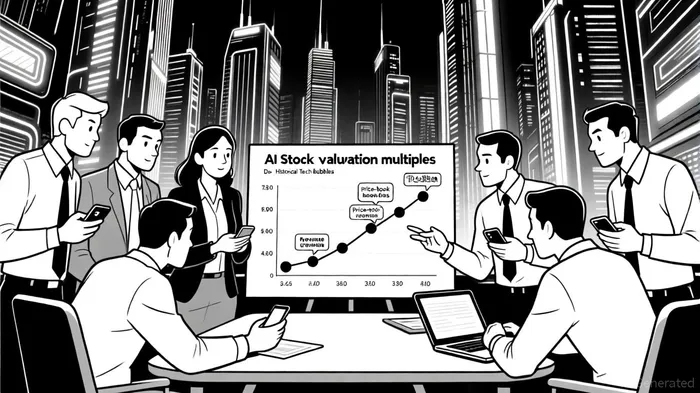
Historical Parallels and Divergences
The parallels between the AI boom and the dot-com era are striking. In both cases, speculative investment outpaced fundamental metrics. The S&P's price-to-book ratio has now surpassed historical bubble peaks, a red flag reminiscent of 2000, as noted in a Forbes analysis. Similarly, global AI infrastructure spending hit $252.3 billion in 2024, with companies like MetaMETA-- and MicrosoftMSFT-- building data centers at a scale that risks replicating the "dark fiber" overinvestment of the 1990s, according to Fortune reporting.
However, key differences exist. Unlike the dot-com era, where many firms had no revenue, today's AI leaders-such as Microsoft's Azure cloud division-are generating substantial income, with a $86 billion annualized run rate, Fortune notes. Additionally, AI-driven SaaS platforms and infrastructure tools often operate with recurring revenue models and high gross margins, offering a more defensible basis for valuation than the traffic-based metrics of the past, as argued in the Forbes analysis.
Fundamental Misalignment and Investor Reassessment
Despite these strengths, a significant misalignment between valuation and fundamentals persists. A recent MIT study found that 95% of generative AI projects fail to deliver measurable returns, a point highlighted by Forbes, while Fortune notes that AI-related revenue remains far below infrastructure costs. This disconnect has triggered a market recalibration: major AI firms have seen valuations correct by 20–40% in 2025 as investors demand clearer ROI, according to the Finrofca report.
The funding stage also reveals troubling trends. Seed-stage AI startups command average multiples of 22.7x revenue, while Series B rounds peak at 41.0x-far exceeding historical averages for non-AI tech firms, per the Finrofca analysis. Such premiums reflect a market prioritizing strategic positioning over profitability, a hallmark of speculative bubbles.
The Path Forward: Innovation vs. Overcorrection
The current phase is best described as a "market reset" rather than a collapse. Nvidia's sustained revenue growth and enterprise adoption of AI tools like Figma's SaaS platform demonstrate the technology's genuine value, a theme emphasized in the Forbes piece. Yet, the risk of overcorrection looms. If infrastructure investments outstrip demand-akin to the dot-com era's unused fiber networks-the sector could face prolonged stagnation, as the Fortune article warns.
Investors must now distinguish between AI firms with scalable, revenue-generating applications and those relying on hype. For example, vertical AI startups in fintech and legal tech trade at 8x revenue multiples, reflecting cautious optimism in the Finrofca report, while infrastructure leaders like OpenAI and Anthropic remain valued on long-term dominance rather than near-term earnings, according to the Forbes analysis.
Conclusion
The AI sector's valuation dynamics encapsulate both the promise and peril of transformative technologies. While historical patterns suggest a high likelihood of overvaluation, the presence of recurring revenue models and enterprise adoption provides a buffer against total collapse. For now, the market is sifting hype from substance-a process that will determine whether AI becomes the next SaaS revolution or the next dot-com cautionary tale.





Comentarios
Aún no hay comentarios