
AI's New Titans: Why Nvidia and OpenAI Dominate the 2025 Company of the Year Race
The AI landscape in 2025 is defined by two titans: Nvidia and OpenAI. Together, they have redefined the boundaries of artificial intelligence, leveraging strategic infrastructure dominance and ecosystem control to cement their positions as the industry's most influential players. As the global AI infrastructure market surges toward a $1 trillion valuation by late 2025, these companies have not only capitalized on the boom but also engineered the very systems that will power the next decade of innovation.
Nvidia's Strategic Infrastructure Dominance
Nvidia's ascent to AI supremacy is rooted in its ability to monetize the entire stack-from chips to data centers. The company's $100 billion letter of intent with OpenAI, covering 10 gigawatts of computing power, exemplifies its strategy of locking in long-term demand for its GPUs while co-optimizing hardware and software roadmaps. This partnership, set to deliver the first gigawatt on the NVIDIA Vera Rubin platform by mid-2026, underscores Nvidia's role as the de facto infrastructure provider for cutting-edge AI models.
Beyond OpenAI, NvidiaNVDA-- has diversified its ecosystem influence through strategic equity stakes. Investments in CoreWeave and Crusoe ensure a steady pipeline of GPU demand, while illustrates its broader vision of a self-sustaining AI infrastructure loop. This circular model-where investments generate both capital appreciation and recurring revenue-has fueled Nvidia's record Q3 2025 revenue of $57 billion, surpassing Wall Street expectations. CEO Jensen Huang has highlighted a half-trillion-dollar sales pipeline for 2025–2026, signaling confidence in sustained demand.
OpenAI's Ecosystem Expansion
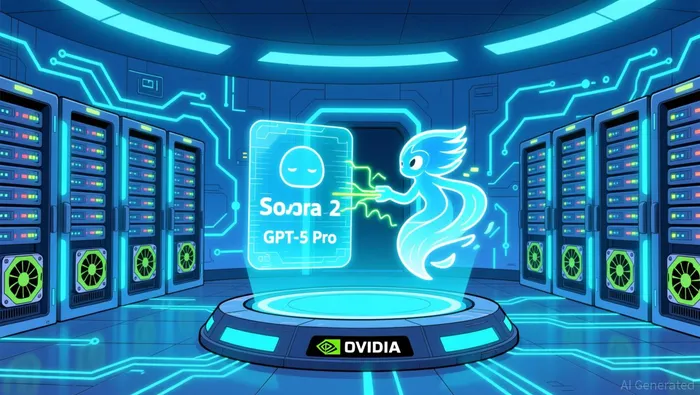
While Nvidia dominates the hardware layer, OpenAI has redefined the software and developer ecosystem. At its 2025 Dev Day, OpenAI unveiled GPT-5 Pro, a model tailored for high-stakes industries like finance and healthcare, alongside gpt-realtime mini, a cost-effective voice model that reduces latency for interactive applications. These launches, paired with Sora 2-a next-generation audio/video generation tool-position OpenAI as the go-to platform for enterprises seeking multimodal AI capabilities.
 OpenAI's developer push extends beyond models. The AgentKit toolkit, designed to streamline AI agent development, includes tools like Agent Builder and ChatKit, lowering barriers for enterprises to deploy autonomous workflows. Meanwhile, partnerships with Shopify and Etsy to enable in-chat purchases within ChatGPT signal a strategic pivot toward AI-driven e-commerce, reshaping how consumers interact with digital marketplaces.
The Symbiotic Relationship Between Nvidia and OpenAI
The collaboration between Nvidia and OpenAI is not merely transactional-it is symbiotic. By securing 10 gigawatts of computing power from Nvidia, OpenAI gains the infrastructure to scale its models globally, while Nvidia benefits from guaranteed demand and co-optimization of its hardware. This dynamic is mirrored in OpenAI's parallel partnership with AMD, which includes 6 gigawatts of GPU-based compute and warrants for up to 160 million AMD shares. Such diversification allows OpenAI to hedge against vendor lock-in while giving AMD a stake in its success.
However, these interdependencies raise concerns about circular investing-a term coined by analysts to describe how interconnected financial and infrastructural commitments may inflate valuations. For instance, OpenAI's $1.4 trillion data center buildout over eight years relies heavily on partnerships with companies like Nvidia and AMD, which in turn depend on OpenAI's demand to justify their own valuations. This creates a feedback loop that could destabilize if AI adoption slows.
Risks and Market Realities
Despite their dominance, both companies face headwinds. OpenAI's cash burn-projected to continue until 2030-raises questions about its long-term sustainability, particularly as it competes with well-funded rivals like Google and Amazon. Meanwhile, Nvidia's circular financing model, while profitable, could backfire if the AI infrastructure market experiences a correction in 2026. Analysts warn that overbuilding data centers and underutilized GPUs could lead to a market reset, forcing companies to scale back ambitions.
AMD's aggressive strategy-offering OpenAI a potential 10% stake in exchange for 6 gigawatts of compute-also highlights the competitive pressure on Nvidia. While AMD's move is a clever gambit, it underscores the fragility of Nvidia's dominance in a market where alternatives are emerging.
Conclusion: Titans of a New Era
Nvidia and OpenAI have redefined the AI landscape in 2025 through strategic infrastructure control and ecosystem expansion. Their partnerships, financial performance, and developer tools position them as the twin pillars of the AI economy. Yet, investors must remain cautious. The interplay between circular investing, sustainability risks, and competitive pressures could reshape the industry by 2026. For now, however, these two entities stand unchallenged as the architects of AI's next frontier.





Comentarios
Aún no hay comentarios