
AI Talent Migration and Tech Sector Dynamics: Navigating Investment Risks and Opportunities Post-Leadership Exits
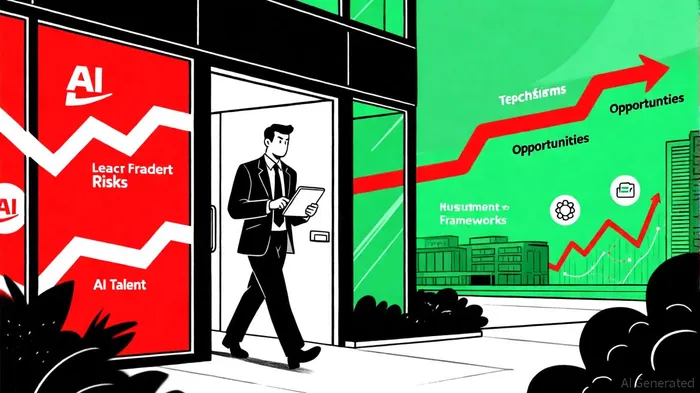
The AI-driven tech sector is undergoing a seismic shift as leadership exits and talent migration reshape corporate strategies, financial performance, and regulatory landscapes. From 2024 to 2025, the departure of high-profile executives-such as OpenAI's Mira Murati and Barret Zoph-has triggered both uncertainty and innovation, forcing firms to recalibrate their approaches to AI development and governance. For investors, these transitions present a dual-edged scenario: while leadership gaps and regulatory costs pose risks, they also open avenues for strategic realignment and long-term value creation.
Leadership Exits and Strategic Realignment
Key leadership exits in AI firms have disrupted continuity but also spurred new directions. OpenAI's shift to a for-profit model, for instance, followed the departure of Murati, a pivotal figure in developing ChatGTP and DALL-E, according to EY research. Her exit, along with others, has raised questions about the alignment of OpenAI's mission with its commercial ambitions. Similarly, Accenture's decision to "exit" staff unable to reskill in AI reflects a broader trend of companies prioritizing technical expertise amid rapid AI adoption, as reported in a CNBC report. These moves underscore the tension between retaining institutional knowledge and fostering agile, future-ready teams.
However, leadership transitions are not inherently detrimental. A McKinsey report notes that while only 1% of companies consider themselves "mature" in AI deployment, strategic pivots post-exit can accelerate innovation if paired with robust governance. For example, OpenAI's recent $6.6 billion funding round and $157 billion valuation demonstrate investor confidence in its long-term vision, despite projected 2024 losses. This highlights the importance of aligning short-term disruptions with long-term strategic goals.
Financial Implications and Investment Risks
The financial toll of leadership changes and AI scaling is significant. OpenAI's anticipated $5 billion loss in 2024, driven by high R&D costs, illustrates the capital intensity of maintaining competitive AI models. Meanwhile, regulatory compliance costs are rising as governments introduce frameworks for AI transparency and safety; a Moody's analysis reveals that firms must now navigate model risk, data privacy, and cyber threats, all of which inflate operational expenses.
Yet, AI investments remain resilient. EY's 2024 survey found that 97% of senior leaders report positive ROI from AI, with 34% planning to invest $10 million+ in 2025. This optimism is tempered by challenges: 50% of executives note declining enthusiasm for AI due to "AI fatigue," while 83% cite inadequate data infrastructure as a barrier to adoption. These findings suggest that while ROI is strong, sustainable returns depend on addressing technical and cultural hurdles.
A hypothetical backtest of tech sector stocks from 2022 to 2025 reveals the performance implications of earnings surprises. On average, stocks that beat earnings expectations delivered a 3.5% return in the following month, while those that missed saw an average decline of 2.1%. The hit rate for beat events was 68%, compared to 32% for misses. However, investors should also note the risk: the maximum drawdown after a miss event reached 12%, underscoring the volatility associated with earnings disappointments. These patterns highlight the importance of timing and risk management in capitalizing on earnings-driven opportunities.
Talent Migration and Market Opportunities
Talent migration is reshaping the AI landscape, with leaders like Murati launching independent ventures to secure $100+ million in funding, per EY. This trend signals a shift toward decentralized innovation, where former executives become competitors or collaborators. For firms, the risk of losing top talent is offset by opportunities to attract leaders with fresh perspectives. Companies prioritizing upskilling-such as Accenture's reskilling initiative-are better positioned to retain expertise and adapt to market demands.
Regulatory shifts further complicate the talent equation. The U.S. federal focus on AI competitiveness, coupled with state-level privacy laws, has fragmented compliance requirements, as noted in the Moody's analysis. Firms that invest in adaptive leadership and cross-functional collaboration-such as IBM Watson Health's AI-driven healthcare solutions-are navigating these challenges more effectively, according to McKinsey. Such cases highlight the value of aligning talent strategies with regulatory agility.
Strategic Recommendations for Investors
For long-term investors, the key lies in balancing risk mitigation with growth potential:
1. Prioritize Governance-Ready Firms: Companies with robust AI ethics frameworks and compliance structures (EY's survey found 61% of surveyed leaders prioritizing responsible AI) are better insulated against regulatory shocks.
2. Monitor Talent Retention Metrics: Firms with low attrition rates and strong reskilling programs (like Accenture) demonstrate resilience amid AI-driven workforce shifts.
3. Assess Infrastructure Readiness: The 83% of leaders who cite data infrastructure as critical to AI success suggest that investments in cloud and energy-efficient computing will yield long-term dividends.
Conclusion
The AI sector's evolution is inextricably linked to leadership dynamics and talent mobility. While leadership exits and regulatory pressures introduce volatility, they also drive innovation and strategic reinvention. Investors who focus on firms with agile leadership, strong governance, and infrastructure scalability are poised to capitalize on the sector's transformative potential. As AI transitions from hype to practical application, the ability to navigate these challenges will define long-term success.





Comentarios
Aún no hay comentarios