
The AI Supercycle: Navigating the Bubble Risks and Seizing Long-Term Opportunities
The Infrastructure Boom: A New Era of Compute Demand
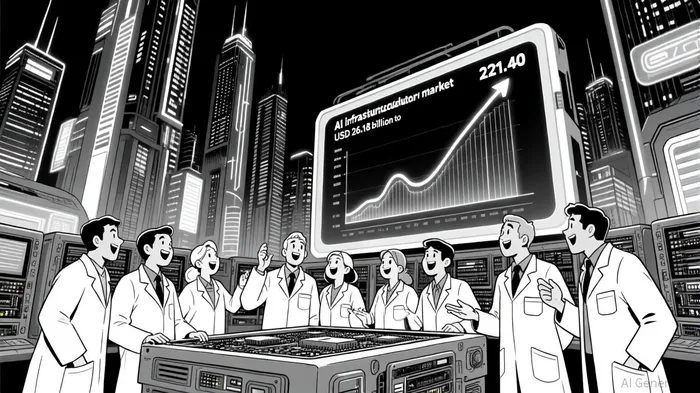
The heart of the AI supercycle lies in the semiconductor industry's transformation. Global semiconductor revenue is projected to hit USD 800 billion in 2025, according to an IDC report, fueled by AI's insatiable hunger for compute power. Datacenter semiconductors alone are expected to grow from USD 209 billion in 2024 to USD 492 billion by 2030, the World Economic Forum projects, with GPUs dominating the market. Networking chips-such as high-capacity Ethernet switches and SmartNICs-are enabling AI training and inference at unprecedented scales, the IDC report adds.
This growth is not just theoretical. Hyperscalers like MicrosoftMSFT-- and AmazonAMZN-- are investing heavily in GPU-rich clusters, while industrial robotics and edge AI adoption are creating localized infrastructure demand, as Forbes also notes. The result? A self-reinforcing cycle where AI applications drive hardware demand, and hardware innovation fuels new AI capabilities.
Bubble Risks: The Fragile Foundation of the AI Boom
Despite the optimism, cracks in the foundation are emerging. A report by Forbes highlights a projected USD 1.5 trillion in debt for AI data centers by 2028, coupled with a 95% failure rate for enterprise AI pilot projects. This suggests a sector where capital is flowing faster than practical applications can justify. Arm Holdings, a key player in AI-specific chips, trades at over 90x forward earnings, while the median price-to-sales ratio for AI-focused companies exceeds levels seen during the dot-com bubble, according to a WRAL Markets article.
The risks are compounded by the sector's reliance on speculative capital. Tech giants like NvidiaNVDA--, Microsoft, and Amazon are driving valuations upward through aggressive spending, but a slowdown in their capital expenditures could trigger a market correction, the World Economic Forum warns. OpenAI's financial dependency on continuous funding further underscores the fragility of the ecosystem. As the World Economic Forum notes, this is less a "bubble" and more a "fragile boom," critically dependent on sustained AI-driven demand.
Strategic Positioning: Balancing Growth and Risk
For investors, the challenge lies in distinguishing between long-term value and speculative hype. Here's how to navigate the AI supercycle strategically:
Prioritize Infrastructure Over Software: While AI applications capture headlines, the real long-term winners will be companies enabling the underlying infrastructure. Firms specializing in energy-efficient semiconductors, AI-optimized accelerators, and edge computing hardware are better positioned to weather volatility, a Precedence Research report argues.
Diversify Within the AI Stack: Avoid overconcentration in overvalued AI software firms. Instead, allocate capital across the AI stack-semiconductors, datacenter networking, and AI-as-a-Service platforms-to balance growth and stability, the IDC report advises.
Hedge Against Overvaluation: Use derivatives or short positions to hedge against speculative excess in AI stocks. For example, shorting overvalued AI software firms while going long on undervalued semiconductor manufacturers could generate alpha in a correction, a WRAL Markets article suggests.
Monitor Energy and Efficiency Trends: AI's future hinges on power efficiency. Companies leveraging AI algorithms to optimize semiconductor energy consumption-such as those implementing dynamic power management strategies-will gain a competitive edge, the Precedence Research report notes.
Conclusion: The AI Supercycle's Dual Edge
The AI supercycle presents a paradox: unprecedented growth potential alongside acute valuation risks. For investors, the key is to embrace the former while mitigating the latter. By focusing on infrastructure innovation, diversifying across the AI stack, and hedging against speculative excess, strategic investors can position themselves to thrive in this transformative era.
As the market evolves, one truth remains: The AI revolution is here to stay. The question is not whether it will succeed, but who will profit most from its inevitable twists and turns.





Comentarios
Aún no hay comentarios