
AI Struggles Fuel Market Volatility as Robot Realities Test Investor Confidence
Article with URL markers
Robots are proving they aren't so different from people, according to an executive in the autonomous delivery sector. MJ Burk Chun, co-founder and vice president of product design at Serve RoboticsSERV--, described how AI-powered robots face similar challenges as humans-like being confused by baby goats and scared of cars according to Chun. These struggles highlight the complexity of navigating real-world environments, where unpredictable variables often test the limits of AI. The insights came during a presentation at the Fortune Brainstorm AI conference, where robot behavior was likened to human experience.
The discussion comes as companies in the AI space face growing scrutiny over performance and value. C3AI--.ai Inc., for example, saw its stock slip 4.10% to $14.02 on Tuesday, underperforming even as broader markets edged upward. The decline ended a two-day winning streak and left the stock 63.66% below its 52-week high. Meanwhile, competitors like Microsoft and Alphabet posted gains, showing the sector is far from uniformly buoyant.
SoundHound AI, another AI player, is also under the microscope. With multiple reports analyzing its stock potential, the company is facing mixed investor sentiment. While some analysts remain bullish on its future, recent volatility and questions about its long-term growth trajectory are prompting caution. The stock has seen both optimistic forecasts and warnings of a potential AI bubble, adding to the uncertainty.
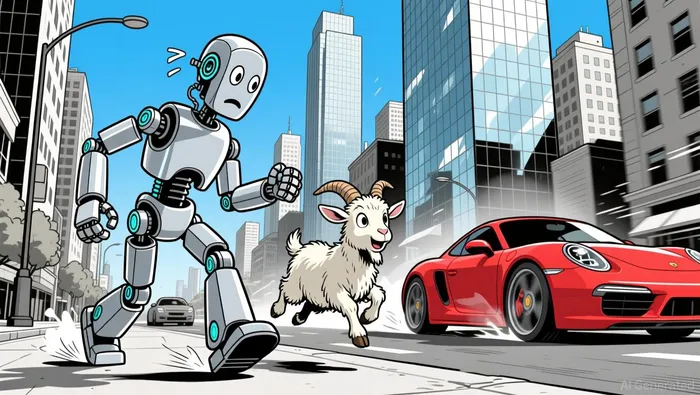
How AI Struggles in the Real World
Burk Chun emphasized the challenges robots face when transitioning from controlled simulations to the unpredictable real world. During a deployment in Los Angeles, robots encountered a "long tail problem" when confronted with a baby goat, an animal not accounted for in typical training data. This highlights the limitations of AI in unpredictable, real-time settings. Just as humans adapt to the unexpected, robots must learn to do the same, albeit with algorithms rather than instincts.
These issues are compounded by the high-speed environments of city streets. Robots, like humans, must calculate the risks of sharing space with vehicles, leading to what Burk Chun described as "nightmares about cars." The AI systems must constantly assess potential threats, a task that is both computationally demanding and socially sensitive as robots navigate public acceptance.
Market Reactions and Investor Sentiment
The market reaction to AI companies varies significantly. C3.ai's recent underperformance contrasts with the relative resilience of SoundHound AISOUN--, which continues to draw both optimistic forecasts and cautionary assessments. Analysts from Motley Fool, TipRanks, and Zacks have all weighed in, with some predicting SoundHoundSOUN-- could reach $20 by 2030. Others, however, warn of the growing risks of an AI bubble.
Meanwhile, C3.ai's stock struggles have raised questions about its competitive positioning. The company faces stiff competition from Palantir and other AI firms, each vying for dominance in enterprise applications. Investors are watching to see if C3.ai can regain its footing or if it will continue to lag behind its peers. The broader AI sector remains a mixed bag, with some companies thriving while others face mounting headwinds.
Risks to the AI Outlook
Despite the excitement around AI, several risks loom large. One major concern is the growing number of companies overvaluing their AI potential. As seen with SoundHound AI, there is a fine line between optimism and hype according to market analysis. This uncertainty is mirrored in the market, where investors are beginning to question whether some AI stocks are overpriced. The fear is that a correction could be on the horizon, especially if growth expectations fail to materialize.
Another risk lies in the technical challenges of AI deployment. Serve Robotics' experience with baby goats and traffic nightmares underscores the difficulty of scaling AI in real-world settings. These challenges are not unique to one company but represent a broader issue facing the industry. As AI systems become more advanced, they will need to handle increasingly complex scenarios-something that will require significant investment and innovation.
What This Means for Investors
For investors, the AI landscape is both promising and perilous. Companies like SoundHound AI and C3.ai represent two different approaches to the market-one focused on enterprise growth and the other on voice and automation according to industry analysis. SoundHound's restaurant-focused AI has shown durability, but it remains to be seen whether it can continue to drive growth as newer verticals emerge.
Meanwhile, investors must weigh the long-term potential of AI against the short-term volatility and risk of overvaluation. The recent performance of AI stocks has been mixed, with some showing strong support and others struggling to gain traction. As the industry evolves, it will be critical for companies to demonstrate real-world value, not just technical prowess. For now, the path forward remains uncertain, with both opportunities and obstacles lying ahead.





Comentarios
Aún no hay comentarios