
Why AI Is a Structural Growth Engine, Not a Bubble
Productivity Gains: A Decade-Long Tailwind
According to a report by the Dallas Fed, AI could boost annual productivity growth by 0.3 to 3.0 percentage points over the next decade, with a median estimate of 1.5% Advances in AI will boost productivity, living standards over .... This aligns with broader projections from the Penn Wharton Budget Model (PWBM), which forecast AI-driven productivity and GDP growth of 1.5% by 2035, 3% by 2055, and 3.7% by 2075, PWBM projections. These figures are not speculative conjecture but empirical extrapolations based on current adoption rates and sector-specific use cases.
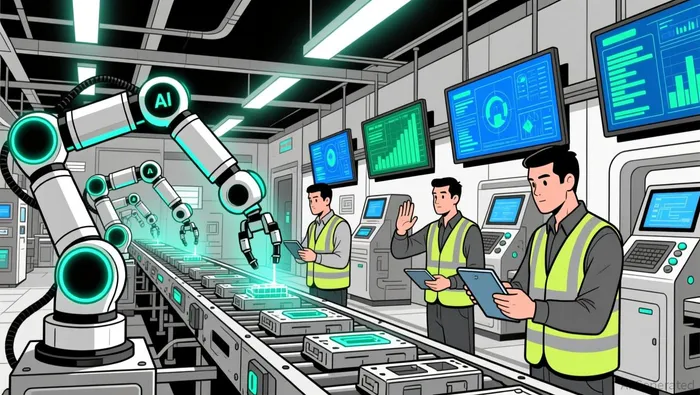
For instance, in software development, AI coding assistants have already demonstrated a 26% productivity lift for developers, with even greater gains for less experienced workers, BNP Paribas literature review. Similarly, AI-driven process optimization in manufacturing has reduced off-spec production by 50%, while increasing output by 10–15% and EBITA by 4–5%, AI for Process Optimization Market. These metrics underscore AI's role as a force multiplier, not a one-time disruption.
Capital Allocation: A New Paradigm
The AI boom is not merely a technological shift but a reconfiguration of global capital flows. The AI for process optimization market, valued at $3.8 billion in 2024, is projected to surge to $113.1 billion by 2034, growing at a 40.4% CAGR, AI for Process Optimization Market. This trajectory reflects sustained investment in AI infrastructure, from cloud computing to specialized semiconductors.
Leading this charge are companies like NVIDIA, Apple, and MicrosoftMSFT--, whose stock trends mirror the accelerating demand for AI hardware and software. These firms are not just beneficiaries of a speculative frenzy-they are enablers of a productivity revolution. For example, NVIDIA's GPUs power AI training models across industries, while Microsoft's Azure and Apple's M-series chips underpin enterprise and consumer AI adoption.
The IMF has emphasized that realizing AI's productivity potential requires significant investment in physical and human capital, BNP Paribas literature review. This creates a virtuous cycle: capital allocated to AI infrastructure generates returns through efficiency gains, which in turn fund further innovation. Unlike past bubbles, where value creation was illusory, AI's impact is quantifiable and compounding.
Sectoral Rebalancing and Long-Term Dynamics
AI's structural impact is uneven but transformative. High-earning professions like programming and engineering are seeing productivity surges, while routine tasks across sectors are being automated, BNP Paribas literature review. This reconfiguration is not job destruction but task reallocation-humans and machines are becoming complementary, not adversarial.
However, the benefits are not evenly distributed. Small and medium enterprises (SMEs) face barriers to adoption due to high upfront costs, BNP Paribas literature review, creating a concentration risk in AI-driven growth. This underscores the need for policy interventions to democratize access, but it also highlights the long-term nature of AI's diffusion. Unlike the dot-com bubble, where overinvestment collapsed within years, AI's growth curve is measured in decades.
Conclusion: Beyond the Bubble Narrative
To dismiss AI as a bubble is to misunderstand its economic mechanics. Bubbles are characterized by speculative excess and sudden collapse; AI, by contrast, is a durable force driving productivity, innovation, and capital reallocation. The evidence-from Dallas Fed projections to market growth figures-confirms that AI is not a passing trend but a structural shift. For investors, this means prioritizing long-term horizons and sectoral leaders positioned to capitalize on AI's compounding effects.





Comentarios
Aún no hay comentarios