
The AI Semiconductor Duopoly: Assessing Nvidia and AMD's Strategic Advantages in 2025-2026
The global AI semiconductor market has entered a pivotal phase, with NvidiaNVDA-- and AMDAMD-- locked in a high-stakes race to define the next era of artificial intelligence. As of Q3 2025, the semiconductor industry surpassed $200 billion in revenue, with Nvidia dominating the data center GPU segment and AMD accelerating its challenge through aggressive product innovation and strategic partnerships. This analysis examines how their contrasting approaches to hardware, software ecosystems, and R&D spending are shaping market sentiment and stock performance.
Market Dynamics: Nvidia's Dominance and AMD's Ascent
Nvidia's Q3 2025 results underscore its commanding position in the AI semiconductor landscape. The company reported $57.0 billion in revenue, with data center revenue alone reaching $51.2 billion-up 66% year-over-year- driven by demand for its Blackwell AI accelerators and CUDA platform. This performance reflects a 62% year-over-year revenue surge, cementing its role as the primary supplier for hyperscalers and cloud providers. In contrast, AMD's Q3 revenue of $9.2 billion (a 36% YoY increase) highlights its growing relevance, particularly in data centers, where its 5th Gen EPYC processors and Instinct MI350 GPUs contributed $4.3 billion. While Nvidia's data center revenue dwarfs AMD's, the latter's growth rate signals a narrowing gap in a market projected to expand further in 2026.
Strategic Innovation: Blackwell, Rubin, and the Race for Efficiency
Nvidia's strategic advantage lies in its relentless innovation cadence. The Blackwell architecture, introduced in 2025, delivers a 10x improvement in tokens per watt compared to prior generations, directly addressing the energy and cost constraints of large-scale AI training. The company is already pre-announcing its next-generation Rubin architecture, expected to debut in 2026 with a 4x efficiency leap over Blackwell. This forward-looking roadmap, combined with $12.9 billion in 2025 R&D spending-a 48.86% increase from 2024-ensures Nvidia maintains a technological lead.
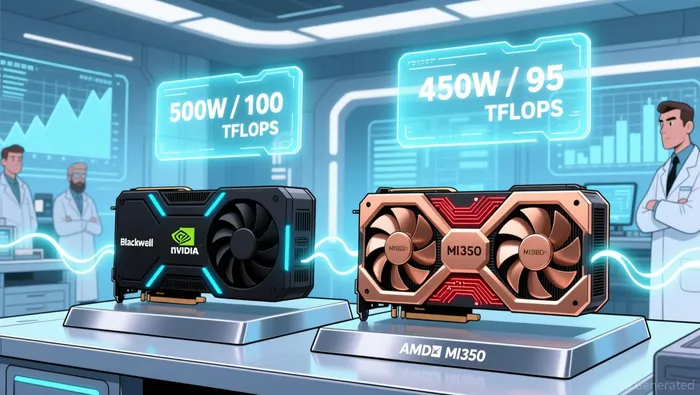
AMD, meanwhile, is leveraging its Instinct line of accelerators, including the MI350 and upcoming MI450, to target hyperscalers like Meta and Microsoft. Analysts project that AMD's MI450, set for a 2026 launch, could bring it closer to parity with Nvidia in performance-per-dollar metrics. However, while AMD's R&D investments are robust, its roadmap lacks the same level of pre-announcement and ecosystem integration as Nvidia's, creating a generational gap in both hardware and software maturity.
Software Ecosystems: CUDA's Moat vs. ROCm's Open-Source Push
The battle for AI dominance extends beyond silicon. Nvidia's CUDA platform remains the de facto standard for AI development, with deep integration into frameworks like TensorFlow and PyTorch. This ecosystem lock-in has created a "moat" that sustains developer loyalty and reinforces Nvidia's market share. Analysts estimate Nvidia controls 80–90% of the data center GPU market, a position bolstered by CUDA's maturity and the company's strategic control over advanced manufacturing nodes like TSMC's CoWoS.
AMD is countering with its open-source ROCm platform, aiming to reduce vendor lock-in and attract developers seeking alternatives. While ROCm has gained traction, its ecosystem remains less mature than CUDA, limiting its ability to fully disrupt Nvidia's dominance. For now, AMD's cost-effective offerings-particularly in inference workloads-appeal to price-sensitive enterprises, but widespread adoption of ROCm will require time and broader industry adoption.
Market Sentiment and Stock Performance: A Tale of Two Trajectories
Investor sentiment reflects diverging trajectories for the two companies. Nvidia's stock has surged on the back of its record revenue and leadership in AI infrastructure, with a projected 2025 revenue of $130.5 billion and a $4 trillion market valuation. However, analysts caution that rising competition and cloud providers' custom silicon (e.g., Meta's MTI) could erode margins in the long term.
AMD, on the other hand, is positioned for explosive growth in 2026. With its MI350 and MI450 chips gaining traction, the company is projected to see quarterly revenue exceed $50 billion in H2 2026-a 400% increase from Q3 2025. This growth, coupled with strategic partnerships (e.g., OpenAI, Alibaba), has fueled optimism that AMD could outpace Nvidia in earnings growth and capture a larger share of the inference market.
Conclusion: Balancing Short-Term Momentum and Long-Term Risks
Nvidia's dominance in AI semiconductors is underpinned by its unparalleled innovation, ecosystem strength, and financial scale. However, AMD's aggressive product roadmap and cost advantages position it as a credible challenger, particularly in markets prioritizing price-performance trade-offs. For investors, the key differentiator lies in the evolution of software ecosystems and the pace of adoption for open-source alternatives like ROCm. While Nvidia's stock remains a bellwether for the AI revolution, AMD's potential for outsized growth in 2026 offers a compelling counterpoint in a market poised for transformation.





Comentarios
Aún no hay comentarios