
The AI Sell-Off: Rotation or Correction?
The recent volatility in AI stocks has sparked a critical debate among investors: Is this a temporary correction driven by profit-taking, or a broader strategic rotation toward value sectors? As the S&P 500 reorients itself in late 2025, the evidence increasingly points to the latter. A shift in capital from speculative AI-driven growth narratives to sectors with tangible cash flows and earnings visibility is reshaping market dynamics, signaling a maturing investor mindset rather than a fleeting market overreaction.
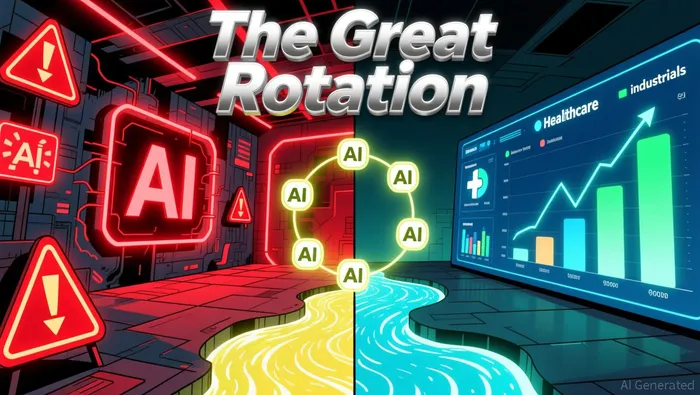
The Great Rotation: From AI to Value
According to a report by , the S&P 500 has witnessed a pronounced reallocation of capital out of high-flying AI stocks and into traditional sectors such as financials, industrials, and healthcare. This "Great Rotation" reflects investor concerns over stretched fundamentals in the technology sector, particularly as companies like OracleORCL-- and NvidiaNVDA-- face scrutiny over capital expenditures and margin sustainability as research shows. For instance, Oracle's recent earnings miss triggered a broader selloff in AI-linked stocks, with analysts noting that the market is now demanding "concrete evidence of profitability" rather than speculative growth stories as cited in a report.
The shift is not arbitrary. Sectors like Communication Services, Health Care, and Industrials have been upgraded to Outperform by Schwab's monthly stock sector outlook, citing their potential to benefit from AI adoption. Meanwhile, Consumer Discretionary and Utilities have been downgraded, underscoring the market's preference for stability over high-growth uncertainty as indicated in the outlook. In the week ending December 13, 2025, materials, financials, and industrials outperformed, while technology and energy lagged-a pattern consistent with a strategic pivot toward value as reported in market analysis.
Drivers of the Rotation: Profitability Over Hype
The rotation is being fueled by a combination of macroeconomic and sector-specific factors. Rising competition in AI infrastructure has intensified pressure on firms to demonstrate scalable profitability, while Wall Street analysts warn of an impending "AI bubble" as noted in financial reporting. As stated by Investor Ideas, the market is recalibrating its expectations, with capital flowing to sectors that offer clearer pathways. This includes industrials and healthcare, which are positioned to benefit from AI adoption without relying on speculative narratives as reported in sector analysis.
Moreover, the Federal Reserve's accommodative policy and resilient macroeconomic fundamentals-such as strong consumer spending and employment-have bolstered investor confidence in cyclical sectors as documented in financial analysis. Small-cap stocks, including the Russell 2000, have also gained traction as falling short-term interest rates make smaller, economically sensitive businesses more attractive as detailed in market reports. This diversification of capital away from overvalued tech giants underscores a broader realignment of risk preferences.
Strategic Implications for Investors
For investors, the AI sell-off presents both challenges and opportunities. The immediate risk lies in overreacting to a correction as a permanent reallocation, potentially missing a rebound if AI firms deliver on long-term growth. However, the strategic opportunity lies in capitalizing on the rotation toward value sectors. Analysts recommend overweighting industrials, materials, and healthcare, which are expected to benefit from AI integration while maintaining stable cash flows. Financials, too, are gaining traction as lower interest rates and regulatory clarity improve their earnings potential as noted in market analysis.
Small-cap stocks, often overlooked during the AI boom, are now emerging as a compelling alternative. As noted by , the Russell 2000's outperformance reflects a shift in investor sentiment toward businesses with tangible economic exposure and undervalued fundamentals. This trend aligns with a broader market recalibration, where diversification and earnings visibility are prioritized over speculative bets as indicated in financial commentary.
Conclusion: A Maturing Market
The AI sell-off of late 2025 is best understood as a strategic rotation rather than a standalone correction. While the sector's long-term potential remains intact, investors are now demanding operational discipline and profitability-a shift that reflects a maturing market rather than a rejection of AI itself. For those navigating this transition, the key lies in balancing exposure to AI's transformative potential with a disciplined tilt toward value sectors and small-cap opportunities. As the market enters 2026, the winners will be those who adapt to this new paradigm of fundamentals-first investing.





Comentarios
Aún no hay comentarios