
AI Sector Volatility: Bubble Warning or Strategic Buying Opportunity?
The AI sector's recent selloff has sparked a heated debate among investors and analysts: Is this a warning of a looming bubble, or a strategic rebalancing offering a buying opportunity? The answer lies in dissecting the interplay of fundamentals, sentiment, and macroeconomic forces shaping the market.
The Selloff and Its Catalysts
In Q4 2025, AI-linked stocks like OracleORCL-- (ORCL), NvidiaNVDA-- (NVDA), and Advanced Micro DevicesAMD-- (AMD) faced sharp declines, with Oracle's shares plummeting 15-16.5% after a disappointing earnings report and rising capital expenditures. This selloff was part of a broader "Great Rotation" of capital from high-growth tech stocks into value-oriented equities and traditional sectors such as energy and industrials. According to market analysis, the Information Technology sector within the S&P 500, which had driven market gains with a 26.5% trailing six-month performance, was downgraded to "Marketperform," signaling alignment with the broader index rather than outperformance.
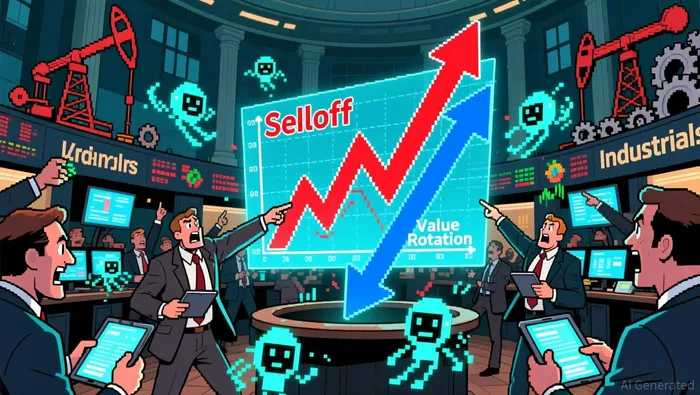 The volatility was exacerbated by macroeconomic uncertainties, including rising tariffs and mixed economic signals, which fueled a flight to safety. The VIX, or "Fear Index," hit its highest level since April's tariff-related turmoil, reflecting heightened anxiety.
Valuation Concerns and Historical Parallels
Comparisons to the dot-com bubble are inevitable. While U.S. equity valuations have approached levels seen in the late 1998s, analysts note key differences. According to IShares analysis, top hyperscalers like Microsoft, Alphabet, and Amazon now trade at forward P/E ratios of around 26, significantly lower than the 70 observed at the peak of the dot-com bubble. Unlike the 2000s, today's AI leaders are profitable and generating robust cash flows, which underpin their capital-intensive infrastructure investments.
However, concerns persist. Circular financing-where AI companies rely on speculative capital to fund growth-and overbuilding in data centers raise questions about sustainability. Some investors argue that the current selloff reflects a correction rather than a bubble, with fundamentals like Nvidia's consistent earnings and Google's Gemini 3 launch offering long-term promise. According to JPMorgan analysis, the market is not yet at a critical stage for a full-scale bubble.
Investor Sentiment: Panic or Prudence?
Institutional investors remain cautiously optimistic. According to a 2025 Natixis report, 71% of institutional investors view the AI race as a "new space race," while 68% are bullish on tech investments. Meanwhile, the AAII Investor Sentiment Survey shows 44.6% of individual investors are bullish, 30.6% bearish, and 24.8% neutral as of December 2025. This suggests a market in flux, with no consensus on the sector's trajectory.
Public sentiment, however, is more divided. While 93% of corporate leaders and 80% of investors believe AI will have a net positive societal impact, only 58% of the general public share this view, citing job displacement and environmental concerns. According to CNBC data, this divide underscores the sector's polarizing nature.
Strategic Rebalancing or Bubble Warning?
The selloff reflects both panic and calculated rebalancing. Analysts like Dan Hanbury of Ninety One caution that overvaluation risks extend beyond AI into sectors like debt-backed instruments and property. Conversely, Michael Field of Morningstar argues the market is not yet at a critical stage for a full-scale bubble.
Strategic rebalancing is evident as investors seek undervalued opportunities. Microsoft's diversified cloud and AI offerings are seen as a safer bet compared to speculative names like Palantir, which trades at bubble-like valuations. The Fed's rate cuts in 2025 have also provided a tailwind, though uncertainty lingers about their long-term impact.
Conclusion: A Crossroads for AI Investors
The AI sector stands at a crossroads. While fundamentals suggest long-term growth potential, valuation concerns and macroeconomic risks cannot be ignored. For investors, the key lies in balancing optimism with caution: prioritizing companies with strong earnings and diversified business models while avoiding speculative overreach. As Sarah Hansen of Morningstar notes, "Strong earnings justify some premium valuations, but sharp corrections remain a risk if economic shocks disrupt the trajectory."
In this environment, the selloff may present a buying opportunity for those with a long-term horizon-but only for those who can distinguish between sustainable innovation and speculative hype.







Comentarios
Aún no hay comentarios