
The AI Revolution in Education: Strategic Investment Opportunities in EdTech and STEM Institutions
The Market's Explosive Growth and Strategic Drivers
The AI in education market is being fueled by three pillars: personalized learning, workforce upskilling, and digital infrastructure. According to a report by Precedence Research, the integration of 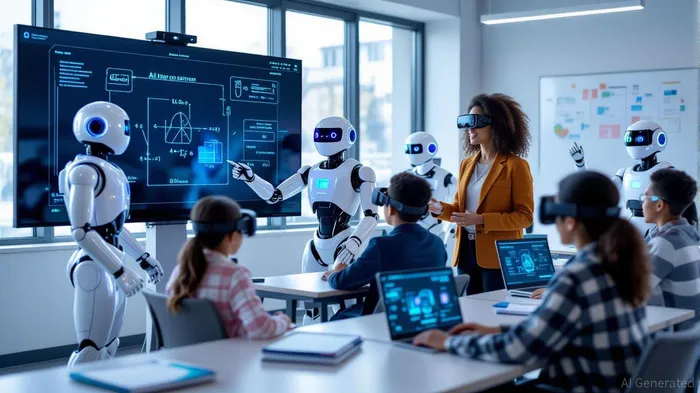 education is automating administrative tasks, reducing grading time by 20-40%, and enabling real-time analytics to tailor curricula to individual student needs. For investors, this means a sector where efficiency gains are not just theoretical but measurable.
The Asia-Pacific region is emerging as a powerhouse, with its 46.12% CAGR outpacing even North America's dominance. Meanwhile, the corporate e-learning market-driven by AI-powered training-is expected to hit $44.6 billion by 2028, with a 57% boost in learning efficiency. These numbers aren't just impressive; they're a call to action for investors to target platforms that bridge the gap between education and employment.
AI EdTech Startups: The New Gold Rush
Q3 2025 data reveals a frenzy in venture capital for AI-driven education. Startups raised $89.4 billion in funding, accounting for 34% of all VC investment, with agentic AI projected to grow at a 150% CAGR. Foundational model players like Anthropic and xAIXAI-- are leading the charge, but it's the application layer-companies like Reflection AI and Cognition AI-that are capturing investor imagination.
What's driving this surge? Scalability. Investors are prioritizing platforms that demonstrate clear pathways to profitability, such as AI-powered tools that reduce operational costs for schools or upskill employees in months rather than years. The "picks and shovles" strategy is alive and well: infrastructure investments in AI are now 51% of global VC deal value, signaling a shift from speculative bets to building the rails for the next industrial revolution.
STEM Institutions: The New Battleground for AI Talent
While startups grab headlines, the real long-term value lies in STEM-focused institutions that are integrating AI into their DNA. The U.S. K-12 STEM education sector alone is projected to grow from $60.1 billion in 2024 to $132 billion by 2030, driven by partnerships between tech giants like LEGO and Makeblock and schools. These collaborations are not just about hardware; they're about creating pipelines for AI literacy from an early age.
Universities are also stepping up. Google's $1 billion AI for Education Accelerator program and MIT's Schwarzman College of Computing are examples of how institutions are becoming incubators for AI talent. The National Science Foundation's $140 million investment in AI research institutes further underscores the strategic importance of aligning academic research with industry needs. For investors, this means opportunities in both public-private partnerships and institutional infrastructure.
The Risks and the Road Ahead
Of course, this isn't without risks. The EdTech sector saw a 66.4% year-over-year revenue decline for some players in Q3 2025, highlighting the volatility of a market still finding its footing. Regulatory scrutiny, ethical concerns, and the need for robust data privacy frameworks are also looming challenges.
But for those who can navigate these hurdles, the rewards are immense. The global education industry is a $7.3 trillion market, with less than 4% digitized-leaving a $404 billion gap in tech spending by 2025. This is where AI-driven edtech and STEM institutions will fill the void, creating a virtuous cycle of innovation, investment, and workforce readiness.
Conclusion: A Strategic Imperative
The AI revolution in education isn't a passing trend-it's a structural shift. Investors who focus on scalable AI platforms, STEM institutions with strong industry ties, and infrastructure that supports lifelong learning will be well-positioned to capitalize on a market that's growing at a pace faster than the dot-com boom. As the lines between education, work, and technology blur, the winners will be those who invest not just in tools, but in the people who will wield them.







Comentarios
Aún no hay comentarios