
The AI-Powered Physical Future: Unlocking Robotics, Autonomous Systems, and Industrial AI at CES 2026
The next frontier of artificial intelligence is no longer confined to screens or servers-it is stepping into the physical world. At CES 2026, the convergence of AI-driven robotics, autonomous systems, and industrial automation has crystallized into a clear investment thesis: physical AI is the new digital AI. From humanoid robots collaborating in factories to AI-powered delivery bots navigating urban landscapes, the shift from theoretical innovation to real-world deployment is accelerating. For investors, this represents a seismic opportunity to capitalize on infrastructure, platforms, and ecosystems that are redefining industries.
The CES 2026 Megatrends: From Prototypes to Production
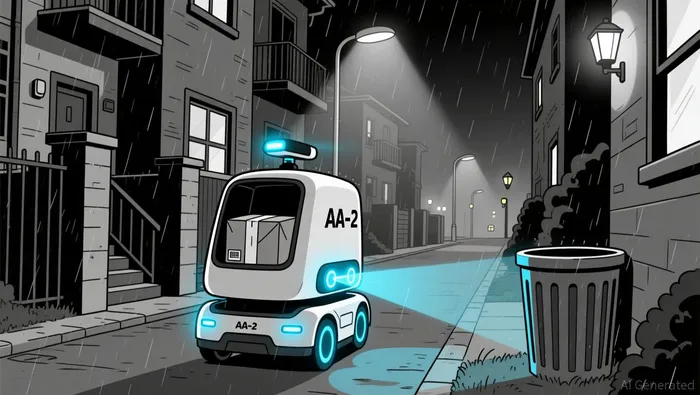
CES 2026 underscored a pivotal transition: AI is no longer just a software layer but a foundational element of physical infrastructure. The Consumer Technology Association highlighted "intelligent transformation" as a core theme, with robotics and autonomous systems moving beyond experimental phases. For instance, the AA-2 autonomous delivery robot, designed for residential complexes, addresses logistical pain points like overnight delivery and elevator congestion. Meanwhile, the AEON Hexagon humanoid robot exemplifies collaborative AI, performing repetitive or hazardous tasks in industrial settings while being accepted as a teammate. These systems are not isolated gadgets but part of a broader trend of embedding intelligence into infrastructure, reshaping manufacturing, logistics, and urban mobility.
The integration of edge AI further amplifies this shift. Devices like the Scan&Go autonomous mobile robot demonstrate how no-code programming and real-time path generation can streamline large-scale manufacturing. As AI moves closer to the user, edge computing platforms like Arm's architecture are enabling responsive, personalized experiences on everyday devices. This convergence of hardware, software, and AI is not just speculative-it is already operationalizing in real-world environments.
NVIDIA's Leadership: Powering the AI-Driven Physical World
NVIDIA's presence at CES 2026 reaffirmed its role as a linchpin in the AI and robotics revolution. CEO Jensen Huang's session spotlighted the company's vision for AI-powered autonomy, with the NVIDIANVDA-- DRIVE Thor platform serving as a cornerstone for Level 4 autonomous vehicles like WeRide's GXR robotaxi according to NVIDIA's CES 2026 event page. The platform's ability to handle real-time perception, decision-making, and execution underscores NVIDIA's dominance in the compute layer for physical AI.
Beyond mobility, NVIDIA's showcase emphasized robotics and industrial applications. The company's Physical AI initiatives, including the Big Bang of Robotics and Autonomous Vehicles panel, highlight its strategic focus on enabling robots to adapt to dynamic environments. For investors, NVIDIA's ecosystem-spanning hardware, software, and developer tools-positions it as a critical infrastructure provider for the physical AI wave.
Amazon's Smart Home Integration: Bridging the Digital-Physical Divide
Amazon's foray into AI-driven physical infrastructure is gaining momentum, particularly in smart home integration. At CES 2026, the company demonstrated how its AI infrastructure and devices are becoming more autonomous and interconnected according to Amazon's CES 2026 announcements. Amazon Web Services (AWS) is pivotal here, offering scalable infrastructure for real-time perception and decision-making in autonomous systems.
Collaborations with partners like Siemens and HERE Technologies further illustrate Amazon's strategic depth. By optimizing cloud-to-production workflows, AWS is enabling enterprises to deploy AI-driven solutions in logistics, energy, and urban planning. For investors, Amazon's edge AI capabilities and ecosystem of smart devices represent a growing opportunity in the physical AI landscape.
Investment Trends: Market Growth and Strategic Priorities
The financial case for AI-driven physical infrastructure is compelling. Deloitte's 2026 predictions forecast a turning point for robotics, with the global industrial robot base surpassing 5.5 million units by 2026. Annual sales are expected to double by 2030 as labor shortages and computing advances drive adoption according to Deloitte's analysis. Meanwhile, the agentic AI market-focused on autonomous decision-making-is projected to grow from $8.5 billion in 2026 to $45 billion by 2030 according to USIQ research.
Infrastructure investments are accelerating to meet these demands. High-performance computing, edge solutions, and domain-specific AI models are becoming table stakes for enterprises in finance, healthcare, and manufacturing according to USIQ analysis. Deloitte also notes that AI-enabled drones and autonomous vehicles are already optimizing supply chains and infrastructure inspection, with Waymo's robotaxi service hitting 10 million paid rides.
Strategic Investment Opportunities
For investors, the key lies in identifying platforms and ecosystems that enable physical AI. NVIDIA's compute infrastructure and AWS's cloud-edge integration are foundational, but the ecosystem extends to robotics startups, industrial automation firms, and edge AI hardware providers. Deloitte emphasizes that companies prioritizing scalable, secure AI infrastructure-and robust governance frameworks-will lead the next decade of innovation.
The shift from digital to physical AI is not just a technological evolution-it is a redefinition of how industries operate. As CES 2026 demonstrated, the future is no longer virtual; it is tangible, autonomous, and driven by AI.







Comentarios
Aún no hay comentarios