
AI-Powered Healthcare Workflow Automation in WhatsApp-Dominant Markets: A Strategic Investment Outlook for Emerging Markets
The convergence of AI-driven healthcare automation and WhatsApp's ubiquity in emerging markets is reshaping access to medical services, administrative efficiency, and patient engagement. For early-stage investors, this intersection represents a high-growth opportunity to scale infrastructure that addresses systemic healthcare gaps while capitalizing on WhatsApp's 2-billion-user global footprint according to a report. This analysis explores the market potential, regional case studies, and strategic challenges of investing in AI-powered healthcare workflows in WhatsApp-dominant economies like India, Egypt, and China.
Market Potential: AI Chatbots as Scalable Healthcare Infrastructure
AI-powered WhatsApp chatbots are emerging as a cornerstone of healthcare automation in emerging markets, where mobile penetration outpaces traditional healthcare infrastructure. By 2030, the global AI chatbot market is projected to reach $27.29 billion, with healthcare-specific applications growing at a 38.6% CAGR. This surge is driven by demand for cost-effective solutions to administrative burdens, telehealth expansion, and patient triage. For instance, AI-generated operative reports now achieve 87.3% accuracy, surpassing human-written reports (72.8%), while chatbots reduce administrative workloads by 35% for healthcare professionals according to industry data.
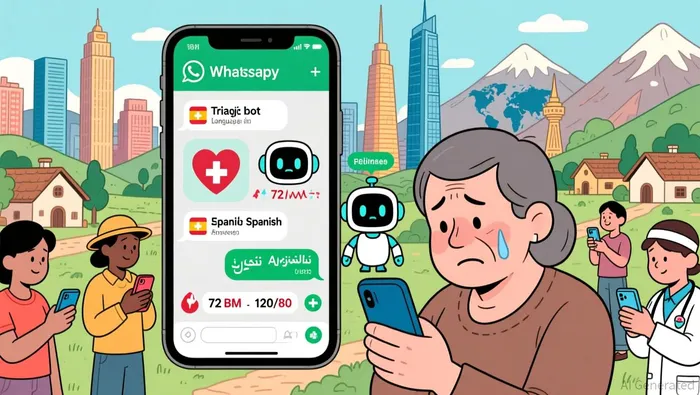
WhatsApp's role is pivotal: its low data requirements and multilingual capabilities make it ideal for regions with fragmented healthcare systems. In India, a multilingual chatbot streamlined appointment scheduling, reducing no-show rates and improving patient-provider communication. Similarly, Egypt's AI chatbot for the Tunisian dialect achieved a 98.60% F1 score in diagnosing conditions according to research, while China's Emohaa platform demonstrated measurable improvements in mental health outcomes according to a study. These examples underscore the platform's adaptability to local contexts, a critical factor for scalability.
Regional Case Studies: Egypt and China as Strategic Hubs
Egypt
Egypt's Digital Egypt 2030 strategy and National AI Strategy (2025–2030) aim to position the country as a MENA AI hub, with a target of 250 AI-driven companies by 2030. Startups like WideBot are leveraging WhatsApp AI to deploy voice agents for real-time citizen engagement in Arabic dialects according to reports, a model that could be adapted for healthcare triage. The Egyptian AI healthcare market is projected to grow at a 33.75% CAGR, reaching $410 million by 2032, driven by initiatives like telemedicine chatbots for Sudanese refugees according to market analysis. However, startups face regulatory ambiguity and limited funding, despite government grants and international partnerships.
China
China's healthcare AI market is accelerating under policies like the 2025 Innovation Task Notice, which prioritizes intelligent diagnostics and therapeutic tools according to industry reports. Startups such as iRegene and BrainCo have secured Series B funding for AI-enabled diagnostics and chronic disease management according to funding data, while partnerships with hospitals (e.g., Zhongshan Hospital with Huawei) demonstrate rapid clinical integration according to market analysis. The global WhatsApp chatbot market is expected to grow at a 33.8% CAGR, reaching $10.29 billion by 2030, with China's healthcare chatbot market projected to hit $2,149.1 million by 2025 according to market research. Challenges include data privacy concerns and regulatory compliance, despite government focus on interoperability.
Challenges and Mitigation Strategies
Despite the promise, investors must navigate several hurdles:
1. Regulatory Uncertainty: Egypt's Responsible AI Charter and China's evolving AI regulations require startups to prioritize ethical compliance according to market analysis.
2. Funding Gaps: While global healthcare AI funding hit $10.7 billion in 2025 according to industry data, early-stage startups in emerging markets often struggle to secure capital. Strategic partnerships with governments such as Egypt's Sehat Misr integration or multinationals such as Tencent's collaborations can bridge this gap.
3. Technical Integration: AI tools must align with existing workflows. For example, China's focus on evidence-based AI solutions and Egypt's emphasis on interoperability highlight the need for startups to demonstrate clinical validation and scalability.
Future Outlook: A $110.61 Billion Opportunity by 2030
The healthcare AI market is forecasted to grow from $21.66 billion in 2025 to $110.61 billion by 2030 according to market research, with WhatsApp-dominant markets leading adoption. Startups that align with national strategies-such as Egypt's 2030 Vision or China's 2025 Innovation Task Notice-will benefit from policy tailwinds and infrastructure support. For investors, the key is to target startups with:
- Local Language and Cultural Adaptation: Multilingual AI models such as Egypt's Tunisian dialect chatbot enhance user trust and adoption.
- Government Partnerships: Integration with national systems such as Egypt's UHIS or China's public hospitals according to market analysis ensures long-term viability.
- Data-Driven Validation: High-performance metrics such as 98.60% F1 scores and clinical trials strengthen investor confidence.
Conclusion
AI-powered healthcare automation via WhatsApp is not merely a technological innovation but a strategic infrastructure play for emerging markets. With WhatsApp's user base, AI's diagnostic accuracy, and supportive policy frameworks, the sector offers a compelling risk-reward profile for early-stage investors. However, success hinges on navigating regulatory landscapes, securing partnerships, and prioritizing scalability. As global health equity becomes a central policy goal, investments in this space are poised to yield both financial returns and transformative social impact.







Comentarios
Aún no hay comentarios