
AI-Powered Defense Modernization: The Strategic Value of BigBear.ai's Tsecond Partnership
The U.S. defense sector is undergoing a seismic shift as artificial intelligence (AI) becomes the linchpin of modernization efforts. At the forefront of this transformation is BigBear.ai's strategic partnership with Tsecond, a collaboration that exemplifies how operational AI adoption is accelerating military technology investment opportunities. By integrating BigBear.ai's ConductorOS orchestration platform with Tsecond's BRYCK edge infrastructure, the duo is addressing a critical gap in battlefield operations: the need for real-time, reliable AI processing in disconnected or contested environments. This partnership not only aligns with the Department of Defense's (DoD) 2025 priorities but also positions itself at the intersection of a rapidly expanding $38.8 billion global military AI market by 2028, according to a BigBear.ai announcement.
The Tactical Edge: Why Edge AI Matters
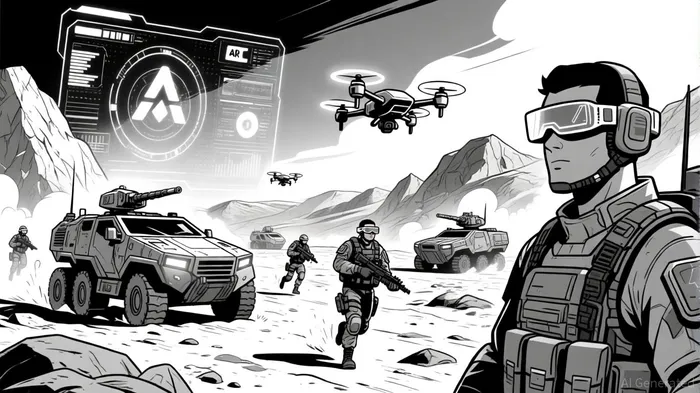
Traditional cloud-based AI systems are ill-suited for the volatility of modern combat zones, where connectivity is often compromised. Edge AI, however, enables data processing directly on tactical devices-drones, wearable systems, and vehicles-reducing latency and ensuring mission-critical decisions can be made in seconds. Tsecond's BRYCK platform, with its petabyte-scale storage and AI compute power, paired with BigBear.ai's ConductorOS, creates a decentralized infrastructure that empowers warfighters to detect threats, analyze sensor data, and execute missions without relying on distant data centers, as explained in a Dedicated Computing analysis.
This capability is not just a technical innovation but a strategic imperative. The DoD's FY2025 budget request of $1.8 billion for AI programs underscores the urgency of deploying systems that provide "decision advantage"-a concept emphasizing faster, higher-quality decisions enabled by AI across all domains, per a Sheridantech analysis. For instance, edge AI applications in autonomous navigation and real-time threat detection are already being integrated into uncrewed systems, with the DoD allocating $47 billion to such platforms over the past five years, according to a Global Market Insights report.
Market Dynamics and Investment Opportunities
The strategic value of BigBear.ai's Tsecond partnership is further amplified by broader trends in military AI adoption. The global AI & analytics in military and defense market, valued at $10.42 billion in 2024, is projected to grow at a 13.4% CAGR through 2034, driven by advancements in autonomous systems, cybersecurity, and logistics optimization, according to Global Market Insights. This growth is fueled by the DoD's aggressive modernization agenda, including initiatives like the Joint Warfighting Cloud Capability (JWCC) and the Replicator program, which aim to deploy attritable autonomous systems and large uncrewed jets for electronic warfare and reconnaissance, as reported by National Defense Magazine.
BigBear.ai's collaboration with DEFCON AI further solidifies its role in this ecosystem. By leveraging AI-powered modeling and simulation solutions, the partnership enhances joint force sustainment and readiness assessments, addressing the military's need for predictive analytics in complex, dynamic scenarios, per a BigBear.ai collaboration. Such innovations align with the DoD's 2023 Data, Analytics, and AI Adoption Strategy, which prioritizes decision superiority through AI-enabled systems, as outlined in the DoD adoption strategy.
Strategic Implications for Investors
For investors, the convergence of operational AI adoption and defense modernization presents a compelling case. The DoD's FY2025 budget not only allocates funds for AI programs but also emphasizes enterprise-wide modernization, including logistics and intelligence analysis, as previously noted by Sheridantech. Companies like BigBear.ai, which are building AI infrastructure tailored to the tactical edge, are well-positioned to benefit from this surge in demand.
Moreover, the NDAA for 2025 reinforces AI governance frameworks, ensuring that investments in technologies like edge computing and generative AI are aligned with long-term strategic goals, according to a GovCIO Media analysis. This regulatory clarity, combined with the DoD's focus on expanding the Chief Digital and Artificial Intelligence Officer Governing Council, creates a stable environment for innovation and capital deployment, per a RAND report.
Conclusion
BigBear.ai's partnership with Tsecond is more than a technological milestone-it is a harbinger of how operational AI adoption is reshaping defense investment landscapes. As the DoD continues to prioritize decision advantage and information-centric warfare, companies that bridge the gap between AI capabilities and tactical execution will dominate the next era of military modernization. For investors, the message is clear: the future of defense lies at the edge, and those who invest in the infrastructure enabling this shift stand to reap significant rewards.







Comentarios
Aún no hay comentarios