
AI-Powered Cybersecurity in K-12 Education: A High-Growth Opportunity in Underserved Markets
The K-12 education sector is facing a cybersecurity crisis. With 4,388 cyberattacks per organization per week on average in 2025-a 31% year-over-year increase-schools are under siege from ransomware, phishing, and data breaches according to DeepStrike. Underfunded districts, which make up 61% of the market, lack dedicated cybersecurity budgets and rely on general funds, leaving them exposed to increasingly sophisticated threats as reported by EdTech Magazine. This is where the convergence of EduTech and AI-powered cybersecurity emerges as a golden opportunity for investors.
The Dependable Solutions and VigilAigent Partnership: A Model for Scalable Protection
Dependable Solutions, a Wisconsin-based managed service provider (MSP), has partnered with VigilAigent (a subsidiary of Tego Cyber Inc., OTCQB:TGCB) to deploy OmniViz+, an AI-powered cybersecurity platform, across 10 school districts in Wisconsin. This initiative protects nearly 18,000 students and aligns with K-12 grant funding to mitigate budget constraints. OmniViz+ offers enterprise-grade threat detection, behavioral analysis, and automated response, supported by 100% U.S.-based security operations and human-in-the-loop oversight as detailed in the partnership announcement.
This collaboration is emblematic of a broader trend: 78% of K-12 IT professionals are investing in managed detection and response (MDR) platforms, and 65% are deploying endpoint protection solutions to combat ransomware and phishing. By leveraging AI, schools can now detect and neutralize threats in real time, a critical advantage given that attackers are using AI to generate convincing phishing emails and fake login pages.
Federal and State-Level Tailwinds: Funding and Legislative Momentum
The federal government's retreat from K-12 cybersecurity support has spurred state-level action. In 2025, states like Texas and Arkansas enacted cybersecurity bills, including Texas's Cyber Command and Arkansas's cyber response funding as reported by GovTech. Meanwhile, the FCC's Schools and Libraries Cybersecurity Pilot Program allocated $200 million over three years to bolster school cybersecurity according to FCC announcements. These initiatives create a fertile ground for AI-driven solutions like OmniViz+, which are designed to be grant-eligible and cost-effective for cash-strapped districts as noted by industry analysts.
At the federal level, H.R.3435 proposes a centralized cybersecurity institute to address systemic gaps as detailed in the bill text. While the bill is still in its early stages, it signals growing political will to prioritize K-12 security-a trend that will likely accelerate as ransomware attacks reached 95 in the U.S. in Q1–Q3 2025.
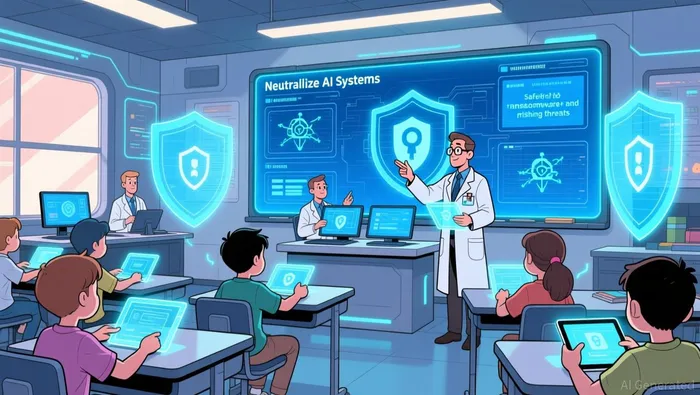
The AI in K-12 education market is projected to grow from $390.8 million in 2024 to $7,949.9 million by 2033, at a 38.1% CAGR according to Grand View Research. This growth is driven by AI's role in personalized learning and administrative automation, but the cybersecurity segment is equally compelling. Schools are adopting AI-powered tools like Secure Email Threat Defense and Cisco Umbrella to counter AI-generated threats as reported by EdTech Magazine.
The underserved nature of this market is a key catalyst. With 61% of districts lacking dedicated cybersecurity budgets as cited in the June 2025 report, there is a massive unmet demand for affordable, scalable solutions. OmniViz+'s alignment with grant funding and its focus on human oversight-critical for ethical AI use as discussed in the webinar-position it as a leader in this space.
Investment Case: EduTech and Cyber Defense Convergence
For investors, the convergence of EduTech and cybersecurity represents a high-conviction opportunity. Companies like Tego Cyber (TGCB), whose VigilAigent subsidiary is at the forefront of this movement, are well-positioned to capitalize on the $7.9 billion market. Additionally, firms providing AI-powered email security, endpoint protection, and behavioral analytics are set to benefit from the 78% adoption rate of MDR platforms in K-12 as reported by EdTech Magazine.
The risk-reward profile is compelling. While federal support remains inconsistent, state-level initiatives and private-sector innovation are filling the void. Schools are prioritizing proactive measures, such as AI governance frameworks and cybersecurity training as highlighted in the webinar, which further validate the long-term viability of this sector.
Conclusion: A Golden Hour for Investors
The K-12 cybersecurity market is at an inflection point. With AI-driven threats escalating and underfunded districts desperate for solutions, partnerships like Dependable Solutions and VigilAigent are not just addressing a problem-they're building a scalable, high-margin business model. For investors, this is a rare intersection of social impact and financial upside. The question isn't whether this market will grow-it's who will dominate it.







Comentarios
Aún no hay comentarios