
U.S. AI Policy and the Global Tech Market: Navigating the U.S.-China Rivalry in 2025
U.S. AI Policy and the Global Tech Market: Navigating the U.S.-China Rivalry in 2025
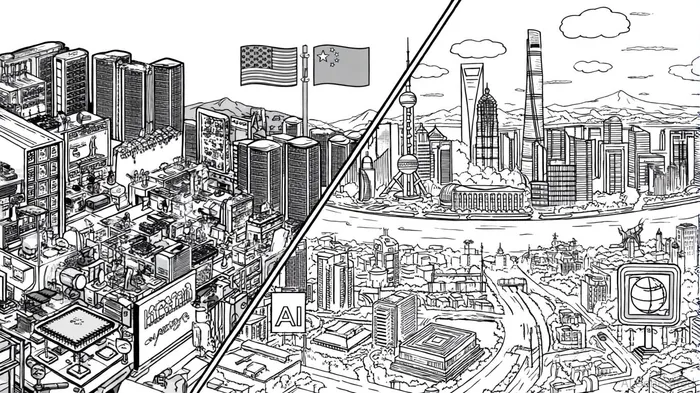
The U.S. and China are locked in a high-stakes race to dominate artificial intelligence, a competition that is reshaping global tech markets and investment strategies. In 2025, the U.S. unveiled its AI Action Plan, a policy shift emphasizing deregulation, private-sector innovation, and global alliances to counter China's rising influence. Meanwhile, China has recalibrated its approach, balancing state-led infrastructure expansion with efforts to shape international governance norms. For investors, understanding these dynamics is critical to navigating a fragmented but lucrative AI landscape.
U.S. AI Policy: Deregulation and Global Alliances
The U.S. 2025 AI Action Plan, announced on July 23, 2025, marks a decisive pivot toward fostering a self-sufficient AI ecosystem, according to a China AI strategy report. By incentivizing states to reduce regulatory burdens-offering federal funding for AI infrastructure and workforce development-the plan aims to accelerate domestic innovation while curbing reliance on foreign supply chains. This strategy mirrors the "permissionless innovation" ethos that fueled the internet boom, prioritizing speed and flexibility over bureaucratic oversight.
A cornerstone of the plan is the push for semiconductor self-reliance, with the U.S. tightening export controls on advanced chips like the NvidiaNVDA-- H100 while investing in domestic manufacturing, as highlighted in a CSIS analysis. The Department of Defense and National Science Foundation have allocated over $4 billion combined for AI-driven defense technologies and foundational research, according to US government AI funding initiatives, signaling a long-term commitment to maintaining a technological edge. Additionally, the U.S. is leveraging its alliances to promote democratic AI norms, exporting infrastructure and standards to partners while restricting access for rivals.
China's Counterstrategy: State-Led Infrastructure and Global Governance
China's 2025 AI policy emphasizes self-reliance and multilateralism, with a focus on building a self-sufficient ecosystem and exporting governance frameworks. The country's AI investment surged to $98 billion in 2025-a 48% increase from 2024-driven by $56 billion in government funding and $24 billion from tech firms, according to The Diplomat. This spending has fueled breakthroughs like DeepSeek's cost-effective large language models, which have positioned China as a global frontier player.
Unlike the U.S., China's strategy prioritizes infrastructure scalability, with data centers consuming 400,000 tonnes of copper annually and driving a projected 3.3% rise in global copper demand in 2025. The government is also leveraging its energy advantages, integrating green power with AI operations to sustain growth. However, economic constraints are emerging: overcapacity in AI infrastructure has left significant portions of China's data centers idle, and its economic slowdown threatens to strain funding for long-term ambitions.
Market Implications: A Diversified but Polarized Ecosystem
The U.S.-China rivalry is creating divergent investment opportunities. In the U.S., private-sector-led innovation is driving demand for semiconductors, cybersecurity, and AI education. U.S. firms like xAI and Anthropic are expanding computing capabilities, with projects like the Colossus supercomputer aiming to outpace Chinese alternatives (noted in CSIS analysis). Meanwhile, the U.S. government's $500 billion in private-sector commitments underscores a focus on infrastructure modernization, including next-generation nuclear energy to power AI operations (per US government AI funding initiatives).
China's infrastructure-centric approach is boosting demand for copper, liquid cooling solutions, and energy-efficient hardware. By 2035, data centers alone could consume 4.3 million tonnes of copper, exacerbating global supply gaps. Chinese firms like Huawei and DeepSeek are also demonstrating resilience against U.S. export controls, optimizing models under constraints and expanding into global markets.
Strategic Risks and Opportunities for Investors
The AI rivalry presents both risks and rewards. For U.S. investors, the focus on deregulation and private innovation offers high-growth potential in semiconductors and AI-as-a-service, but geopolitical tensions could disrupt supply chains. Conversely, China's state-led model provides stability in infrastructure-related sectors but faces uncertainties from economic headwinds and overcapacity.
A key risk lies in the fragmentation of global AI standards. The U.S. promotes democratic values like transparency, while China advocates for sovereignty-driven governance through initiatives like the Shanghai Declaration on Global AI Governance. This divergence could lead to incompatible ecosystems, complicating cross-border collaboration and investment.
Conclusion: Positioning for the AI-Driven Future
The U.S. and China are reshaping the AI landscape through contrasting strategies: deregulation and private-sector dynamism versus state-led infrastructure and global governance. For investors, the path forward requires balancing exposure to both ecosystems while hedging against geopolitical risks. As the 2025 AI Index Report notes, "The global AI race is not a zero-sum game but a complex interplay of innovation, regulation, and resource allocation." Those who navigate these currents with agility will be best positioned to capitalize on the transformative potential of AI.





Comentarios
Aún no hay comentarios