
AI Policy Divergence: How Trump and Biden Strategies Shape U.S. Tech Leadership and Global AI Competition
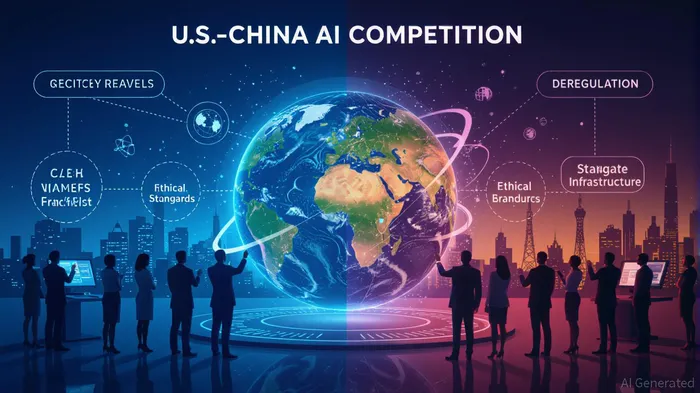
The United States stands at a crossroads in its approach to artificial intelligence (AI), with starkly divergent policies under the Biden and Trump administrations. These contrasting strategies—rooted in regulation versus deregulation, oversight versus innovation—have profound implications for U.S. tech leadership, global competition, and sector-specific investment opportunities. For investors, understanding this policy divergence is critical to navigating the rapidly evolving AI landscape and capitalizing on emerging markets.
Policy Divergence: Regulation vs. Deregulation
The Biden administration's AI strategy, epitomized by Executive Order 14110 (2023) and its follow-up, EO 14141 (2025), prioritized safety, ethics, and international collaboration. Key pillars included the creation of the U.S. Artificial Intelligence Safety Institute (AISI), mandatory reporting for high-risk AI systems, and alignment with global standards like the EU's AI Act. This approach aimed to mitigate risks such as bias, disinformation, and national security threats while fostering trust in AI technologies.
In contrast, the Trump administration has reversed these policies, framing AI as a tool for unbridled innovation and national dominance. Executive Order 14179 (2025) dismantled Biden-era regulations, emphasizing deregulation, infrastructure investment, and the removal of barriers to private-sector development. The Stargate AI initiative—a $500 billion partnership to expand data centers and computing power—exemplifies this shift, prioritizing speed and scale over caution.
Geopolitical Implications: U.S.-China AI Competition
The U.S. and China are locked in a high-stakes race for AI dominance, with policy choices determining the trajectory of this competition. The Biden administration's focus on global governance and ethical AI aligns with European and Canadian regulatory frameworks, fostering multilateral collaboration. However, the Trump administration's unilateral approach—prioritizing U.S. leadership over international norms—risks fragmenting global standards and alienating key allies.
China, meanwhile, has accelerated its state-led AI industrial policy, aiming for a $100 billion AI industry by 2030. Its National Integrated Computing Network and “Eastern Data, Western Computing” initiative highlight a strategic push to overcome U.S. export controls on semiconductors. While the U.S. leads in private-sector innovation and compute capacity, China's blend of state support and local government incentives ensures it remains a formidable competitor.
Sectoral Investment Opportunities
AI Infrastructure and Energy:
The Trump administration's Stargate project and Google's $25 billion AI infrastructure investment underscore a surge in demand for data centers and energy. Companies like NVIDIANVDA-- (NVDA), which supplies AI chips, and energy firms repurposing hydropower (e.g., Google's Pennsylvania hydropower upgrades) are prime beneficiaries. Investors should monitor permitting timelines and energy costs, as these drive infrastructure scalability.Regulatory Compliance and Cybersecurity:
Despite deregulatory trends, AI compliance remains a growing sector. The EU's AI Act and state-level U.S. laws (e.g., Colorado's AI Act) create a patchwork of requirements. Firms like AXA XL, which launched the first AI-specific insurance endorsement in 2024, and cybersecurity players like PalantirPLTR-- (PLTR) are well-positioned to address risks such as data poisoning and regulatory violations.Open-Source AI and Workforce Development:
The Trump administration's emphasis on open-source AI development and K-12 to postgraduate training aligns with global trends. Open-source platforms like Apache Software Foundation and educational tech firms (e.g., Coursera) could see increased funding. Investors should also track AI workforce indices, as talent shortages may drive demand for reskilling programs.
Investment Advice: Navigating the Divergence
- Prioritize Infrastructure and Energy: The U.S. is fast-tracking AI data centers and energy projects. Invest in firms with expertise in high-performance computing (HPC) and renewable energy integration.
- Balance Deregulation with Compliance: While the Trump administration reduces federal oversight, state and international regulations persist. Firms offering compliance tools or cybersecurity solutions will remain relevant.
- Monitor Geopolitical Shifts: U.S. policy choices influence global AI governance. Support companies that adapt to both U.S. and EU regulatory frameworks to mitigate fragmentation risks.
Conclusion
The AI policy divergence between the Trump and Biden administrations reflects a broader ideological clash: regulation for safety versus deregulation for innovation. For investors, the key lies in hedging between these extremes. While the Trump administration's focus on infrastructure and deregulation accelerates U.S. AI growth, the Biden-era emphasis on ethics and global standards ensures long-term trust. In this dynamic environment, those who align with both innovation and compliance will thrive.






Comentarios
Aún no hay comentarios