
AI in Marketing and Investment Strategy: Evaluating Tools for Competitive Advantage and ROI in 2026 Budgets
The 2026 marketing landscape is no longer defined by traditional metrics or one-size-fits-all strategies. As artificial intelligence (AI) becomes a cornerstone of competitive advantage, businesses must reorient their investment frameworks to prioritize tools that deliver measurable ROI while aligning with evolving buyer behaviors. The data is clear: AI-driven marketing is no longer a luxury but a necessity, with 95% of researchers now using AI tools regularly. Yet, the key to success lies not in the volume of tools adopted but in their strategic integration.
The ROI Imperative: From Cost Savings to Strategic Growth
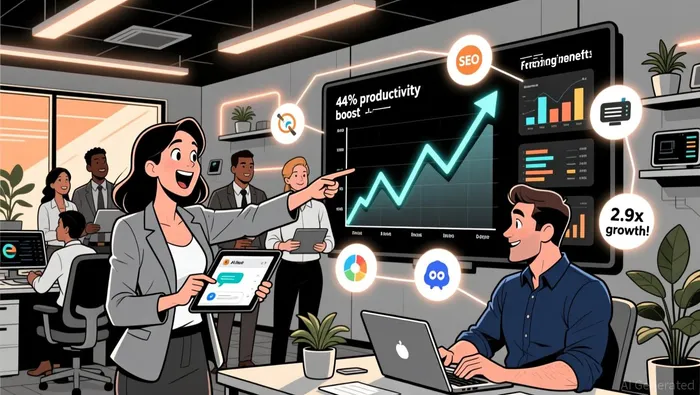
AI's impact on marketing ROI is profound. According to a report by McKinsey, marketing teams leveraging AI report a 44% increase in productivity, saving an average of 11 hours per week. These gains translate directly into cost efficiency, with 37% lower acquisition costs and 25% higher conversion rates for companies using AI strategically. Forrester ResearchFORR-- further underscores this, noting that organizations using predictive analytics achieve 2.9x higher revenue growth compared to competitors relying on historical data.
However, the ROI of AI extends beyond cost savings. By 2026, the focus has shifted to compounding value-investments that drive innovation and scalability. For instance, AI-powered SEO tools like Surfer SEO and Jasper AI enable marketing teams to produce high-quality, SEO-optimized content at scale, resulting in 60% faster editing processes and 30% improved SEO rankings. Similarly, AI-driven campaigns deliver 20–30% higher ROI than traditional methods. These tools are not just reducing costs; they are redefining how brands engage with audiences through hyper-personalization and data-driven decision-making.
Strategic Allocation: The 2026 Budget Framework
To maximize ROI, 2026 marketing budgets must adopt a disciplined, AI-centric allocation framework. Key recommendations include:
- AI SEO (20–30% of budget): Prioritize content creation, backlink strategies, and Generative Engine Optimization (GEO) to dominate AI-powered search engines like ChatGPT and Perplexity. Traditional SEO is obsolete; AI tools now favor authoritative, structured content tailored to industry-specific queries.
- Email Marketing (15–20%): Leverage automation and AI-driven personalization to boost engagement. HubSpot's research shows that AI-powered predictive lead scoring increases conversion rates by 27%.
- Google Ads (10–15%): Focus on high-intent keywords and smart bidding, avoiding broad match strategies that no longer deliver value.
- AI and Martech Investments (10–15%): Treat AI as a portfolio of use cases, prioritizing scalable initiatives with clear kill and scale criteria to avoid pilot purgatory.
- Video Marketing (10%): AI reduces production costs while enabling personalized, high-impact content.
These allocations reflect a shift from exploratory AI investments to measurable outcomes. As PwC notes, success in 2026 is tied to verifiable business results-revenue growth, cost reduction, and risk mitigation-rather than the number of models built.
Competitive Advantage: Beyond Adoption to Mastery
The competitive edge in 2026 belongs to companies that master AI's strategic potential. High-performing organizations exhibit traits like cross-functional C-suite collaboration, advanced KPIs for AI success, and algorithmic forecasting for market shifts. For example, Sephora's Virtual Artist tool, which allows customers to try on makeup virtually, increased engagement and sales by delivering hyper-personalized experiences. Amazon's AI-driven recommendation engine similarly boosted cross-selling and upselling by analyzing user behavior.
Purpose-built AI tools are now favored over general-purpose platforms, as they align with niche workflows and standards. This is evident in B2B marketing, where AI-powered predictive analytics drives 42% more content output and 27% higher conversion rates. The Washington Post's Heliograf tool, which automates short news reports, and IBM's use of AdobeADBE-- Firefly to generate 200+ original images for campaigns resulting in 26x higher engagement, exemplify how AI scales creative efforts while maintaining quality.
Frameworks for Evaluation: Measuring AI's Impact
To justify AI investments, businesses must adopt robust evaluation frameworks. Key performance indicators (KPIs) include:
- Conversion Rate Lift: AI-driven campaigns outperform traditional methods by 20–30%.
- Lead Quality Score: Forrester found that AI-powered lead generation produces 50% more sales-ready leads at 33% lower cost per lead.
- Pipeline Velocity: AI accelerates lead-to-customer cycles, reducing time-to-close by up to 40%.
- Revenue Attribution: AI tools enable precise tracking of revenue generated from specific campaigns or channels.
ROI calculations must also account for indirect value, such as productivity gains and cycle time reduction. PwC emphasizes embedding governance and explainability into AI systems to ensure compliance and scalability.
The Future: Agentic AI and Synthetic Research
Looking ahead, agentic AI and synthetic research will further transform marketing. Agentic AI automates complex workflows, enabling self-service insights and real-time decision-making. Synthetic research, which generates high-quality data for training models, will reduce reliance on manual data collection. These advancements will deepen AI's role in marketing, but success will depend on organizations' ability to align tools with business objectives.
Conclusion
The 2026 marketing budget is a battleground for competitive advantage. AI tools are no longer optional; they are foundational. However, their value lies in strategic integration-allocating resources to scalable, measurable initiatives while fostering AI literacy across teams. As the global AI marketing market surges toward $107.5 billion by 2028, businesses that master this framework will dominate, turning AI from a cost center into a growth engine.







Comentarios
Aún no hay comentarios