
The AI Infrastructure Transition: Why Ex-Bitcoin Miners Like Hut 8 Are Becoming High-Value Power-Infrastructure Play
The global shift toward artificial intelligence (AI) has created a seismic demand for high-performance computing (HPC) infrastructure, and former BitcoinBTC-- miners are uniquely positioned to capitalize on this trend. Companies like Hut 8 are leveraging their pre-existing energy assets-massive power capacity, industrial-scale cooling systems, and grid-connected data centers-to repurpose their operations for AI-driven workloads. This strategic pivot is not only transforming their business models but also redefining their value propositions in the digital economy.
The Strategic Repurposing of Energy Assets
Hut 8's transition from Bitcoin mining to AI infrastructure is emblematic of a broader industry trend. As of March 31, 2025, the company has developed a pipeline of 10,800 MW of utility-scale power origination projects, with 1,530 MW under development specifically for AI and HPC data centers according to Hut 8's press release. This shift is underpinned by a "power-first" strategy, where low-cost energy assets are flexibly allocated to either Bitcoin mining or AI workloads depending on market conditions. For instance, Hut 8's Vega data center in Texas, expected to generate $135 million in annualized revenue starting Q2 2025, exemplifies how repurposed infrastructure can deliver scalable returns.
The company's hybrid model is further strengthened by its 675 MW of operational capacity across Canada and the U.S., with four new U.S. development sites progressing for high-power digital operations according to financial reports. These assets are being optimized for AI hosting, which generates $1–4 million per megawatt annually, far outpacing the returns from traditional Bitcoin mining according to industry analysis. Hut 8's joint venture with Macquarie on natural gas power plants in Ontario also underscores its ability to secure stable, low-cost energy for AI workloads according to company announcements.
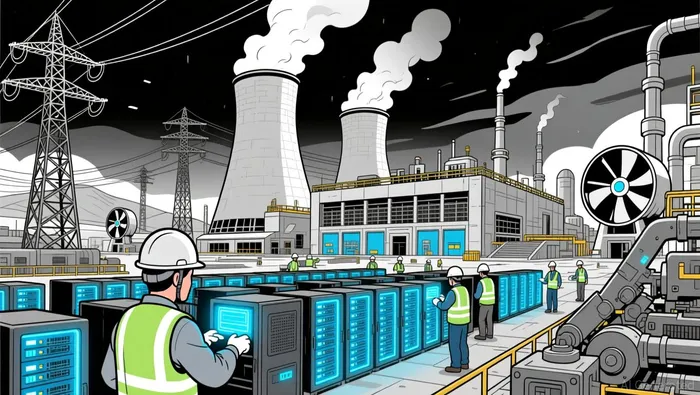
Industry-Wide Validation of the AI Infrastructure Play
Hut 8 is not alone in this transition. The broader ex-Bitcoin mining sector is witnessing a $20 billion industry-wide pivot to AI infrastructure, driven by declining mining profitability and surging demand for HPC. For example:
- IREN Limited secured a $9.7 billion, five-year AI hosting deal with Microsoft, leveraging its 200 MW of GPU-powered capacity according to industry reports.
- Cipher Mining signed a $5.5 billion, 15-year lease with AWS for 300 MW of AI infrastructure according to market analysis.
- CoreWeave acquired Core Scientific in a $9 billion all-stock deal to expand its data center footprint according to business news.
These moves are validated by institutional investors and analysts. Benchmark, a Wall Street broker, has labeled Hut 8HUT-- a "flexible call option" on AI growth, Bitcoin, and future energy-hungry applications, raising its price target to $78. Similarly, Bernstein Research highlights that Bitcoin miners' power edge-low-cost, grid-connected infrastructure-makes them key enablers of the AI boom according to market research.
Financial and Operational Advantages
The economics of AI hosting are compelling. According to industry reports, AI workloads generate $1–4 million per megawatt annually, compared to Bitcoin mining's $0.5–1 million per megawatt according to industry analysis. This margin advantage is amplified by Hut 8's focus on efficiency improvements and cost optimization, including upgrading its mining fleet with 31,000 BITMAIN S-21 Antminer units to boost hash rate by 66% according to earnings reports.
Moreover, the hybrid model allows Hut 8 to hedge against volatility in both Bitcoin prices and AI demand. For example, the company is evaluating 6 gigawatts of expansion capacity, with 1.5 gigawatts under exclusivity, ensuring flexibility to pivot between use cases according to company updates. This adaptability is critical in a market where energy prices and GPU availability fluctuate.
Regulatory and Capital Market Tailwinds
The transition is also supported by favorable capital market activity. Companies are issuing convertible notes and high-yield secured debt to fund GPU procurement and facility conversions according to financial analysis. For instance, Hut 8's $7 billion, 15-year lease for a 245-MW data center in Louisiana according to press reports reflects the long-term revenue stability offered by AI hosting. Regulatory responses, while mixed, have generally favored structured transitions, with some governments launching utility-led initiatives to integrate HPC and AI operations into grid management according to industry analysis.
Conclusion: A High-Value Power-Infrastructure Play
The strategic repurposing of energy assets by ex-Bitcoin miners like Hut 8 is not a short-term pivot but a long-term repositioning to meet the AI era's infrastructure demands. With $135 million in annualized revenue from Vega, a 10,800 MW power pipeline, and a hybrid model that balances Bitcoin and AI workloads, Hut 8 is well-positioned to capture value from both sectors. As the AI infrastructure market expands, these companies are likely to see triple-digit valuation gains, outperforming even Bitcoin itself. For investors, this represents a unique opportunity to bet on the convergence of energy, AI, and digital infrastructure.







Comentarios
Aún no hay comentarios