
The AI Infrastructure Revolution: How IREN's $9.7B Microsoft Deal Signals a New Era for Neocloud Players
The Strategic Pivot: IREN's $9.7B Microsoft Deal and AI Cloud Expansion
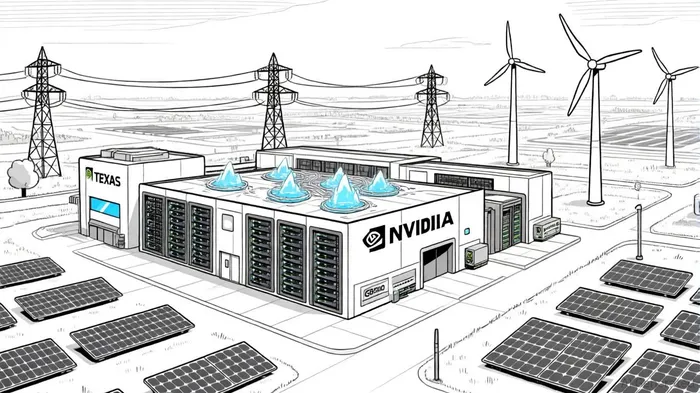
IREN's transformation from a Bitcoin mining firm to an AI infrastructure powerhouse is emblematic of the sector's evolution. The company's five-year agreement with Microsoft includes a 20% upfront payment, providing immediate liquidity to fund its AI ambitions. This prepayment structure is critical, as it mitigates the upfront capital risks typically associated with large-scale infrastructure projects. To fulfill the contract, IREN has secured a $5.8 billion procurement deal with Dell TechnologiesDELL-- for NVIDIANVDA-- GB300 GPUs, which will be deployed at its 750-megawatt liquid-cooled data center in Texas.
IREN's recent GPU purchases further illustrate its aggressive scaling strategy. In the past quarter, the company doubled its AI cloud capacity to 23,000 GPUs by acquiring 12,400 additional units, including NVIDIA B300s and B200s, and AMD MI350Xs, according to Investor's Observer. These investments are not speculative; they are backed by pre-orders from clients seeking multi-thousand GPU clusters, with IREN targeting $500 million in annualized run-rate revenue (ARR) by early 2026. Analysts from Bernstein and Roth Capital Partners have raised their price targets for IREN, citing its unique approach to building proprietary AI cloud infrastructure rather than relying on third-party platforms.
Broader Market Trends: AI Infrastructure's Explosive Growth
IREN's pivot aligns with a broader industry trend. The global AI infrastructure market, valued at $26.18 billion in 2024, is projected to grow at a 23.8% CAGR through 2034, reaching $221.4 billion, according to a GlobeNewswire report. This growth is fueled by edge AI adoption in industrial robotics, generative AI models requiring exascale compute, and the rise of on-premises solutions in regulated sectors like healthcare and finance.
The capital reallocation from Bitcoin mining to AI is accelerating. Post-2024 halving, Bitcoin miners faced squeezed margins, prompting firms like Cipher Mining and Bitdeer to convert mining sites into AI data centers. The IEA estimates AI data center demand could hit 1,000 terawatt-hours annually by 2030, a figure discussed in the MarketsandMarkets coverage; for infrastructure suppliers like NVIDIA and DellDELL--, this represents a $1.3 trillion market opportunity by 2032.
Why Infrastructure Layer Companies Are the New High-Conviction Play
Investors should prioritize firms positioned at the infrastructure layer-those supplying GPUs, data centers, and energy solutions-due to their defensibility and scalability. Unlike software or application-layer players, infrastructure providers benefit from long-term, high-margin contracts. Microsoft's $9.7B deal with IREN, for instance, locks in a stable revenue stream for five years, insulating the company from the volatility of Bitcoin or equity markets.
Moreover, the energy efficiency of AI infrastructure is a critical differentiator. IREN's liquid-cooled data centers and Microsoft's partnership with NVIDIA on Blackwell AI infrastructure highlight the industry's shift toward sustainable designs. This aligns with regulatory pressures and ESG investor demands, further solidifying the long-term viability of these projects.
Conclusion: Capitalizing on the AI Infrastructure Gold Rush
IREN's strategic pivot and Microsoft's bet on its AI cloud infrastructure signal a permanent reallocation of capital toward compute. As the AI infrastructure market expands, firms with access to affordable energy, scalable GPU deployments, and long-term client contracts will outperform. For investors, this means prioritizing companies like IREN, NVIDIA, and Dell-those building the physical and digital backbone of the AI revolution. The next decade will be defined by the winners of this infrastructure race, and the time to act is now.





Comentarios
Aún no hay comentarios