
The AI Infrastructure Gold Rush: Why High-Margin Tech Sectors Are Poised for Decade-Long Growth
Dell's AI-Driven Revenue Surge: A Barometer for the Industry
Dell Technologies has emerged as a bellwether for AI infrastructure demand, with its Infrastructure Solutions Group (ISG) posting a 24% year-over-year revenue increase in Q3 2025 to $14.1 billion. This growth is fueled by a 37% surge in servers and networking revenue to $10.1 billion, underscoring the critical role of AI hardware in enterprise digital transformation. 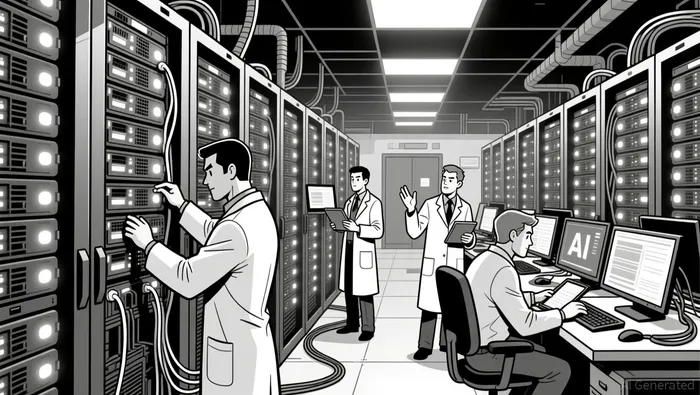 The company's full-year 2026 guidance is even more striking: AI server shipments are projected to reach $25 billion, a 150% increase compared to 2025.
Dell's performance aligns with broader market dynamics. The company's focus on hybrid and on-premises AI deployments-particularly in data-sensitive sectors like finance and healthcare-mirrors industry trends where 56.4% of 2024 AI infrastructure spending still favors on-premises solutions. Meanwhile, cloud-native AI infrastructure, led by hyperscalers like AWS and Microsoft, is growing at a 20.6% CAGR, offering scalable alternatives for AI training and inference.
High-Margin Dynamics: Hardware as the Core of AI Infrastructure
The AI infrastructure market's profitability hinges on its hardware-centric nature. In 2024, hardware accounted for 72.1% of AI infrastructure spending, a figure that reflects the capital-intensive demand for specialized processors such as GPUs and TPUs. NVIDIA, the dominant player in AI silicon, has already captured significant market share, but Dell's partnerships with chipmakers and its vertically integrated solutions position it to capitalize on the downstream value chain.
The hardware segment's dominance is further reinforced by the training vs. inference split. Training, which requires massive computational power, accounted for 71.4% of AI infrastructure revenue in 2023. This creates a flywheel effect: as enterprises invest in training infrastructure, they become locked into ecosystems that require complementary inference tools, storage, and networking solutions-areas where Dell excels.
Market Projections: A $223 Billion Opportunity by 2030
The AI infrastructure market's trajectory is nothing short of explosive. By 2030, it is projected to grow from $35.42 billion in 2023 to $223.45 billion, at a compound annual growth rate (CAGR) of 30.4% according to Grand View Research. Even more conservative estimates, such as the $197.64 billion forecast by 2030 at a 17.71% CAGR according to Mordor Intelligence, highlight the sector's resilience across macroeconomic cycles.
This growth is underpinned by three forces:
1. Cloud-Native AI: Hyperscalers and cloud service providers now account for 51.3% of 2024 demand, driven by the need for flexible, on-demand AI compute.
2. Edge AI Adoption: Localized infrastructure deployments are rising, particularly in manufacturing and autonomous systems, where latency-sensitive applications require on-site processing.
3. Regulatory Tailwinds: Government initiatives like the U.S. CHIPS Act and the EU's Horizon Europe programs are accelerating semiconductor development and sustainable infrastructure design.
Strategic Implications for Capital Allocation
For long-term investors, the AI infrastructure sector offers a rare combination of high margins, recurring revenue potential, and defensibility. Dell's Q4 2025 revenue forecast of $31.5 billion (a 32% YoY increase) demonstrates the scalability of AI-driven infrastructure, while its $25 billion 2026 AI server target suggests a compound annual growth rate (CAGR) of over 50% for that segment alone.
However, the sector's capital intensity requires careful scrutiny. Companies that can balance R&D investment in cooling technologies, energy efficiency, and ecosystem partnerships-like Dell's collaboration with NVIDIA and Intel-will outperform peers. Additionally, firms with hybrid cloud capabilities (e.g., Dell's PowerEdge servers paired with VMware's cloud management tools) are better positioned to serve enterprises navigating data privacy and compliance challenges.
Conclusion: A Structural Shift in Tech Spending
The AI infrastructure boom is not a fleeting cycle but a structural reorientation of global tech budgets. With Dell's revenue forecasts and industry-wide growth projections aligning, investors who allocate capital to high-margin segments-particularly hardware, cloud-native solutions, and sustainable infrastructure-stand to benefit from a decade-long inflection. As enterprises and governments race to build AI-ready ecosystems, the winners will be those who can scale compute power without sacrificing efficiency-a challenge Dell and its partners are uniquely equipped to solve.







Comentarios
Aún no hay comentarios