
AI Infrastructure Expansion: The Strategic Implications of OpenAI and Oracle's Texas Data Center Partnership
The Stargate Project, a $500 billion collaboration between OpenAI, OracleORCL--, and SoftBank, represents one of the most ambitious capital allocations in modern technology history. By focusing on AI infrastructure expansion, the partnership aims to secure the United States' dominance in frontier AI while addressing the exponential demand for computational power. For investors, the project's scale, strategic design, and alignment with macroeconomic trends offer a compelling case for long-term positioning in the AI ecosystem.
Capital Allocation: A $10 Billion Bet on Scalability
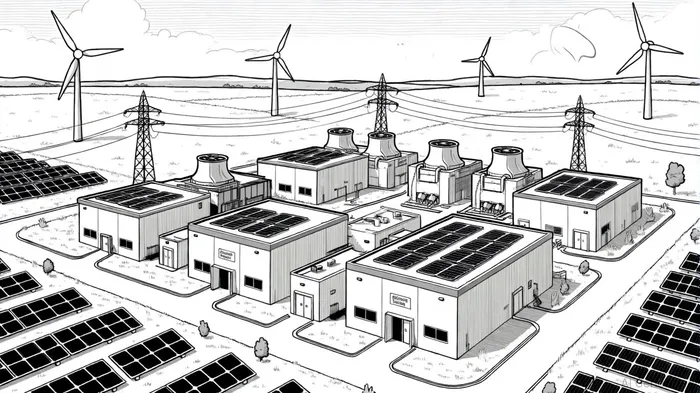
Oracle's aggressive capital expenditure (CAPEX) plans, including a $10 billion investment in 2025, underscore the urgency of scaling AI infrastructure to meet surging demand[4]. The Texas flagship site in Abilene, already operational, is a testament to this strategy. With eight data center buildings—each housing 60,000 NvidiaNVDA-- GB200 chips—the complex requires 900 megawatts of electricity, a figure that highlights the infrastructure's capacity to handle large-scale AI training and inference workloads[1].
The partnership's financial architecture is equally noteworthy. SoftBank, a key player, is funding and developing two of the five new sites, while Oracle oversees three[2]. This division of labor ensures rapid deployment without overburdening any single entity. The total investment of $400 billion already committed—nearly 80% of the $500 billion target—suggests strong alignment between private capital and strategic goals[2]. For investors, this signals a low-risk, high-impact allocation model, where shared costs and distributed risk amplify returns.
Strategic Positioning: Building AI's National Grid
The Stargate Project's geographic diversity—from Texas to Ohio and New Mexico—reflects a deliberate effort to create a resilient, decentralized AI infrastructure network[2]. This approach mirrors the U.S. power grid's redundancy, ensuring that no single point of failure disrupts operations. By 2025, the initiative aims to deliver 10 gigawatts of AI computing capacity, a figure that would rival the energy consumption of entire cities[1].
Oracle's integration of Oracle Cloud Infrastructure (OCI) into the project further cements its role as a critical enabler of AI democratization. The company's closed-loop water system and gas-fired backup power plant demonstrate a commitment to sustainability without compromising performance[1]. Such innovations align with global regulatory trends, making the project attractive to ESG-focused investors.
Politically, the initiative has secured high-level backing, with President Donald Trump emphasizing its role in maintaining U.S. AI leadership[3]. This support is not merely symbolic; it ensures access to favorable policies, tax incentives, and energy subsidies that could reduce operational costs.
Long-Term Ecosystem Implications
The Stargate Project's success hinges on its ability to catalyze a broader AI ecosystem. By creating 25,000 on-site jobs and tens of thousands of ancillary roles, the partnership is fostering a skilled workforce capable of sustaining future AI innovation[4]. This labor multiplier effect is critical for long-term growth, as it reduces dependency on foreign talent and accelerates domestic expertise.
Moreover, the project's collaboration with CoreWeave—a cloud computing provider—highlights the importance of third-party integration in scaling AI infrastructure[2]. Such partnerships ensure that the Stargate network remains adaptable to evolving technological demands, from generative AI to quantum computing.
Risks and Considerations
While the project's scale is impressive, investors must remain cautious. The energy demands of AI computing—particularly for training large models—could strain local grids and attract regulatory scrutiny. Oracle's reliance on gas-fired backup power, though practical, may conflict with net-zero pledges in some regions[1]. Additionally, the rapid pace of technological obsolescence in AI hardware (e.g., the transition from GB200 to next-gen chips) could render parts of the infrastructure obsolete within a few years.
Conclusion
The Stargate Project exemplifies the intersection of visionary capital allocation and strategic infrastructure planning. For investors, its $500 billion commitment to AI computing capacity represents not just a bet on technology, but on the U.S.'s ability to lead the next industrial revolution. By addressing energy, labor, and political challenges through innovative partnerships, OpenAI, Oracle, and SoftBank are laying the groundwork for an AI ecosystem that could redefine global competitiveness.





Comentarios
Aún no hay comentarios