
The AI Infrastructure Arms Race and Anthropic's Strategic Position in the Compute Age
The Multi-Cloud Imperative: Beyond Monoculture
The shift to multi-cloud AI infrastructure is driven by three forces: security, cost optimization, and workload specialization. Enterprises are abandoning single-cloud dependencies to mitigate risks from outages, data breaches, and vendor lock-in. Simultaneously, AI workloads-particularly in defense, IoT, and real-time analytics-require distributed architectures capable of handling petabytes of data across geographies, as the 2025 State of AI Infrastructure Report notes.
This trend is evident in the performance of companies like Palantir Technologies, which reported a 62.8% year-over-year revenue surge in Q3 2025, fueled by its AI Platform (AIP) adoption in government and commercial sectors, according to a Palantir (PLTR) Soars on AI Optimism and Analyst Upgrade, Signaling Strong Market Confidence report. Palantir's success underscores a broader truth: AI infrastructure must be agile, interoperable, and resilient-qualities only achievable through multi-cloud ecosystems.
Anthropic's $50 Billion Bet: A Multi-Cloud Powerhouse
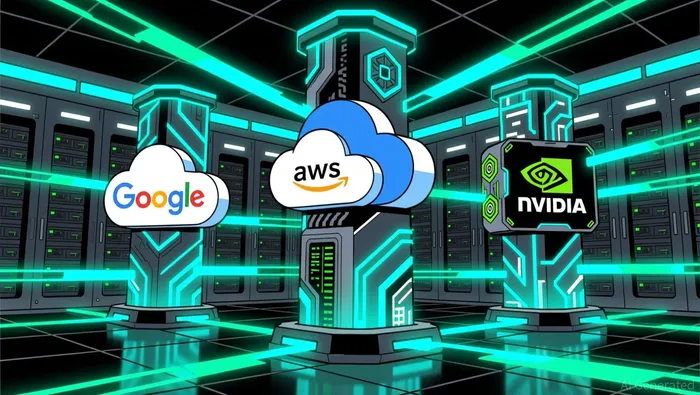
Anthropic, the creator of the Claude series, has positioned itself as a leader in this new era. The company's $50 billion investment in U.S. data centers-spanning Texas and New York-signals a bold commitment to building a compute infrastructure capable of sustaining long-term AI growth, as reported in a Forbes article. But what makes this strategy unique is its multi-cloud architecture, which integrates Google Cloud TPUs, Amazon's Project Rainier, and NVIDIA GPUs, as detailed in a blog post.
- Google Cloud: Anthropic has secured up to 1 million TPUs in a deal valued at tens of billions, enabling it to scale its AI research and Claude model training, according to the blog post.
- Amazon: As its primary cloud partner, AmazonAMZN-- has invested $8 billion into Anthropic and co-developed Project Rainier, a compute cluster spanning hundreds of thousands of AI chips, as the blog post explains.
- NVIDIA: Leveraging GPUs for flexibility, Anthropic ensures it can adapt to evolving AI workloads, from natural language processing to autonomous systems, as the blog post notes.
This diversified approach not only mitigates supply chain risks but also aligns with global sustainability goals. Anthropic's Texas and New York data centers are designed with energy-efficient cooling and renewable energy sources, reflecting a commitment to enterprise sustainability, as the Forbes article notes.
Strategic Differentiation in a Crowded Market
Anthropic's multi-cloud strategy contrasts sharply with competitors like C3.ai, which reported a 19% revenue decline in Q1 2025 and a $116.8 million net loss, prompting a strategic review and potential sale, as a TechSpot report reported. Meanwhile, BigBear.ai is carving out a niche in defense autonomy with its ConductorOS platform, but its focus on government contracts limits its scalability compared to Anthropic's enterprise-first approach, according to a SSBCrack report.
The key differentiator for Anthropic is its ecosystem flexibility. By avoiding over-reliance on a single cloud provider, it can optimize costs, leverage cutting-edge hardware (e.g., Google's TPUs for training, NVIDIA's GPUs for inference), and meet the diverse needs of clients ranging from Fortune 500 companies to national defense agencies, as the Forbes article notes.
Investment Implications: A Compute-Centric Future
For investors, Anthropic's trajectory highlights a critical insight: multi-cloud infrastructure is no longer optional-it is foundational. The company's $50 billion investment and partnerships with tech giants position it to capture a significant share of the AI infrastructure market, which is projected to grow exponentially as enterprises adopt AI at scale, according to the 2025 State of AI Infrastructure Report.
However, risks remain. The AI arms race is capital-intensive, and Anthropic's success hinges on its ability to maintain cost efficiency while competing with well-funded rivals like Google and Microsoft. Additionally, regulatory scrutiny of AI's environmental impact could pressure companies to adopt greener practices-a challenge Anthropic is proactively addressing, as the Forbes article notes.
Conclusion
The AI infrastructure arms race is defined by one question: Who controls the compute, controls the future. Anthropic's multi-cloud strategy-anchored in strategic partnerships, sustainability, and scalability-positions it as a formidable contender in this high-stakes arena. As enterprises and governments alike prioritize AI-driven innovation, Anthropic's ability to deliver a resilient, interoperable compute layer will determine its place in the compute age.
For investors, the message is clear: multi-cloud infrastructure is the bedrock of sustainable AI growth, and Anthropic's $50 billion bet is a testament to its long-term vision.







Comentarios
Aún no hay comentarios