
The AI Inflection Point: How Meta, Applied Digital, and Nvidia Are Reshaping the Future of Compute and Commerce
The artificial intelligence revolution is no longer a distant promise but a present-day reality, driven by a seismic shift in compute infrastructure and capital allocation. As demand for AI capabilities surges, companies like MetaMETA--, Applied DigitalAPLD--, and NvidiaNVDA-- are redefining the competitive landscape through bold investments, strategic partnerships, and financial commitments that signal a tectonic shift in the tech industry.
Nvidia: Vertical Integration and Ecosystem Dominance
Nvidia has positioned itself at the center of the AI infrastructure boom by securing both hardware and software dominance. According to a report by Reuters, the chipmaker is set to invest up to $100 billion in OpenAI, supplying it with data center chips while securing a financial stake in the AI firm. This move underscores Nvidia's strategy to lock in long-term relationships with AI leaders, ensuring its GPUs remain the backbone of next-generation models.
Beyond OpenAI, Nvidia is expanding its influence through cross-industry collaborations. The company recently invested $5 billion in Intel, partnering on custom data center CPUs and system-on-chip (SOC) designs. This partnership not only diversifies Nvidia's ecosystem but also addresses bottlenecks in compute performance, a critical factor as AI models grow in complexity. By aligning with both AI pioneers and traditional semiconductor firms, Nvidia is building a vertically integrated infrastructure that could solidify its dominance for years.
Meta: Scaling Compute Capacity Through Strategic Alliances
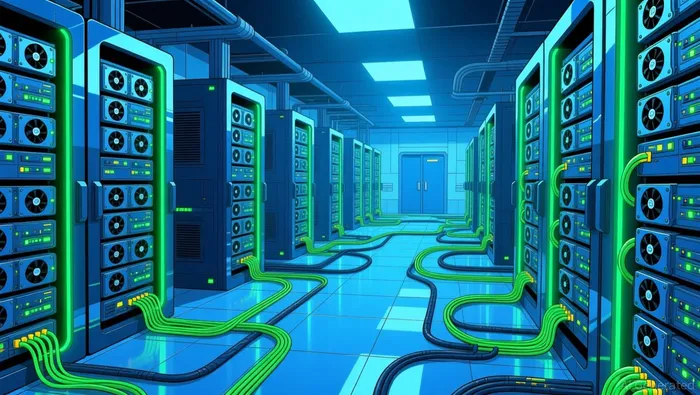 Meta's approach to AI infrastructure reflects its dual role as both a consumer and provider of cutting-edge technology. The social media giant has entered into a $14.2 billion contract with CoreWeave, a cloud computing specialist, to secure AI development capacity. This partnership highlights Meta's focus on scalability, as it races to deploy large language models and generative AI features across its platforms.
Meta's reliance on third-party providers like CoreWeave also signals a broader industry trend: the decoupling of infrastructure ownership from innovation. By outsourcing compute capacity, Meta can avoid the capital intensity of building its own data centers while still accessing the resources needed to compete with rivals like Google and Microsoft. However, this strategy introduces risks, including dependency on external partners and potential bottlenecks in supply chains.
Applied Digital: Debt-Driven Expansion in the AI Data Center Sector
Applied Digital, a relatively newer player in the AI infrastructure space, is leveraging aggressive debt financing to scale its data center operations. The company recently raised $2.35 billion through a senior secured notes offering, a move that reflects the sector's appetite for capital-intensive growth. This financing strategy mirrors broader trends, as hyperscalers including Google, Amazon, and Microsoft issued a combined $121 billion in bonds during Q3 2025-far exceeding historical averages.
While debt allows Applied Digital to rapidly expand its footprint, it also raises questions about long-term sustainability. High leverage increases vulnerability to interest rate fluctuations and execution risks, particularly in a sector where demand is still evolving. For investors, the key will be monitoring Applied Digital's ability to convert its infrastructure into recurring revenue streams, such as cloud services or AI-as-a-Service offerings.
The Bigger Picture: Compute Commerce and Competitive Differentiation
The AI infrastructure race is not just about hardware or data centers-it's about reshaping the very economics of technology. As noted in a Global X ETFs analysis, companies are forming "compute commerce" ecosystems where partnerships and financial stakes create interdependent value chains. Nvidia's investment in OpenAI, for instance, blurs the line between supplier and collaborator, while CoreWeave's contracts with Meta and OpenAI position it as a critical node in the AI supply network.
This shift has profound implications for competitive differentiation. Traditional metrics like market share or product features are being eclipsed by access to compute capacity and strategic alignment with AI leaders. For Meta, the ability to scale AI features quickly could determine its relevance in the post-social-media era. For Applied Digital, the challenge lies in proving that its debt-funded data centers can generate returns in a market still defined by rapid innovation.
Risks and Opportunities for Investors
The AI infrastructure boom presents both tailwinds and headwinds. On one hand, the sector is experiencing unprecedented capital inflows, with hyperscalers and specialized firms collectively issuing over $100 billion in bonds in 2025. On the other, execution risks-such as technical delays, regulatory scrutiny, and overleveraging-could derail even the most ambitious projects.
Investors must also consider the pace of technological change. Nvidia's dominance today could be challenged by emerging chip architectures or open-source alternatives, while Applied Digital's debt-heavy model may struggle if demand for AI infrastructure plateaus. Meta, meanwhile, faces the dual challenge of balancing AI R&D with profitability in a sector where margins are often thin.
Conclusion
The AI inflection point is here, and it is being shaped by companies that are redefining the rules of compute and commerce. Nvidia's ecosystem-building, Meta's strategic outsourcing, and Applied Digital's debt-driven expansion each reflect a unique approach to navigating this new era. For investors, the key will be identifying which strategies align with long-term trends-such as the convergence of hardware and software, the rise of compute-as-a-service, and the financialization of AI infrastructure. As the sector evolves, those who can adapt to the shifting dynamics of AI commerce will likely emerge as the next wave of industry leaders.





Comentarios
Aún no hay comentarios