
AI and Humanoid Robotics: The Next Industrial Revolution at CES 2026
The dawn of the next industrial revolution is no longer a distant promise but a tangible reality unfolding at CES 2026. As artificial intelligence (AI) converges with robotics and energy innovation, the stage is set for a transformative shift in manufacturing, logistics, and domestic life. This year's Consumer Electronics Show has spotlighted a new era where AI-driven robotics infrastructure and energy solutions are no longer speculative but foundational to global economic competitiveness. For investors, the implications are profound: the companies leading this charge-Nvidia, Hyundai, LG, and Hugging Face-are not just innovators but architects of a new industrial paradigm.
The Convergence of AI, Robotics, and Energy
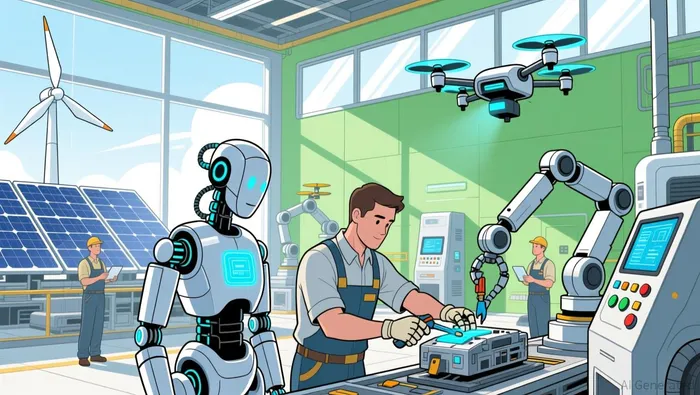
The integration of AI with robotics is no longer confined to theoretical models. At CES 2026, Hyundai Motor Group unveiled its Atlas humanoid robot, a 56-degree-of-freedom machine designed for industrial tasks like material sequencing in manufacturing plants according to company announcements. This robot, developed in partnership with Boston Dynamics, exemplifies the shift from rigid automation to adaptive, human-centric collaboration. Hyundai's Software-Defined Factory (SDF) and Robot Metaplant Application Center (RMAC) further underscore this trend, enabling robots to learn and adapt to dynamic environments. Such systems require not only advanced AI but also robust energy solutions to sustain continuous operation-a challenge addressed by LG Energy Solution's expansion into energy storage systems.
Meanwhile, NvidiaNVDA-- has emerged as a critical enabler of this revolution. The company's Jetson T4000 module, powered by the Blackwell architecture, delivers four times the energy efficiency of previous generations, making it ideal for autonomy applications. Paired with open-source models like Cosmos Transfer 2.5 and Isaac GR00T N1.6, Nvidia is democratizing access to physical AI, allowing developers to simulate and deploy robots capable of reasoning and adapting to real-world tasks. Hugging Face's collaboration with Nvidia to integrate these models into the LeRobot framework further accelerates innovation, creating a global ecosystem where open-source tools and hardware coalesce.
Strategic Investments and Sovereign AI Dynamics
The rise of sovereign AI initiatives is reshaping the investment landscape. Governments are no longer passive observers but active participants in securing strategic autonomy. According to industry analysis, the UK's £18 billion Sovereign AI Unit, Saudi Arabia's $40+ billion HUMAIN initiative, and the U.S.'s $500 billion Project Stargate are all betting on localized AI infrastructure to reduce reliance on foreign technology. These programs directly influence corporate strategies: Hyundai's AI Robotics Strategy, for instance, aligns with global efforts to localize production and data sovereignty, positioning the company to capitalize on state-backed investments in AI manufacturing.
LG's expansion into energy solutions-such as its 109 GWh EV battery deal with Ford and partnerships in aerospace battery development- reflects a similar alignment. By securing long-term contracts and investing in U.S. gigafactories, LG Energy Solution is not only diversifying its revenue streams but also aligning with national priorities to bolster domestic energy security. For investors, this signals a shift from purely market-driven growth to a hybrid model where geopolitical and regulatory forces play a decisive role.
The Human-Centric Future: From Factories to Homes
The convergence of AI and robotics is not limited to industrial applications. LG's CLOiD home robot, unveiled at CES 2026, embodies the "Zero Labor Home" vision, performing tasks like folding laundry and cooking while integrating with the company's ThinQ ecosystem. This robot, equipped with Affectionate Intelligence technology, learns from user interactions to deliver personalized assistance-a leap beyond traditional automation. Such innovations are underpinned by energy-efficient hardware and AI models that balance computational power with sustainability, a niche where Nvidia's Jetson T4000 and Hugging Face's open-source frameworks are proving indispensable.
Hyundai's foray into logistics and construction robotics further illustrates the sector's breadth. By 2028, the Atlas robot will be deployed at the Hyundai Motor Group Metaplant America to handle precision tasks, while the company's partnerships with Google DeepMind aim to enhance robotic reasoning for complex environments. These efforts are not isolated; they are part of a broader trend where AI-driven infrastructure-powered by sovereign energy solutions-becomes the backbone of economic resilience.
Investment Implications and the Road Ahead
For investors, the key lies in identifying companies that are both innovators and integrators. Nvidia's role as a platform provider-bridging AI models, hardware, and open-source ecosystems- positions it as a linchpin in the physical AI revolution. Similarly, Hyundai's strategic partnerships and vertical integration in robotics and energy solutions offer a scalable model for industrial adoption. LG's dual focus on home automation and energy storage, meanwhile, creates a diversified portfolio that aligns with both consumer and industrial demand.
However, the risks are non-trivial. Sovereign AI initiatives, while supportive, can also fragment global markets, creating regulatory hurdles for cross-border collaboration. Moreover, the energy demands of AI-driven robotics infrastructure-particularly in data centers and autonomous systems- necessitate continued innovation in battery technology and renewable energy integration.
Conclusion
CES 2026 has crystallized a vision of the future where AI and robotics are not just tools but partners in human progress. The companies leading this charge-Hyundai, LG, Nvidia, and Hugging Face-are not merely responding to technological change; they are shaping it. For investors, the next industrial revolution offers both opportunity and complexity. Those who recognize the interplay of AI, energy, and sovereign strategy will be best positioned to navigate the challenges and capitalize on the rewards of this transformative era.







Comentarios
Aún no hay comentarios