
The AI Home Revolution: How Samsung and LG Are Reshaping Smart Living and Capturing Market Share
The global AI-integrated home appliance market is undergoing a seismic shift, driven by rapid advancements in artificial intelligence, IoT, and consumer demand for smarter, more efficient living solutions. As of 2025, the market is projected to grow at a compound annual growth rate (CAGR) of 14% between 2025 and 2032, with major players like Samsung and LG leading the charge. These two Korean tech giants are not only capturing market share but also redefining the smart home ecosystem through strategic innovation, robust R&D investments, and ecosystem-driven partnerships. For investors, the convergence of technological leadership and financial strength in these companies presents compelling opportunities in the AI home revolution.
Market Dynamics and Growth Projections
The AI home appliance sector is expanding rapidly, fueled by demand for devices that enhance convenience, energy efficiency, and personalized user experiences. According to a report by Intel Market Research, the global AI major appliance market size was valued at USD 10.72 billion in 2024 and is projected to reach USD 23.31 billion by 2032, with a CAGR of 11.8%. This growth is underpinned by innovations such as AI-powered refrigerators that suggest recipes based on inventory and washing machines that adjust cycles automatically.
North America is emerging as a key growth driver, with its high adoption rates of smart home technologies and a consumer base increasingly prioritizing connectivity and automation according to market analysis. Meanwhile, emerging markets in Asia-Pacific and Latin America are expected to contribute significantly to expansion as urbanization and disposable incomes rise according to Intel Market Research.
Samsung: Leveraging Semiconductor Dominance and Ecosystem Integration
Samsung's dominance in the AI home appliance market is closely tied to its leadership in semiconductor manufacturing and its SmartThings ecosystem. In Q3 2025, Samsung reported consolidated revenue of KRW 86.1 trillion, a 15.4% increase from the previous quarter, with its Device Solutions (DS) division contributing KRW 33.1 trillion in revenue. The DS division, which includes memory and semiconductor products, is critical to Samsung's AI strategy, as high-bandwidth memory (HBM) and server SSDs are foundational to AI applications.
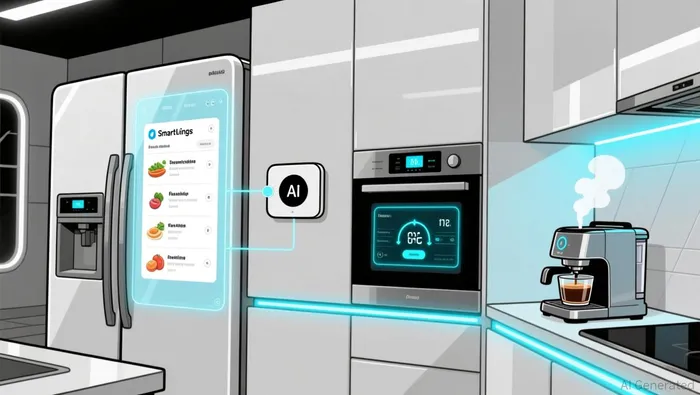
Samsung's Device eXperience (DX) division is also accelerating AI integration across home appliances. The division reported an 11% quarter-over-quarter revenue increase in Q3 2025, driven by the launch of new foldable phones and flagship devices. While specific revenue figures for AI-integrated home appliances are not disclosed, the DX division's focus on AI-driven product innovation-such as smart fridges with AI-based inventory management-signals a strategic pivot toward AI-centric offerings.
Samsung's financial muscle further strengthens its position. The company plans to invest $44 billion in a new semiconductor plant in Texas, a move that will bolster its supply chain resilience and reinforce its role in the AI hardware ecosystem. Additionally, Samsung's SmartThings platform, which connects over 100 million devices globally, provides a scalable foundation for expanding AI-driven home automation solutions.
LG: Dual-Track Strategy and AI-Driven Ecosystem Expansion
LG's approach to the AI home appliance market is characterized by its "Two Track strategy," which targets both premium and mass-market segments. In Q1 2025, LG reported its highest-ever consolidated revenue of KRW 22.74 trillion, with an operating profit of KRW 1.26 trillion. The company's Home Appliance & Air Solution division, which reported KRW 33.2 trillion in revenue for 2024, is a key growth engine, driven by AI-integrated products like smart ovens and AI-powered air purifiers.
LG's R&D investments are equally impressive. In 2024, the company allocated KRW 4.76 trillion ($3.28 billion) to R&D, with a focus on AI-driven smart home technology and automotive electronics. For 2025, LG plans to invest an additional $70 billion in AI development, targeting high-margin opportunities in the AI data center market. This includes the commercialization of AI models like EXAONE and the establishment of Pado AI, a spin-off focused on energy management solutions.
Strategic partnerships are amplifying LG's reach. The acquisition of Athom in 2024, a Dutch company behind the Homey smart home platform, has strengthened LG's open-standard integration capabilities, particularly with protocols like Matter. Additionally, LG's collaboration with Microsoft and its involvement in Saudi Arabia's Net Zero AI data center project highlight its ambition to transition from component supplier to integrated AI solutions provider.
Investment Considerations: Financial Health and Strategic Positioning
Both Samsung and LG demonstrate strong financial health, with Samsung's Device Solutions division accounting for 57% of the company's operating profit in 2024. LG, meanwhile, aims to achieve B2B sales exceeding $14.6 billion by 2025, with AI-driven solutions forming a core part of its growth strategy according to market analysis.
For investors, the key differentiators lie in their strategic positioning:
- Samsung benefits from its semiconductor dominance and ecosystem scalability, making it a critical player in the hardware layer of AI home appliances.
- LG excels in software and AI integration, with a dual-track strategy that balances mass-market accessibility with premium innovation.
Moreover, both companies are capitalizing on Edge AI and TinyML technologies, which enable on-device intelligence and reduce reliance on cloud connectivity. This trend aligns with growing consumer concerns over data privacy and enhances the long-term viability of their AI appliances.
Conclusion: A Dual-Opportunity Landscape
The AI home appliance market is poised for explosive growth, with Samsung and LG at the forefront of innovation and market capture. Samsung's semiconductor expertise and ecosystem integration, coupled with LG's dual-track strategy and AI-first R&D investments, position both companies as attractive long-term investment opportunities. As the market evolves, their ability to scale AI-driven solutions while addressing consumer needs for privacy and efficiency will be critical to sustaining their leadership. For investors, the AI home revolution is not just a technological shift-it's a strategic battleground where Samsung and LG are already winning.







Comentarios
Aún no hay comentarios