
AI in Healthcare: Anthropic's Strategic Expansion with Claude for Healthcare
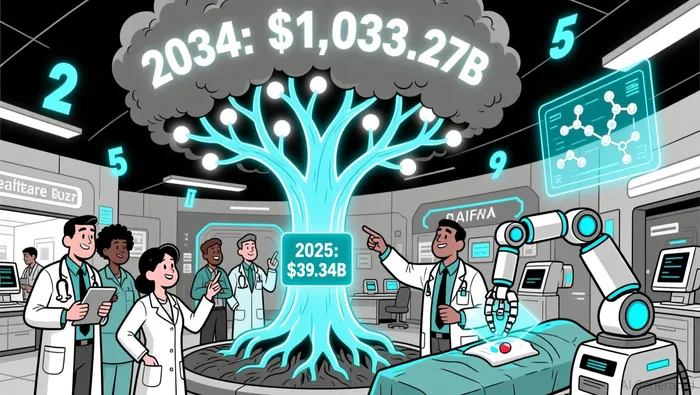
The AI healthcare market is undergoing a seismic shift, driven by a confluence of technological innovation, systemic healthcare challenges, and surging capital inflows. As global healthcare systems grapple with rising costs, an aging population, and data complexity, AI is emerging not just as a tool but as a foundational infrastructure layer. According to a report by Fortune Business Insights, the AI healthcare market was valued at USD 39.34 billion in 2025 and is projected to grow at a compound annual growth rate (CAGR) of 43.96% from 2026 to 2034, reaching USD 1,033.27 billion by 2034. This trajectory underscores a critical inflection point for investors, particularly as companies like Anthropic are redefining the landscape through targeted strategic expansions.
Anthropic's Strategic Expansion: A Case Study in Enterprise Adoption
Anthropic's 2025 launch of Claude for Healthcare and the expansion of Claude for Life Sciences exemplifies how AI is being tailored to solve industry-specific pain points. By integrating HIPAA-compliant connectors to databases like the CMS Coverage Database and ICD-10, Anthropic is addressing the urgent need for interoperability and regulatory compliance in healthcare workflows. These tools streamline tasks such as prior authorization requests and clinical trial management, which are notoriously time-consuming and error-prone. For instance, the partnership with HealthEx allows patients to connect their medical records to Claude, enabling personalized health insights and democratizing access to complex medical data.
On the enterprise side, Anthropic's collaboration with Accenture is a masterstroke. This multi-year partnership, which includes training 30,000 Accenture professionals on Claude and forming the Accenture Anthropic Business Group, signals a shift from AI experimentation to full-scale deployment. The focus on regulated industries like healthcare and life sciences aligns with a broader trend: 70% of healthcare organizations are actively pursuing generative AI implementation, prioritizing solutions with measurable ROI. Anthropic's integration with platforms like Medidata and ClinicalTrials.gov further positions it as a key player in accelerating drug discovery and clinical research, areas projected to see exponential growth as AI reduces R&D timelines and costs.
Investment Potential: AI as a Strategic Infrastructure Play
The investment case for AI in healthcare is bolstered by three pillars: market growth, enterprise adoption, and operational efficiency gains.
Market Growth: By 2035, the AI healthcare market is forecasted to reach USD 928.18 billion, growing at a CAGR of 37.66% from 2026. This growth is fueled by advancements in diagnostics (e.g., 99.6% accuracy in detecting heart attacks), robotic-assisted surgery, and mental health solutions. The Asia-Pacific region, with its rapid AI adoption in China and Japan, is emerging as a second growth engine, complementing North America's 44.50% market share in 2025.
Enterprise Adoption: Healthcare providers and payers are prioritizing AI for revenue cycle management (RCM) and administrative automation. A 2025 report by Menlo Ventures notes that 81% of healthcare organizations using AI report increased revenue, while 73% cite reduced operational costs. Anthropic's focus on HIPAA-compliant tools and partnerships with industry giants like Accenture directly addresses these needs, reducing the friction of AI adoption in highly regulated environments.
- Operational Efficiency: AI is transforming healthcare from a cost center to a value driver. For example, generative AI is automating documentation and prior authorization, tasks that consume 20% of clinicians' time. Anthropic's tools, which integrate with existing systems like CMS and ICD-10, are designed to minimize disruption while maximizing ROI-a critical factor for risk-averse healthcare executives.
The Road Ahead: Agentic AI and Robotics as Next-Gen Opportunities
Looking beyond 2025, the next frontier for AI in healthcare lies in agentic AI and AI-powered robotics. Anthropic's expansion into life sciences and its partnerships with platforms like PubMed suggest a long-term vision of AI as a collaborative agent in drug discovery and clinical decision-making. Similarly, the integration of AI in robotic-assisted surgery- a segment capturing the largest market share in 2024-highlights the potential for AI to enhance surgical precision and reduce recovery times.
Investors should also monitor the generative AI subset, which is projected to grow from USD 3.3 billion in 2025 to USD 39.8 billion by 2035 at a CAGR of 26.7%. Anthropic's focus on personalized health insights and clinical trial management positions it to capitalize on this trend, particularly as patient-centric care models gain traction.
Conclusion: A Compelling Investment Thesis
The AI healthcare market is no longer a speculative bet-it's a strategic imperative. With global healthcare AI spending reaching USD 1.4 billion in 2025 and surging to over USD 100 billion by 2030, the sector is attracting capital at an unprecedented rate. Anthropic's strategic expansion, characterized by HIPAA-compliant tools, enterprise partnerships, and life sciences integration, aligns perfectly with the industry's shift from exploration to execution. For investors, the key takeaway is clear: AI-driven healthcare infrastructure is not just a growth sector but a foundational pillar of the future of medicine.







Comentarios
Aún no hay comentarios