
The AI Gold Rush: Separating Fundamental Strength from Speculative Fervor
The artificial intelligence sector in 2025 is a study in contrasts: a landscape of breathtaking innovation and explosive growth, yet shadowed by concerns of overvaluation and speculative excess. According to Stanford HAI's 2025 AI Index and AI industry statistics, the global AI market size is projected to balloon from $542.5 billion in 2025 to $10,173.1 billion by 2034, growing at a 38.5% compound annual growth rate (CAGR). This trajectory is fueled by generative AI, which attracted $33.9 billion in private funding in 2024-a 18.7% increase from the prior year, according to Stanford HAI's 2025 AI Index.
The Fundamentals: A New Era of Revenue and Market Dominance
The financial performance of leading AI companies paints a picture of dominance. NVIDIANVDA--, the poster child of the AI revolution, reported record-breaking Q3 FY2025 results, with total revenue of $35.1 billion-a 94% year-over-year increase-and a Data Center segment generating $30.8 billion, up 112% YoY, according to a Morgan Stanley analysis. Its Hopper and Blackwell GPUs have become indispensable for AI training and inference, cementing its role as the backbone of global AI infrastructure, as the Morgan Stanley analysis notes. Microsoft's Intelligent Cloud segment, driven by Azure, reported $26.8 billion in revenue for Q3 2025, a 21% YoY increase, according to a Microsoft press release. AmazonAMZN--, though less vocal, is quietly expanding its AI infrastructure, with AWS revenue in Q2 2025 reaching $30.4 billion to $30.72 billion, bolstered by tools like Amazon Bedrock and SageMaker, according to Stanford HAI's 2025 AI Index.
Market capitalizations reflect this momentum. NVIDIA commands a staggering $4.28 trillion, followed by MicrosoftMSFT-- at $3.74 trillion and Amazon at $2.42 trillion, figures highlighted in the Microsoft press release and in AI industry statistics. These figures underscore the market's belief in AI's transformative potential, particularly in cloud computing and enterprise solutions.
The Speculative Haze: Overvaluation and Market Saturation
Yet, beneath the surface, cracks are emerging. The Morgan Stanley analysis warns of a 16% decline in free cash flow growth for major AI cloud providers over the next 12 months, driven by market saturation and monopolistic practices. For instance, OpenAI's annualized revenue of $12–$13 billion (primarily from ChatGPT subscriptions and API usage) and Anthropic's $5 billion ARR, while impressive, pale in comparison to the valuations assigned to these firms-LLM vendors trade at 44.1x revenue, far outpacing legal tech and prop tech multiples, according to AI startup valuations.
The venture capital frenzy exacerbates these concerns. In early 2025, AI startups raised $73.1 billion, accounting for 57.9% of all global VC deals, according to an AI company revenue guide. Such concentrated speculation echoes past risky strategies, including vendor-financing deals in generative AI, which prioritize short-term hype over long-term sustainability, as the Morgan Stanley analysis describes.
A Balancing Act: Innovation vs. Prudence
The AI sector's duality is perhaps best captured by its valuation dynamics. While NVIDIA's Data Center revenue surged to $41.1 billion in Q3 2025, according to the AI company revenue guide, and Amazon's AI infrastructure capex is projected to hit $100 billion in 2025, as the Morgan Stanley analysis projects, these figures must be weighed against slowing growth in key segments. For example, hyperscalers are grappling with diminishing returns as demand for AI infrastructure matures, a trend highlighted by Morgan Stanley.
Conclusion: The Road Ahead
The AI revolution is here, but investors must navigate it with both optimism and caution. The fundamentals-driven by NVIDIA's hardware dominance, Microsoft's cloud prowess, and Amazon's infrastructure bets-are undeniably robust. However, the speculative fervor, evidenced by inflated valuation multiples and VC overflows, introduces volatility. As Bain & Company notes, AI could disrupt tech's most valuable companies, but only if they adapt to evolving market dynamics.
For now, the sector remains a high-stakes game: one where innovation fuels growth, but prudence tempers it. 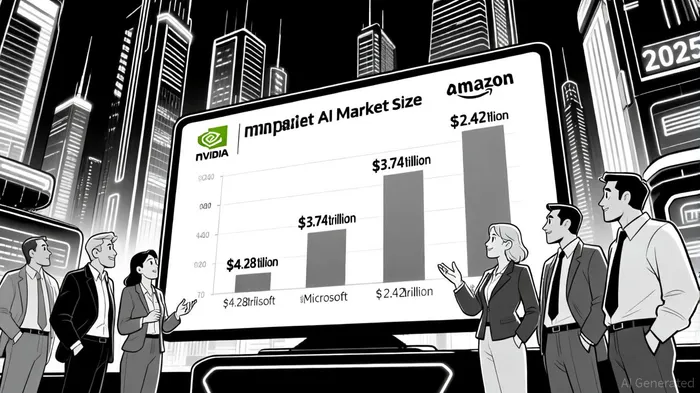





Comentarios
Aún no hay comentarios