
Take-Two’s AI Fear Sell-Off Creates Tactical Buy Setup Amid Strong Booking Pipeline
The sell-off in Take-Two's stock is a classic case of a specific news event triggering a broad market overreaction. The catalyst was Google's January 30 announcement of Project Genie, a generative AI tool capable of creating interactive, playable worlds from simple prompts. For investors, this wasn't just another AI demo. It directly threatened the core technological moats of companies like Rockstar, whose long-standing advantage has been built on complex, proprietary engines like RAGE. The market's immediate reaction was visceral: Take-Two's stock dropped 7.9% that day, marking the start of a steep 5-day losing streak.
The scale of the panic was significant. Over those five days, the company's market capitalization has plummeted by around $4.7 billion, bringing its total value down to roughly $41 billion. This isn't a minor correction; it's a multi-billion dollar repricing based on a single event. The fear was sector-wide, with Unity Software dropping 19% and Roblox falling over 12% on the same day. This broad-based decline suggests a "fear of the future" event, where investors collectively priced in a long-term disruption to game development workflows, rather than a company-specific problem.
Yet, the tactical setup here hinges on the disconnect between this knee-jerk reaction and the company's fundamental outlook. The sell-off is a pure sentiment play on AI disruption fears. The evidence shows the market is reacting to a potential future threat, not a current operational failure. The key question for a tactical investor is whether this fear is overblown. The technology, while impressive, is still nascent. As one analyst noted, the current output is essentially "AI slop" with significant limitations in consistency and physics. The real-world impact on premium, multi-year development cycles like GTA VI remains distant. This creates a potential mispricing: a sharp, broad-based drop driven by speculative fear, while the company's core business-its robust bookings and upcoming game releases-remains intact.
The Disconnect: AI Risk vs. Booking Reality
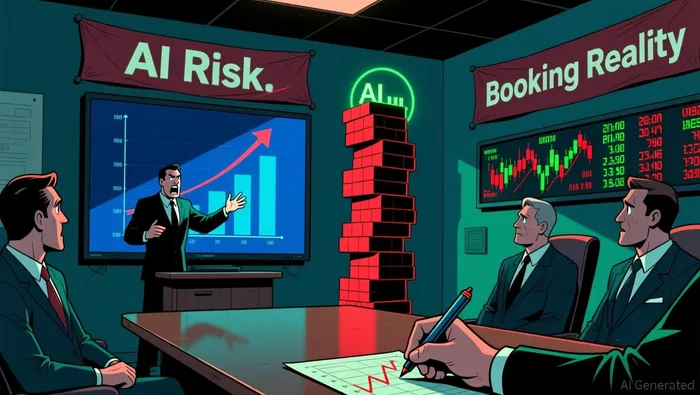
The market's reaction has been a pure sentiment play, but the company's financials tell a different story. Despite the steep 5-day drop, Take-TTwo's underlying business strength remains robust. The company just reported Q4 revenue of $1.70 billion, which beat estimates by 7.5% and showed 24.9% year-over-year growth. More importantly, its forward guidance is strong. For the full fiscal year, management raised its outlook to Net Bookings of $5.9 to $6.0 billion, a clear signal of continued momentum. This booking power, driven by franchises like GTA Online and NBA 2K, is the real engine of value, not speculative fears about future AI tools.
The primary risk is a permanent devaluation of the technological moat. The market is pricing in a long-term threat to the complex, proprietary engines that have defined AAA development. Yet, the current state of AI is far from a replacement. As noted, tools like Google's Project Genie produce output that is essentially "AI slop" with significant limitations in consistency and physics. They cannot yet create the fully playable, scripted, and mission-driven worlds like GTA VI. The threat is real, but it's a future one, not a present operational failure.
This creates a stark disconnect. The stock's year-to-date decline of -14.0% significantly underperforms the S&P 500's gain, suggesting the market is pricing in existential risk beyond current fundamentals. The tactical setup is clear: a multi-billion dollar repricing based on a nascent technology, while the company's booking pipeline and recent financial beats remain intact. For a tactical investor, this gap between fear and reality is where the opportunity lies.
The Setup: Key Levels and Near-Term Catalysts
For a tactical play on this mispricing, the focus must be on the immediate events that will either confirm the AI fear thesis or validate the underlying booking reality. The setup is defined by three key levels and catalysts.
First, the primary near-term catalyst is the Q1 CY2026 earnings report in late April. This release will be a critical test of management's confidence. The company has already shown strong guidance, with Q1 revenue guidance of $1.60 billion at the midpoint, which beat analyst expectations. A beat here would reinforce the robust booking pipeline and provide a tangible counter-narrative to AI fears. Conversely, any guidance cut or commentary that acknowledges the AI threat would likely reignite the sell-off.
Second, investors must monitor for any official response from Take-TwoTTWO-- or Rockstar on the AI threat. Management may push for a more aggressive marketing cycle for upcoming titles like GTA VI to reassure investors and reinforce the premium, human-crafted experience. CEO Strauss Zelnick has already stated that people are largely overstating what it can do and that no one will be able to prompt an AI to deliver a competitor to Grand Theft Auto. Any public pushback from the company's leadership could help stabilize sentiment.
Finally, watch for stabilization in the broader gaming sector. The sell-off has been broad-based, with Unity Software dropping 24.2% and RobloxRBLX-- falling 13.1% on the same day. If sentiment improves and these stocks begin to recover, it would signal a de-escalation of the AI fear trade and could provide a tailwind for Take-Two. The tactical trade hinges on this sector-wide volatility subsiding.
The bottom line is that the current setup offers a clear risk/reward. The stock is down sharply on speculative fear, but the fundamental catalysts-strong bookings, a solid Q1 guide, and a potential management pushback-are all in place. The next few weeks will determine if this is a temporary mispricing or the start of a sustained re-rating.





Comentarios
Aún no hay comentarios