
AI-Enabled Open RAN and Its Pathway to 6G: A Strategic Investment Play in Telecom Transformation
The telecom industry is on the cusp of a seismic shift, driven by the convergence of AI-enabled Open RAN (O-RAN) and the impending rollout of 6G networks. For investors, this represents a golden opportunity to capitalize on a sector poised for exponential growth. According to a report by Mordor Intelligence, the AI-enabled Open RAN market is projected to surge from USD 3.98 billion in 2025 to USD 19.58 billion by 2030, growing at a blistering CAGR of 37.56%. This isn't just a tech story-it's a structural transformation of global infrastructure, and the stakes couldn't be higher.
The 6G Catalyst: Why AI and Open RAN Matter
The transition from 5G to 6G isn't merely about faster speeds; it's about redefining the very architecture of telecom networks. Dell'Oro Group forecasts that 6G-related RAN capital expenditures (capex) will account for 55–60% of total RAN investments between 2029 and 2034. This shift is being fueled by AI-native networks, which enable autonomous optimization, predictive maintenance, and real-time decision-making. Omdia adds that global communications provider (CP) revenue could hit $5.6 trillion by 2030, with AI and 6G investments as the twin engines of growth.
The key to unlocking this potential lies in Open RAN. Unlike traditional monolithic systems, Open RAN allows for multi-vendor interoperability, slashing total cost of ownership (TCO) and enabling rapid innovation. Grand View Research notes that the Open RAN market itself is growing at a CAGR of 25.6%, with AI integration accelerating adoption. 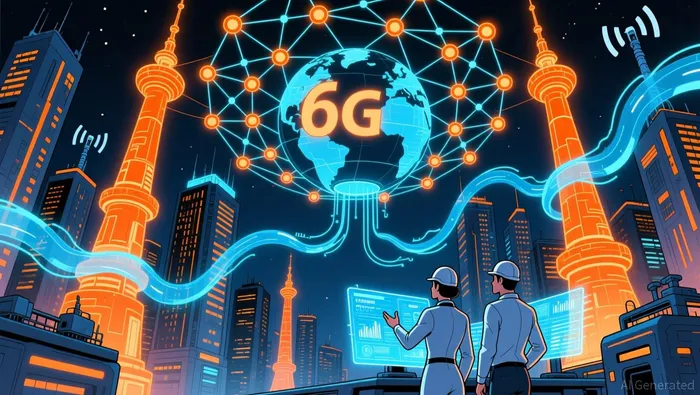
Strategic Alliances: NVIDIA, NokiaNOK--, and the AI-RAN Ecosystem
The most compelling investment story here is the NVIDIA-Nokia partnership. In a landmark move, NVIDIA has committed $1 billion to Nokia to accelerate AI-RAN development, creating a 6G-ready platform called the Arc Aerial RAN Computer. This collaboration isn't just about hardware-it's about building a software-defined infrastructure that can evolve from 5G-Advanced to 6G with software updates. T-Mobile U.S. and Dell Technologies are already testing these technologies, with field trials expected in 2026.
The AI-RAN Alliance, now boasting over 100 members, is another critical player. Companies like Samsung, SoftBank, Ericsson, and Vodafone are leveraging AI to optimize RAN performance, reduce power consumption, and unlock new revenue streams. For example, Samsung and SK Telecom are pioneering AI-powered 6G networks in South Korea, while Ericsson and Nokia are leading AI-driven RAN automation in Europe.
Government Incentives: A Tailwind for Open RAN
Governments are turbocharging this transition. The U.S. has allocated $1.5 billion for open-network programs, including open-radio prototypes from firms like JMA Wireless and Nokia. Similarly, the EU and South Korea are pushing for Open RAN adoption to diversify supply chains and bolster national security. These policies reduce regulatory risks and create a fertile ground for startups and incumbents alike.
Investment Opportunities and Risks
The AI-Enabled Open RAN ecosystem offers multiple entry points for investors. First, there's the hardware-software integration layer, where companies like NVIDIA and Nokia are dominating. Second, the edge AI inferencing market, crucial for 6G applications like integrated sensing and communications, is projected to grow into a $200 billion market by 2030. Third, the AI-RAN Alliance's open API ecosystem mirrors the app revolution, creating opportunities for network app developers and federated learning frameworks.
However, risks abound. Data sovereignty and AI model governance remain thorny issues, particularly as generative AI and large language models (LLMs) enter the mix. The concentration of mobile network market share in China also poses geopolitical risks, from spectrum policy to infrastructure exports. Investors must prioritize companies with strong Sovereign AI strategies-those that emphasize national or operator-level control over AI development and deployment.
The Bottom Line: A No-Brainer for Long-Term Investors
The telecom sector is entering a new era, and AI-Enabled Open RAN is the linchpin. With 6G on the horizon, the companies that master AI-native infrastructure, secure government partnerships, and navigate regulatory risks will dominate the next decade. For investors, this means doubling down on leaders like NVIDIA and Nokia while keeping an eye on the AI-RAN Alliance's ecosystem. The numbers don't lie: this is a $20 billion market by 2030, with 6G capex set to outpace 5G. The question isn't whether to invest-it's how much to bet.







Comentarios
Aún no hay comentarios