
The AI-Driven Workforce Transition: Investment Opportunities in Automation and Reskilling
The Urgency of Capital Reallocation
The scale of AI-driven layoffs underscores the need for immediate action. In October 2025 alone, the U.S. saw 153,000 jobs lost, with 33,281 in tech and 47,878 in warehousing, according to a New York Post report. While AI is a key driver, economic pressures and cost-cutting strategies also play roles. For instance, UPSUPS-- reduced its workforce by 48,000 positions, shifting focus from Amazon to higher-margin industries, a CNBC analysis notes. These shifts highlight a dual challenge: addressing short-term unemployment while investing in long-term solutions to retrain displaced workers.
The White House's AI Action Plan, released in July 2025, aims to address this by allocating federal funds for rapid retraining programs, a Governing analysis notes. Meanwhile, private capital-particularly private equity and venture capital-is surging into AI infrastructure, with the U.S. dominating 83% of AI-related transaction value in H1 2025, according to a JDSupra report. This bifurcation of capital-toward both automation and reskilling-defines the current landscape.
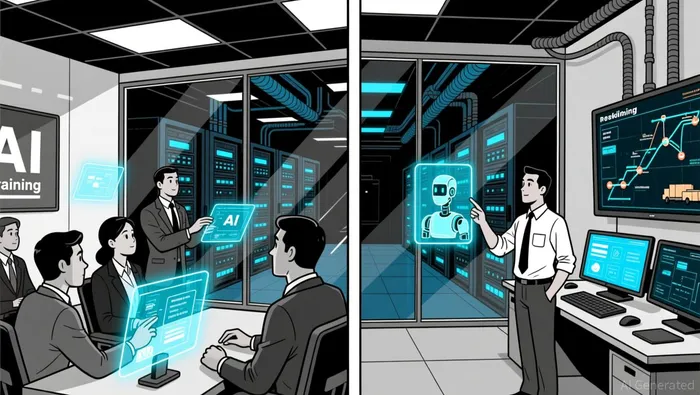
AI Infrastructure: The New Gold Rush
The AI infrastructure market is booming, driven by demand for platforms that integrate hardware, software, and data analytics. Palantir Technologies, a leader in AI-driven decision-making, exemplifies this trend. Its Artificial Intelligence Platform (AIP) is being adopted by governments and corporations for logistics, healthcare, and defense applications, a Wral Markets report notes. A $10 billion, 10-year contract with the U.S. Army and a £1.5 billion deal with the UK Ministry of Defence have propelled Palantir's revenue growth, with U.S. commercial sales surging 121% year-over-year, the Wral Markets report notes.
BigBear.ai, another key player, is capitalizing on defense and homeland security spending. The One Big Beautiful Bill-a $320 billion legislative package-allocates $150 billion for disruptive defense technologies, directly aligning with BigBear's expertise in biometrics, autonomy, and maritime intelligence, a Nasdaq report notes. The company's ConductorOS platform is already deployed in swarming drone operations and is set to support U.S. Navy missions in 2025, the Nasdaq report notes. With $390.8 million in cash and a $380 million backlog, BigBear.ai is well-positioned to scale its offerings, the Nasdaq report notes.
Human Capital Development: Bridging the Skills Gap
While infrastructure investments are critical, reskilling displaced workers is equally urgent. Shell's AI-driven initiatives offer a blueprint. By deploying over 100 AI applications-ranging from deep-sea oil exploration to electric vehicle charging stations-Shell has reduced exploration times from nine months to nine days, a Analytics Insight case study notes. Such innovations require a workforce adept at AI tools, prompting companies to invest in training. The AI process optimization market, projected to grow at a 40.4% CAGR through 2034, according to a Market.us report, underscores the long-term value of these efforts.
Government programs are also stepping in. Connecticut's legislation to measure AI's workforce impact and provide reskilling opportunities reflects a growing trend, a Governing analysis notes. Meanwhile, the White House's AI Action Plan emphasizes federal funding for retraining, particularly in states with favorable regulatory environments, the Governing analysis notes. These initiatives, though still nascent, signal a shift toward proactive workforce adaptation.
Strategic Investment Opportunities
For investors, the intersection of AI infrastructure and human capital development presents two clear avenues:
1. AI Infrastructure Providers: Companies like Palantir and BigBear.ai are benefiting from both corporate and government demand. Palantir's recent partnerships with Nvidia and Dubai Holding highlight its versatility, while BigBear.ai's focus on defense AI aligns with multi-year funding trends, the Nasdaq report notes.
2. Reskilling Platforms: Firms enabling workforce transitions-such as C3 AI (despite recent challenges, a GlobeNewswire report notes) and edtech startups-stand to gain as governments and corporations prioritize training. The AI process optimization market's growth trajectory, according to the Market.us report, further validates this potential.
Conclusion
The AI-driven workforce transition is no longer a hypothetical scenario but a present reality. As layoffs mount and industries restructure, capital must be reallocated to both automate efficiently and reskill effectively. The winners in this transition will be those who invest in scalable AI infrastructure and forward-looking human capital strategies. For investors, the path forward is clear: align with companies and policies that balance innovation with inclusivity.





Comentarios
Aún no hay comentarios