
The AI-Driven Transformation of Logistics and Its Implications for Tech and Sectoral Valuations
C.H. Robinson: AI as a Margin-Enhancing Engine
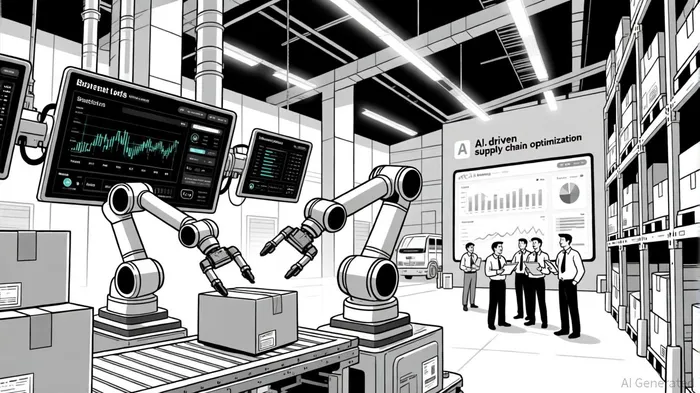
C.H. Robinson (C.H. Robinson), a global leader in logistics and supply chain management, has emerged as a poster child for AI's practical application in industrial sectors. Between 2023 and 2025, the company's "Lean AI" strategy has delivered double-digit productivity gains, scalable margin improvements, and a dramatic reduction in operating expenses. According to The Outpost AI, C.H. Robinson's North American Surface Transportation (NAST) segment achieved a 39% adjusted operating margin in Q3 2025, even as the broader freight market contracted by 7.2% year-over-year (The Outpost AI). This performance underscores the power of AI to optimize asset utilization and reduce costs in a capital-intensive industry.
The company's AI-driven automation has streamlined processes such as quote generation, shipment tracking, and demand forecasting. As stated by Seeking Alpha, C.H. Robinson reduced operating expenses by 12.6% year-over-year in 2025 while cutting employee headcount by 10.8%, demonstrating that AI can enhance efficiency without compromising service quality (Seeking Alpha). These gains have directly translated into financial performance: the company raised its 2026 operating income target by $50 million and reported $1.40 per share in adjusted earnings for Q3 2025, surpassing analyst expectations.
Palantir: The AI Bubble in the Tech Sector
In stark contrast to C.H. Robinson's grounded AI success lies Palantir Technologies (PLTR), a company whose valuation has soared to levels that defy conventional metrics. As of October 2025, Palantir trades at a forward price-to-sales (P/S) ratio of approximately 100× and a forward price-to-earnings (P/E) ratio of 277×, according to Tech Street 2 (Tech Street 2). These multiples place it among the most expensive software stocks in history, despite the company's FY2025 revenue of just $4.2 billion.
Palantir's valuation is driven by speculative optimism around its Artificial Intelligence Platform (AIP), a cloud-agnostic tool designed for enterprise AI integration. While the platform has attracted high-profile contracts-such as a $10 billion U.S. Army agreement-its financials remain unproven. A Tickeron analysis notes that Palantir's stock surged 145% from April to September 2025, fueled by bullish sentiment about its AI ambitions (Tickeron). However, the company's valuation implies that it would take over a century to recoup its market capitalization based on current revenue, raising questions about its sustainability.
Critics argue that Palantir's valuation lacks a foundation in earnings or consistent growth. As highlighted by FX Street, some analysts label the stock "wildly overvalued," citing the absence of substantial earnings growth to justify its multiples (FX Street). While Palantir's strong cash flows and low risk of financial manipulation-as shown by its Piotroski F-Score of 7 and Beneish M-Score of -2.85, according to GuruFocus-provide some reassurance, the company's success hinges on executing its AI vision at scale-a high-stakes gamble for investors (GuruFocus).
Implications for Investors: Winners vs. Bubbles
The divergence between C.H. Robinson and Palantir highlights a broader theme in the AI era: the importance of distinguishing between companies that use AI to create value and those that trade on hype. C.H. Robinson's AI strategy is rooted in operational efficiency, with measurable outcomes like margin expansion and cost reduction. Its success is a testament to the power of AI in industrial sectors, where tangible improvements in productivity can directly boost profitability.
Palantir, meanwhile, represents a classic speculative bubble. Its valuation is predicated on the assumption that its AI platform will dominate enterprise markets, but the company's financials do not yet support such optimism. For investors, the lesson is clear: AI-driven growth must be backed by concrete financial metrics, not just strategic narratives.
Conclusion
As AI continues to disrupt industries, investors must adopt a discerning approach. C.H. Robinson's logistics transformation demonstrates how AI can be a force multiplier for operational efficiency, while Palantir's valuation serves as a cautionary tale about the risks of overpaying for unproven AI potential. In the AI era, the winners will be those who build sustainable value, not those who chase speculative hype.







Comentarios
Aún no hay comentarios